
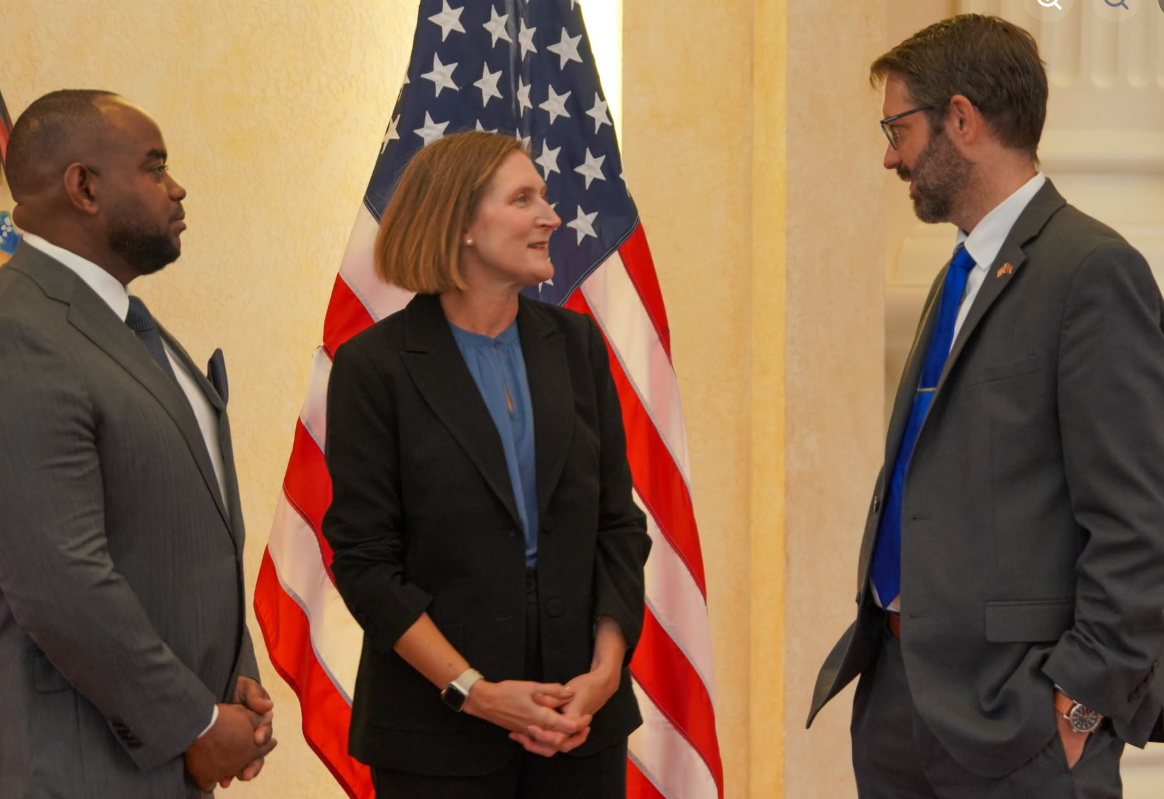
PORT OF SPAIN, Trinidad, Oct 27, CMC – A senior United States official Tuesday said funding for prevention and victim protection has been “reduced sharply” even as Trinidad and Tobago is reported to have made “real progress” in dealing with human trafficking.
Principal Deputy Director of the United States Department of State: Bureau of Democracy, Human Rights, & Labour Office to Monitor and Combat Trafficking, Rachel Poynter, said he wanted to speak frankly about the situation.
Addressing the “Human Trafficking Investigative Training Workshop,” hosted by the U.S. Homeland Security Investigations (HSI) and the Counter Trafficking Unit (CTU) of the Ministry of Homeland Security, Poynter said funding for prevention and victim protection has been “sharply reduced.
“Screening of vulnerable populations remains limited, which reduces opportunities to identify victims – and perpetrators – as well as risking the inappropriate penalization of trafficking victims for unlawful acts committed under coercion.
“Law enforcement plays a critical role in victim identification, since often they are the first ones to come into contact with a victim. The government identified and assisted fewer victims than in the previous year.”
The US official said that there were also fewer human trafficking investigations initiated than the previous year and evidence collection for trafficking investigations remained a weakness.
“Corruption and official complicity continue to impede law enforcement action, and several investigations into senior officials remain stalled without public update,” Poynter said, adding that he raise these issues “as a partner because we know what this country can achieve”.
Poynter told delegates that their presence at the workshop reflects a shared commitment between the two governments to protect the most vulnerable among the population.
He said in the United States, “Trafficking in persons” and “human trafficking” refer to a crime where traffickers exploit and profit at a victim’s expense by compelling them to perform labour or engage in commercial sex.
He said the US recognises two primary forms, namely sex trafficking and forced labour and that it’s important to distinguish trafficking from smuggling, because people often confuse the two.
“Smuggling occurs when a person voluntarily seeks assistance to gain unlawful entry into a country. Trafficking, by contrast, does not require movement at all — its defining feature is exploitation for profit.
“Put simply, smugglers profit from transport; traffickers profit from ongoing exploitation. That said, smuggled individuals are often highly vulnerable to trafficking, particularly when they lack documentation or carry debts to smugglers — debts that can become powerful leverage for coercion, including through threats to family members back home.”
Poynter said he wanted to acknowledge the real progress that has been made in Trinidad and Tobago recently, noting according to the 2026 TIP Report, Trinidad and Tobago increased trafficking prosecutions, initiating 13 sex trafficking cases, up from 11 the year before.
“A former police officer was convicted and sentenced to over 16 years imprisonment for human trafficking. That outcome sends a clear and important signal that no one is above the law. These achievements matter and take the hard work of people like those in this room.”
He noted that in May, the Counter Trafficking Unit charged two suspects with 29 offenses and, for the first time, used Preventive Detention Orders against a trafficking operation. In August, the CTU’s first operation in Tobago led to charges against three people.
“These results are part of a broader law enforcement partnership between our two countries that keeps growing stronger. Working alongside U.S. counterparts, Trinbagonian officers have seized tons of narcotics linked to Venezuelan criminal groups, including US-sanctioned Tren de Aragua.
Poynter said joint investigations have also sent firearms traffickers who armed criminal groups here to prison in the United States.
He said that over the past year, dozens of officers from the Police Service, the CTU, and specialized units have trained at the International Law Enforcement Academy and in U.S.-supported courses on investigations, interviewing, asset forfeiture, and money laundering, many of which include human trafficking content.
In September, U.S. Customs and Border Protection trained about 170 aviation and border personnel to spot signs of human trafficking.
Poynter said Trinidad and Tobago’s new Advance Passenger Information law sets up a 24-hour Passenger Information Unit, which will strengthen information sharing with the United States, INTERPOL, and CARICOM IMPACS.
He said that the workshop is an opportunity to work together on precisely the challenges namely strengthening evidence collection, improving victim identification and protection, and reinforcing accountability at every level.
CMC/hg/ir/2026