
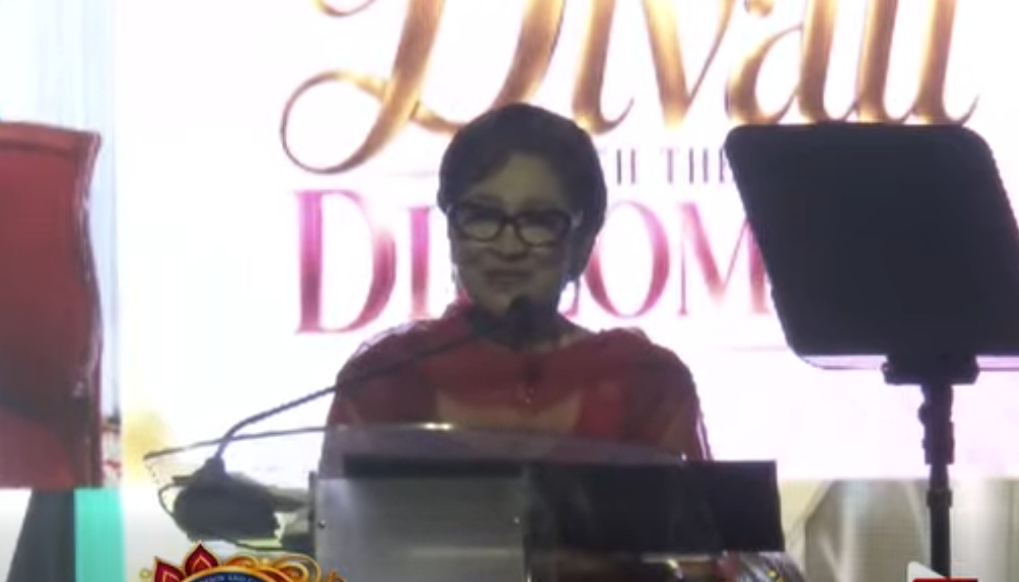
PORT OF Spain, Trinidad, Oct 30, CMC -Trinidad and Tobago’s Prime Minister, Kamla Persad-Bissessar, has doubled down on her government’s decision to support the United States trade and economic embargo against Cuba, saying “we cannot want to live in light at home and remain silent when others live in the shadows of oppression and exploitation”
Speaking the second annual Divali with the Diplomats function on Thursday night, Persad-Bissesar said Trinidad and Tobago’s commitment to freedom and democratic values must guide it “to advocate for the right of every individual at home and abroad to live in dignity, in hope and freedom.
“As I’ve said before, we cannot demand democracy and free and fair elections for ourselves and remain silent when those freedoms are denied for neighbouring citizens in neighbouring countries,” she told the event attended by diplomats whose countries are accredited to the twin island Republic.
Trinidad and Tobago became the first Caribbean Community (CARICOM) country in decades to ever have voted against the resolution, but while the Cuban government may have been pleased with the outcome of the vote, Havana lost significant support from countries in the Western Hemisphere and Europe.
The resolution passed 130-17, with 25 abstentions, a sharp drop from last year, when it won 165 votes, with seven against and 12 abstentions.
Of the CARICOM countries that were present at Wednesday’s debate, Jamaica, Haiti and Guyana abstained, while Trinidad and Tobago voted against. The Bahamas, Belize, Barbados, Grenada, St. Vincent and the Grenadines, St. Kitts and Nevis and Suriname, all voted in favour of the resolution, while Antigua and Barbuda, and Dominica and St. Lucia were marked as being absent when the vote was taken.
Persad-Bissessar said she was standing “firmly” by the position taken by Trinidad and Tobago took with respect to the vote at the UN regarding Cuba.
“We cannot stand up and talk here and say leave Cuba alone. 29 plus years, it’s all been the same. It has not changed. And therefore I stand for freedom. I stand for democracy. And in Cuba, the people deserve a democratic government.
“They are suffering. We feel the human suffering of the Cuban people, but we cannot stand by and do nothing or say nothing to support a military dictatorship in Cuba. They’re our neighbours, they’re our friends
“We cannot as well continue to do the same as has been done before. Some of our critics are saying, oh Trinidad always had, always had. So when will it ever end? And it must end one day.
“They should have a democracy and the freedoms that we have and enjoy here in Trinidad and Tobago. So my friends, just as this light guides us, the Diwali light guides us towards a brighter future, we must remain committed to democratic rights and freedoms and values.
“As I’ve said before, we cannot demand democracy and free elections for ourselves and remain silent when those freedoms are withheld and denied for citizens in Cuba,” Persad-Bissessar added.
Meanwhile, Cuba’s Ambassador to Trinidad and Tobago, Gustavo Veliz, says countries supporting the United States’ position on its economic embargo against Cuba risk becoming complicit in a policy that could cost lives.
In a statement following the UN vote, the Cuban deplomat accused Washington of pursuing a policy with devastating humanitarian consequences for the Cuban people.
“A crime is being committed against Cuba. Supporting the US narrative means becoming complicit in, or contributing to, a policy whose consequences can cost human lives. Every passing minute may mean the loss of a life, including that of a child, as a result of electricity shortages and the inability to access essential goods, medicines and basic necessities,” he said.
In the statement, Veliz recalled the country’s historic role in establishing diplomatic relations with Cuba in 1972, when the island faced significant international isolation.
“Trinidad and Tobago holds a special place in the history of Cuba’s relations with the Caribbean. In 1972, it was one of the first four countries to formally establish diplomatic relations with Cuba, at a time when our country faced significant international isolation,” he said, adding Cuba deeply valued the courage and historical significance of that decision, which marked a turning point in relations between Cuba and the Caribbean.
“We express our sincere gratitude to all those in Trinidad and Tobago who continue to stand in solidarity with the Cuban people. Solidarity is not a crime. The blockade is the crime,” he said, rejecting attempts to frame the UN vote as a debate about democracy or Cuba’s political system.
“This is not a debate about Cuba’s political system or democracy. Attempts to frame the issue in those terms are intended to divert attention from the fundamental question: the unjustifiable energy siege imposed on Cuba and the collective punishment inflicted upon its population,” he said.
Veliz accused the US of deliberately trying to provoke a humanitarian crisis in Cuba and using the population’s suffering as a political weapon. He also alleged that the US had exerted extraordinary diplomatic pressure on other countries to influence their votes.
“We must also denounce the extraordinary diplomatic pressure exerted by the Permanent Representative of the United States to the United Nations in an attempt to force countries to change their votes,” he said.
Despite the alleged pressure, Veliz welcomed the resolution’s adoption, describing it as a significant victory for international law and evidence of the growing international isolation of US policy towards Cuba.
“We remain confident that truth, justice and reason will prevail once again in international relations, including in the longstanding bonds of friendship, cooperation and solidarity between Cuba and the member states of CARICOM.
Meanwhile, the Barbados Cuba Friendship Association (BCFA), has condemned the UN vote reaffirming “our full, unwavering and unconditional solidarity with our sister nation, the Republic of Cuba, and its heroic people”.
BCFA president, David Denny, praised the decision of Barbados and “all other Caribbean governments who stood firmly on the right side of history and voted in support of Cuba’s resolution.
“You have shown that the Caribbean still has dignity, principle, and memory. You have shown loyalty to true friendship to our brothers and sisters in the Republic of Cuba,” Denny said, “strongly” condemning the position taken by Trinidad and Tobago “and those other Caribbean countries that abstained or cowardly stayed away from the United Nations General Assembly voting session:
“You will be seen by the Caribbean people as hypocrites and enemies of the Caribbean people who respect Cuba’s contributions to our Caribbean. There is no neutrality on this issue. To vote against and to abstain is to betray. To hide and stay away from the vote is to side with imperialism against your own Caribbean sister county. ”
DEnny said that these governments should have stood in full solidarity with Cuba.
“Cuba is not just any nation, Cuba is a sister Caribbean nation. Cuba is a peace-loving nation. Cuba is a nation that is always there to save the lives of Caribbean people. When hurricanes destroy us, Cuba sends doctors. When COVID was killing us, Cuba sent nurses and medicine. When we need scholarships, teachers and solidarity, Cuba gives without asking for anything in return.”
Denny said that any Caribbean government that refuses to support Cuba’s resolution at the UN “has forgotten who its true friends are.
“You have turned your back on your own Caribbean family for the favour of Washington,” he added.
CMC/dh/ir/2026