
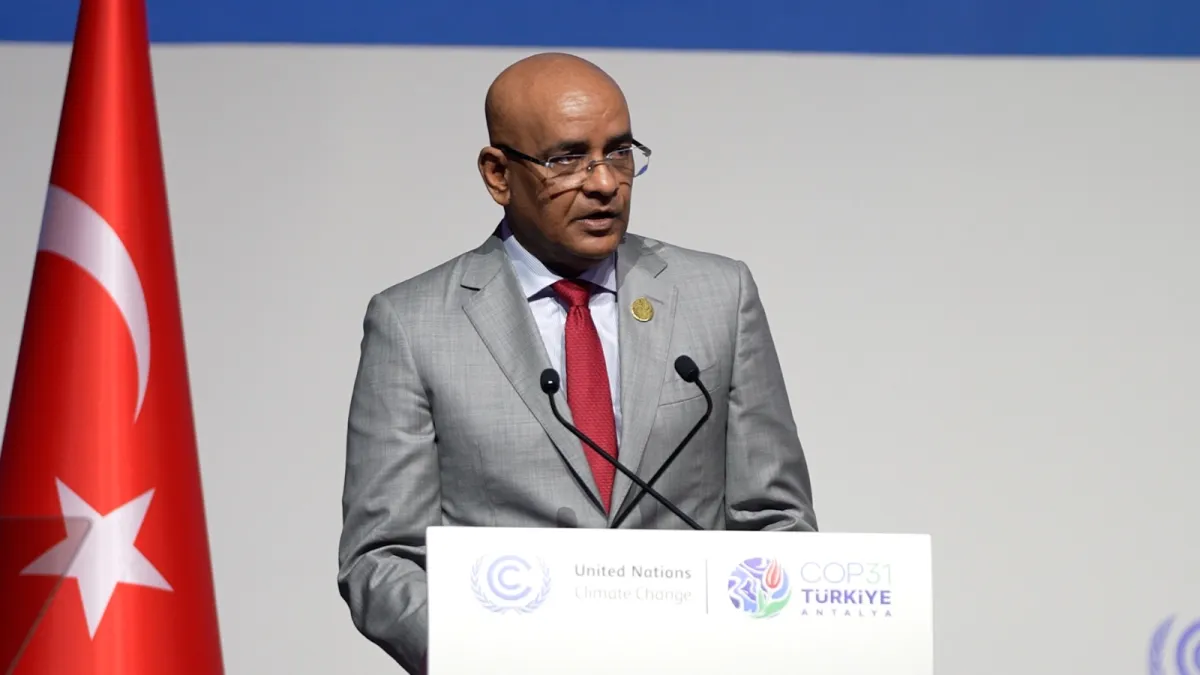
ANTALYA, Türkiye, Nov 12, CMC – Guyana’s Vice President Bharrat Jagdeo has urged world leaders to move beyond decades of climate pledges and deliver tangible results, warning that the global transition away from fossil fuels cannot be reduced to a choice between abandoning them entirely and continuing their use.
Delivering Guyana’s national statement at the United Nations (UN) COP31 climate summit in Antalya on Thursday, Jagdeo said that despite years of international negotiations, many of the fundamental challenges confronting global climate policy remained unresolved.
He said developing countries needed solutions that recognised their different economic circumstances, energy requirements and capacities, while calling on wealthier nations to provide greater support for climate adaptation and the transition to cleaner energy.
“As I listen to the discussions at this COP, I am encouraged by the commitment of so many people working to address climate change.
“Yet I also note that many of the issues we debated years ago remain unresolved,” Jagdeo said.
He urged negotiators to maintain pressure for more ambitious commitments, particularly those aimed at helping vulnerable countries respond to the effects of climate change.
Jagdeo invoked the United Nations principle of “common but differentiated responsibilities and respective capabilities”, which recognises that countries have different obligations and capacities in addressing climate change.
“Countries have different circumstances, and we need solutions that recognise those differences, deliver results and improve people’s lives rather than impose unnecessary hardship on them,” he said.
Jagdeo identified forest conservation as an area where international climate negotiations were beginning to produce practical financing mechanisms.
He pointed to the Forest Finance Roadmap, developed by the Forest and Climate Leaders’ Partnership, Brazil and the United Nations Environment Programme, as an important step towards rewarding countries for protecting their forests.
The roadmap outlines six financing options to support forest-rich countries, including Indigenous Peoples and local communities.
Jagdeo said the priority should now be implementing those mechanisms rather than continuing to debate their merits.
Among the options are the Tropical Forests Forever Facility (TFFF) and jurisdictional carbon markets, which enable governments to generate carbon credits based on verified emissions reductions across entire geographical areas.
While Guyana supports the TFFF, Jagdeo said jurisdictional carbon markets remained its principal pathway to securing financial returns from forest conservation.
“For ourselves, our main pathway is jurisdictional carbon markets. But for these markets to fulfil their potential, we need political leadership from partner countries to pass CORSIA legislation, open compliance markets to forest credits and operationalise Article 6,” he said.
CORSIA, the Carbon Offsetting and Reduction Scheme for International Aviation, is an international mechanism aimed at addressing emissions from aviation, while Article 6 of the Paris Agreement provides frameworks for international cooperation on carbon markets.
Jagdeo’s comments reflected Guyana’s push to expand demand for forest carbon credits through regulated markets, rather than relying exclusively on voluntary purchases or international assistance.
Turning to energy policy, Jagdeo argued that the global transition away from fossil fuels must take account of growing electricity demand and the economic realities confronting individual countries.
He referred to the COP28 agreement to transition away from fossil fuels in a just, orderly and equitable manner, but questioned how that commitment could be translated into workable national policies.
“Fossil fuel demand will not disappear overnight, and electricity demand continues to grow, especially with the advance of AI and other technologies,” he said.
Jagdeo warned against treating fossil fuels and renewable energy as mutually exclusive options in efforts to achieve global net-zero emissions by 2050.
“If we are to achieve global net zero by 2050, we cannot make the solution a binary discussion about whether fossil fuels or no fossil fuels,” he said.
Instead, he advocated a broader approach involving reductions in fossil fuel production and consumption, expanded renewable energy, accelerated electrification, reduced deforestation and the adoption of emerging technologies.
The position is particularly significant for Guyana, whose expanding oil industry places it at the intersection of petroleum development and international efforts to reduce greenhouse gas emissions.
Jagdeo maintained that the energy transition must accommodate different national circumstances rather than impose a uniform timetable or approach.
He also identified carbon pricing as an important instrument for encouraging the shift towards cleaner energy, while acknowledging that other policy measures could contribute to the same objective.
Throughout his address, Jagdeo returned to the gap between international climate commitments and their implementation, arguing that the success of negotiations should be measured by the policies, investments and tangible results they produce.
He placed particular emphasis on practical financing arrangements, international cooperation and ensuring that climate policies did not impose disproportionate economic burdens on developing countries.
He also called for greater political leadership from countries whose legislative and regulatory decisions could determine whether emerging climate-financing mechanisms become viable.
More than three decades after the first United Nations climate conference, Jagdeo said the credibility of the international process increasingly depended on implementation rather than further declarations of intent.
“After thirty-one COPs, we must judge success not by the agreements we reach, but by whether countries can deliver on them,” he said.
CMC/ed/2026