
CASTRIES, St. Lucia, Nov 9, CMC -The St. Lucia government Monday said it has responded to concerns raised by the European Union regarding the island’s Citizenship by Investment Programme (CBI) that Europe wants ended by June 1, 2028.
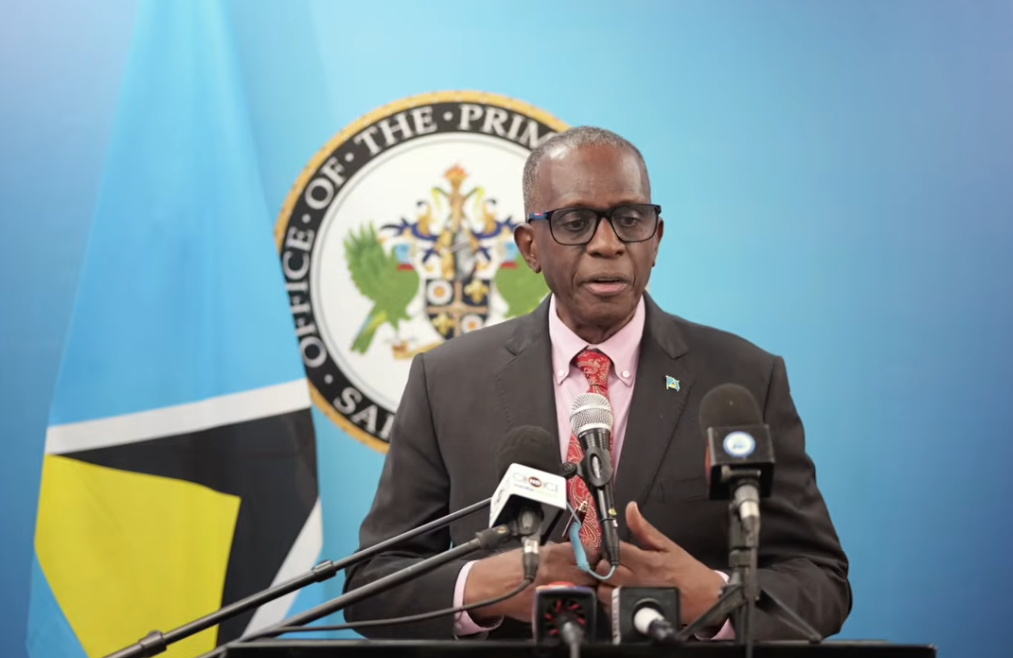
Prime Minister Phillip J Pierre told a news conference that Castries had submitted a response to the EU, but he would await the correspondence is received on Brussels before making any statement regarding its contents.
“That issue affects all the countries that have CBI programmes. It’s not a St. Lucia problem. Nobody has identified St. Lucia …because that is not true. It’s not a St. Lucia problem,” Pierre said, adding “I want to make that one position clear.
“Secondly, we’ve sought an extension from the EU. The EU had given us up to the 31st of October to make a declaration as to whether we will continue our CBI programme or not. This deadline was extended.”
Pierre said that the Deputy Prime Minister Dr. Ernest Hilaire headed a delegation from the Organisation of Eastern Caribbean States (OECS) that held a meeting Brussels.
“You must understand, St. Lucia depends the least on CBI revenue. That’s a fact. We want the revenue, but St. Lucia was chosen to lead the delegation as far as discussions are concerned. We’ve got an extension to make a decision by the 12th of November.
“We have written a letter to the EU. I don’t think we should make a letter to the EU public. These discussions have to be held at the level of confidentiality, diplomacy, and trust. You can’t write a letter to somebody and before they receive the letter, you disclose what’s in the letter.
“St. Lucia is not like that. St. Lucia is a country in which we take principled positions,” Pierre said, adding “if you are in discussion with someone and you wrote a letter, you can’t publicise a letter before he receives it.
“St. Lucia will not do that. St. Lucia will continue the path of dialogue. But as I always said to you, all countries see about their own self-interest. The countries of Europe, politically, they have an issue with migration, and Saint Lucia happens to be the one, the CBI programmes, happens to be the programmes that fall right in the ambit as far as that is concerned.
“But we are talking to them. We wrote the letter. I will disclose the issue when they receive the letter and they have acknowledged the receipt of that letter, I will come to you or the Deputy Prime Minister will come to you and tell you what was in that letter,” Pierre told reporters.
The European Union had given the countries in the Organisation of Eastern Caribbean States (OECS) with a CBI programme a June 1, 2028 deadline to end the programme or risk losing visa free access to the Schengen area.
Last week, the Antigua and Barbuda government informed the European Union that it is prepared to “terminate” its CBI programme, proposing a transition period to 2030 to achieve that objective.
In an October 30 letter to Magnus Brunner, the EU Commissioner for Internal Affairs and Migration, Antigua and Barbuda’s Prime Minister Gaston Browne acknowledged that Europe had given the island three options regarding the CBI.
“Antigua and Barbuda places great value on its partnership with the European Union and on the freedom of our people to travel to Europe. In that spirit the Government has weighed these options carefully, and I am pleased to advise that we have selected the third,” Browne wrote, saying that the island is prepared to “terminate” its CBI programme under certain conditions.
According to the letter, the third option open to Antigua and Barbuda is for it to terminate the programme “with a longer transition period.
“The country would confirm its intention to close its programme, but request a longer transition, specifying the period proposed for the Commission’s consideration, together with the support it would need to manage the transition and any other special requests”.
Antigua and Barbuda, Dominica, Grenada, St. Kitts and Nevis and St. Lucia all operate a CBI programme through which citizenship is granted to foreign investors in return for making a substantial investment in the socio-economic development of these countries.
Prime Minister Pierre said his administration is prepared to work with the EU “to see if we can come to a position but fact is the EU have said that they would prefer, they would like us to stop these programmes.”
Pierre said that the government would not be “lying down and die” adding “we’re working with them.
“But I want to tell you, I want to tell the people of St. Lucia to have trust in the government. The government will always look towards the interests of the people of this country,” he said, adding “we are always going to do that and we continue to do that.
“We know that they are trying times but I’m telling you, your government will work with you to ensure that St. Lucia continues to survive,” Pierre said, disclosing that while the “government could have boasted a little bit more” about the CBI programme “we were very frugal with our use of CBI funds.
“We know that the CBI funds go in two places, the national economic fund, the development of the country, then there is the infrastructure fund, then there is the enterprise fund and there is excess cash.”
Pierre said most of the CBI funds have been used to improve security on the island and that last year, the island received 65 million dollars (One EC dollar=US$0.37 cents) from the programme.
“ I’ll tell you that in the next budget statement, if that’s what you want to hear, we are going to list every cent we spent on national security from the excess cash of the CBI programme. Every cent on national security and health,” Pierre said, adding that there had been a deliberate attempt by those opposed to his administration “to mislead the people of the country.
“In the estimates, you will see it. Look in the estimates, non-tax revenue, CBI, you’ll see what’s there. But again, that’s deliberate distortion of facts for political gain. But it’s there. It is there.”
CMC/fg/ir/2026