
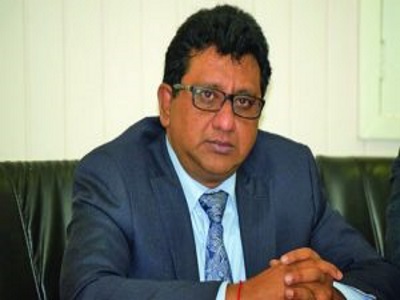
GEORGETOWN, Guyana, Jan. 16, CMC – The Justice System in Guyana is expected to drastically improve with the introduction of sentencing guidelines which are expected to come on stream by mid-2022.
This was revealed by Minister of Legal Affairs and Attorney General, Anil Nandlall, during an interview on Saturday as his ministry is spearheading a project which includes the hiring of a consultant for the drafting of sentencing guidelines.
According to Nandlall, in accordance with stipulations outlined by the funding agency, the Inter-American Development Bank (IADB), many countries in the Caribbean have sentencing guidelines.
The Legal Affairs Minister noted that these sentencing guidelines, hopefully, will assist in bringing regularity, consistency and predictability to sentencing because these three factors are important in sentencing, and tribunals must apply the law and sentencing, uniformly and consistently.
He noted that members of the public are also entitled to, with reasonable prediction, be able to say what the sentence is going to be for specified offences, especially when there are similar facts, repeating themselves.
Recently, concerns were raised by residents of Region Nine where they voiced their dissatisfaction via social media and other means over the administration of justice at the Lethem Magistrate’s Court.
Nandlall stated that most times the law prescribes a limit within which the sentence must be situated in terms of time, length of imprisonment, if the offence carries imprisonment, or if it carries a fine, or the sum to be fined or at least a limit within which the fine must be imposed.
“Sentencing is a complex legal issue and persons have been complaining about inconsistent sentencing, as well as harsh sentences, and in some cases, they have been complaining about the minor nature of sentences so it’s a complicated exercise, but there are guiding principles that ought to govern a court, when a court is delivering a sentence, for a particular offence.
The Minister said that the sentence must bear the proportionate relationship with the nature and gravity of the crime, however, “once that sentence is disproportionate, then something is wrong, it’s unusual, if not unlawful.”
He noted too, that members of the public are free to criticise Magistrates and Judges, provided, that they do so respectfully and they do not attribute an improper motive to that judicial officer.
“Members of the public who feel aggrieved, by this particular magistrate are free to vent their concerns publicly and to write the chancellor if they wish, or to write the minister of legal affairs. Government has a stake in the way the people feel about the administration of justice. The administration of justice is funded from public monies and therefore, is accountable to the public,” Minister Nandlall noted while referring to the concern in Region Nine.
The minister is hopeful that such matters will be adequately addressed in the sentencing guidelines.
The minister explained that the sentencing guidelines are being done in tandem with the judiciary, “because government doesn’t impose sentence, that’s a function of the judicial arm, and I know that the judicial arm of the state would welcome that type of assistance.
We have had problems with overcrowding in the prison, we have had problems with a spiralling crime rate, we have had problems with persons complaining that crimes are being committed and persons are going to court and they walk free or they walk away with a rap on the knuckle, so you have to look at it from all angles,” the Attorney General noted.
CMC/gt/kb/2022