
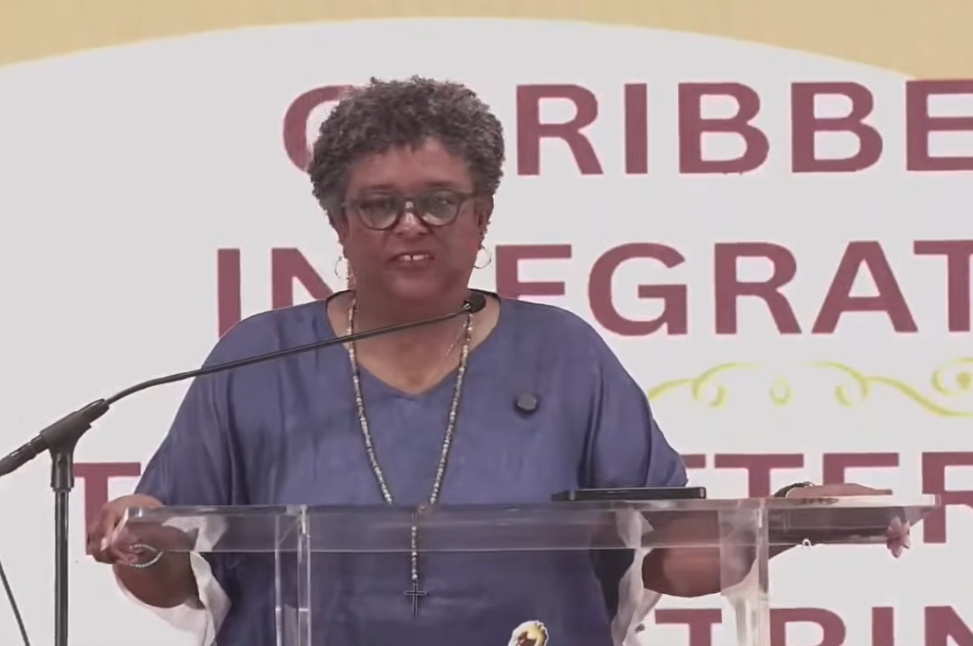
KINGSTON, Jamaica, Nov 16, CMC -Barbados Prime Minister Mia Mottley is advocating new mechanisms for funding the regional integration movement (CARICOM) as well as pushing for a greater role on the international scene for the secretary general.
Addressing the launch of a new book that examines whether the CARICOM has reached the limits of its founding model while setting out a path for its renewal, Mottley reminded her audience of a statement made by one of her Barbadian predecessors “that unless this region is prepared to finance through an automatic mechanism its existence, we will never make the progress.
“Which one of us in this room can live without independent financing being assured whether through salary or contractual arrangements? None of us. And why therefore do we believe that if we should not be at the mercy of others in order to exist, why should the Caribbean community be at the mercy of others in order to continue the excellent work which it is doing?,” Mottley asked her audience.
Mottley told her audience that the reality is that CARICOM runs on an annual assessed contribution from member governments set by a formula and it is voted through national budgets.
“The amounts are small, they are often paid late, and every payment, regrettably, is a fresh political decision. You cannot run an organisation on that basis. And that is why at Rose Hall you agreed in 2003 for automatic resource transfers. But 23 years later, we have not had the political will to execute it as a core action for our regional community.”
Mottley was speaking at the launch of the 386-page book titled “Caribbean Integration: The Patterson Doctrine — Governance, Transformation and the Future of the Caribbean Community,” co-authored by former Jamaica Governor General Professor Sir Kenneth Hall and long-time collaborator Myrtle Chuck-A-Sang.
The book analyses the governance framework, political philosophy and strategic vision for regional integration associated with former Jamaica prime minister PJ Patterson, with the authors contending that while CARICOM has recorded real gains in economic cooperation and collective diplomacy, a critical gap persists between regional institutions and the citizens they are meant to serve.
Mottley told the book launch at the Mona campus of the University of the West Indies (UWI) on Sunday that CARICOM now faces three existential threats that will force the region in the direction of common action.
She said the first is that as small states “we will fight for our sovereignty and our capacity to survive if there is not a strong international rules-based order. Secondly, it is climate and the loss of biodiversity and thirdly, it is now the rise of Artificial Intelligence”.
She said that the truth is that each of these threats, without reference to what regional countries individually face domestically “cannot be ignored if we want to survive.
“It requires not singular national action, but indeed coordinated policy and action on the part of this community and that is why funding CARICOM cannot be an afterthought, because it is the very same CARICOM that will help us get to safety.”
She recalled that when the COVID-19 pandemic occurred, it was the Trinidad-based Caribbean Public Health Agency (CARPHA) that made the defining difference for the region and “our ability to be able to save lives and livelihoods”.
She said when Hurricane Melissa hit Jamaica in October last year, it was the Barbados-based Caribbean Disaster Emergency Management Agency (CEDMA) that was among the first on the ground as it was in Grenada and St. Vincent and the Grenadines when these islands were also struck by hurricanes before.
“These agencies are not decorative. They serve purposes and deliver for individual member states in circumstances where individual member states do not have the capacity. And that is why the community of sovereign states resting on functional cooperation is at the core of this integration movement at this stage.”
Mottley said that the region msut come to the realisation that functional integration is critical and as a result “we have to come to the recognition that CARICOM should finance itself through some clear means.
“I put a few on the table today, not to believe that this is the way or the only way, but to start the debate that must now once again engage the heads of the Caribbean community. I refer specifically to the possibility of a very modest treaty-based levy of, I suggest, 0.3 per cent on imports from outside the region, paid automatically from customs into a community account.”
Mottley said this can be supplemented by a small travel levy of no more than one US dollar for each cruise ship passenger and two US dollars for each long-stay visitor.
“We recognise that any adjustment to cruise ship passenger duties requires negotiations with cruise ships with a long lead time. But in the interim, our ability to put a modest levy on extra-regional imports of 0.3 per cent will not add to the already difficult issue of cost of living, not if people are being faithful.”
Mottley said that three dollars on 1,000 dollars of goods distributed cannot even in many instances be considered as a basis for the increase of price on anything.
She said Barbados is also committed to providing to CARICOM institutions 25 megawatts of renewable energy licences “and the Community, if they can get from others, can take those licences and monetise them and provide an independent source of revenue, not just for the Caribbean Community, but for all regional institutions, including the University of the West Indies.
“The problem, my friends, is not the amount. It is the mechanism. It is the governance. Governance decides success,” she said, noting that the African Union provides a blueprint for dealing with funding issues that levies fail when national treasuries keep the money, when each act becomes a new political decision.
“My recommendation, therefore, is for us to do and conclude a protocol to our treaty that makes the levy community revenue, automatic remittance through central banks, and a collection fee for Customs, which incentivises Customs to make sure that the money is put in there.
“In Africa, I think it is as high as 25 per cent and thereafter, if people do not comply, sanctions, as usual, would have to apply. Independent audits would become critical.But what it does is allow us to see continuity in this regional experiment called CARICOM.
“If you want to know how much it will raise, the truth is that the 0.3 per cent on the current volume of extra-regional imports is roughly likely to raise anywhere between 60 to 86 million U.S. dollars,” she said, adding that “our support in regional institutions needed is 80 to 90 million U.S. dollars on an annual basis”.
She said that the amount for the travel levy can raise as much as another 30 million U.S. dollars.
In her address, Prime Minister Mottley also sought to outline a new role for the CARICOM Secretary General adding what “we lack is decision-making and political will.
“More precisely, we have taken decisions and lacked that machinery to carry those decisions out and this book …is honest about the way…names the obstacles one by one…,” she said noting that since 2003, however, that world has changed significantly and more sharply.
“The book describes a Caribbean diplomatic tradition that was built on international law, not power politics. It notes what I’ve repeatedly said, that for small states to survive, a rules-based order is absolutely essential. “
Mottley warned that for without that, “our sovereignty walks right out of the window”.
She said 2026 caused the region to know that more than ever, particular when “when we saw how the year began, we knew that without a rules-based order, we too could equally become a victim, as happened to other countries at the beginning of this year.
“I said that we’re under strain. Trade is increasingly governed by leverage rather than law. Development finance is being cut or redirected towards strategic competition and allies,” Mottley said, recalling her statement made at the UN Climate Change Conference (COP31) in Turkey that pledges are not payments.
“And even climate finance pledges are 70 per cent below previous levels. Our exposures grow, while promises, my friends, regrettably shrink. We must organise the strength we possess together.
“For in a world of rules, size matters less. In a world of power, size matters a great deal. We now know that more and more, we are being driven into a world dominated by power, and less so, regrettably, by rules.
“In that context, who must speak for the Caribbean? Simple question. Who must speak for the Caribbean?,” she asked, noting that every year, Caribbean leaders go to the United Nations and yet CARICOM itself, as an institution, has no voice, unlike the European Union.
“We have simply observer status. Our Secretary General may attend. She may consult. She may host side events. But she has no automatic place at the rostrum. But my friends, one regional organisation is treated differently. And this time, we cannot blame only mindset. We must blame ourselves.”
Mottley recalled that in May of 2011, the General Assembly Resolution 65 of 276 gave the European Union enhanced participation rights and that its representatives may speak in the General Debate, present proposals orally, and exercise a right of reply.
She said this followed the 2009 Lisbon Treaty, which gave the European Union a single legal personality, a permanent European Council President, and a high representative for foreign affairs.
“It took the European Union 50 years to move to the Treaty of Lisbon, to give itself that independent legal personality, and to give itself what it needed in terms of structure to ensure that even though France and Germany and other members may have their own Minister of Foreign Affairs and their perspective, that the Union itself would have a voice that must be heard in the international community.
“Europe had agreed who would speak for it, and the world agreed at the United Nations to listen. What is perhaps less well remembered by all is that it was the Caribbean Community that shaped the outcome,” she said, noting the role played by Suriname in that regard.
“ Our principle as a Caribbean community was clear. In a United Nations of sovereign equals, no regional bloc should receive privileges closed out to others. That is what we fought for,” she said, arguing that CARICOM “fought to leave that door open, but 15 years later we have not walked through it.
“As a community. For us, as a regional community, the honest answer therefore remains no. And we must ask, why have we not done it? And how do we enter the door that the General Assembly opened up for Europe?
“There are real reasons, and we should name them.Most of our legal systems are dualist. Treaties do not automatically become domestic law, and legislation is needed. Our constitutions entrench parliamentary and cabinet powers, with some provisions changeable only by special majorities or referendum. Article 236 of the revised (8:43) Treaty of Chaguaramas requires treaty amendments to be agreed unanimously and ratified by all parties before taking effect.
“One delayed parliament or one change of government could have held the whole community still in the same place,” Mottley said, noting that the Organisation of Eastern Caribbean States (OECS) has given its “organisation legislative competence in defined areas, including the common market, trade policy, and civil aviation, governing its effect.
CMC/pr/ir/2026