
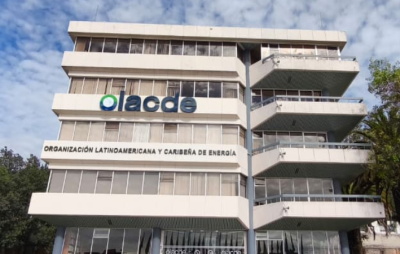
SANTO Domingo, Dominican Republic, Oct 5, CMC – The Latin American and Caribbean Energy Organization (OLACDE) MOnday announced plans to release two white papers examining a US$35 billion opportunity in critical minerals and the potential of energy efficiency to reduce costs and improve competitiveness.
The intergovernmental organization for energy in Latin America and the Caribbean said that the region holds approximately 60 per cent of the world’s lithium reserves and more than 30 per cent of its copper reserves, yet its energy efficiency is improving at less than half the global rate.
It questioned how can the region harness this wealth and use energy more efficiently? Noting that these are the challenges addressed by two new white papers, which will be presented jointly with the Ministry of Energy and Mines of the Dominican Republic during the XI Energy Week which takes place here from October 6-9.
 The White Paper on Mining Development and Energy Planning in Latin America and the Caribbean examines how to translate mineral resources and an electricity mix that is nearly 70 per cent renewable into competitive, sustainable projects with greater added value.
“If the region significantly expands its refining and processing capacity, the economic value of the critical minerals it produces could rise from US$185 billion to US$220 billion by 2035, a US$35 billion opportunity that requires coordinated investment, infrastructure development and energy planning.”
OLACDE, whose Caribbean members include Barbados, Belize, Cuba, the Dominican Republic, Grenada, Guyana, Haiti, Jamaica, Suriname, and Trinidad and Tobago, said that the White Paper on Energy Efficiency warns that the region’s energy efficiency improved by just 0.54 per cent annually between 2000 and 2023, compared with 1.37 per cent worldwide. It said only eight of OLACDE’s 27 member countries have a publicly identifiable numerical target, and just five have a recent useful energy balance.
“The opportunities for savings are tangible: industry accounts for more than 28 per cent of the region’s final energy consumption, and 66 cases of ISO 50001 implementation avoided more than US$70 million in energy expenditure.
CMC/aj/ir/2026