
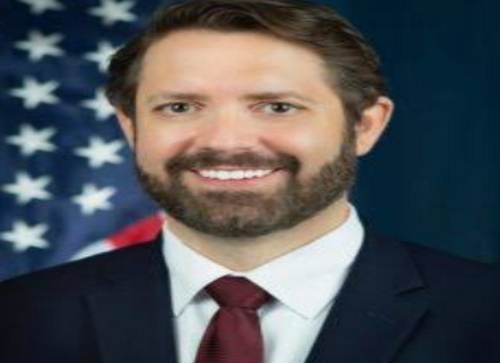
PORT OF SPAIN, Trinidad, Oct 24, CMC – Chargé d’Affaires at the US Embassy here, Philip Kern
“Venezuela has a long history as one of the world’s major energy producers. Renewed investment in that industry can help restore reliable electricity, rebuild industrial capacity, and create economic opportunity for the Venezuelan people,” Chargé d’Affaires at the US Embassy here, Philip Kern, told the annual general meeting of the Energy Chamber of Trinidad and Tobago on Friday night.
The Trump administration ousted and captured Venezuelan President Nicolás Maduro during a large-scale military operation in Caracas on January 3, 2026.
Maduro along with his wife have been transported to New York and they have pleaded not guilty in federal court to narco-terrorism and cocaine-trafficking charges.
Kern told the annual general meeting that on a clear day from Trinidad, “you can see Venezuela” and that the Gulf of Paria connects the two countries and their peoples “who share many ties and much history, and who have much to work on together in the coming months”.
He recalled that in 1879, a Venezuelan named Pedro Rafael Rincones traveled to Pennsylvania and went on to learn the petroleum business and to buy a drilling rig that he brought back to Venezuela.
“He also brought back equipment to refine crude into kerosene and lamp oil to light homes.
In the generations that followed, American geologists and engineers worked side by side with Venezuelans to help build one of the most impressive energy industries the world had seen.”
He said the United States in uts support for Venezuela’s economic recovery believes that stronger institutions, respect for fundamental freedoms, and a marketplace that rewards investment and innovation will help build a more prosperous future.
“American companies can contribute to that recovery. But there is nothing quite like a next-door neighbour,” he said, adding that Trinidad and Tobago has a vital role to play in Venezuela’s recovery.
“You know what peaceful transitions of power after elections look like. You know the value of a free press, of political dissent, and of a diverse society living together. You understand the importance of a government that leaves room for civil society, for voluntary contracts, for businesses to provide solutions, and for people to trade freely.
“And you bring practical experience. Trinidad’s energy service companies…know the geology, the waters, and the industry. Your engineers and technicians have decades of experience producing, processing, and exporting hydrocarbons.”
Kern said that Trinidad and Tobago’s proximity, existing infrastructure, and industrial capacity “offer a practical opportunity to bring Venezuelan natural gas to downstream facilities that need new supplies”.
Kern recalled that many of the delegates here had “helped jump-start the energy boom in Guyana,” adding that the “experience, those capabilities, and those relationships can also contribute to Venezuela’s economic recovery.
The US Embassy has been actively encouraging Trinbagonian companies to be part of that effort. We were on the phone with business chambers here…to mobilise assistance and donations after the terrible June 24 earthquakes.
“We encouraged Trinidadian companies to attend the Venezuela International Oil and Gas Summit last month,” he said, adding that he had also arranged for the Trinidad and Tobago delegation to be hosted by the American Embassy in Caracas.
“We brought together AmChamTT, VenAmCham, PDVSA leadership, and a dozen of your companies on the margins of the summit. The purpose was straightforward: to establish commercial relationships, connect businesses across our region, and identify opportunities for cooperation that can create lasting economic benefits.”
Kern said that Washington will continue working together to develop those commercial relationships and strengthen the energy supply chains that connect the economies.
The US diplomat said that while the partnership between Trinidad and Tobago and the United States is strong “there is considerable opportunity to make it stronger”.
He said that Prime Minister Kamla Persad-Bissessar challenged the US Embassy “to deepen our commercial partnership by encouraging quality American companies to come to Trinidad and Tobago and invest.
“We have taken that challenge seriously. In 2026 alone, we have brought American companies to Trinidad and Tobago to explore projects representing more than five billion U.S. dollars in potential investment.”
Kern said that these projects would bring new technology, modern manufacturing, and industrial capacity that can compete against the best producers in the world, noting hat they would create jobs, generate foreign exchange, and strengthen economic ties between our countries.
“ Some of these build on traditional strengths, such as petroleum blending and bunkering. These businesses make use of Trinidad and Tobago’s location, its port infrastructure, and its skilled workforce to serve the shipping lanes of the Caribbean and the Atlantic.
“Your companies have helped build the energy infrastructure alongside ExxonMobil in Guyana. Some of that oil should be brought to specification right here, in south Trinidad,” Kern said that “some would bring back capacity that has sat idle for too many years, such as restarting the ISCOTT steel mill”.
He said that steel production would create 500 jobs, foreign exchange, and tax revenue and that the steel mill would give new life to an industrial base “and branch it into a strategic metal, vanadium”.
He said vanadium is used to strengthen steel in everything from wrenches to rockets and can be used in battery production.
“The United States produces only half of the vanadium that it uses. This plant would have enough capacity to meet all our import needs – further deepening the industrial linkages between our peoples.”
He said in addition some of the steel would be used to build oil platforms, provide assistance to shipbuilders as well as becoming rebar for projects here as well as within the energy sector.
He said that US-Trinidad and Tobago relationship could also provide for other opportunities including security.
“Modern energy systems depend on digital networks, and those networks must be protected. We are bringing trusted American information technology and cybersecurity companies to Trinidad and Tobago because critical infrastructure deserves trusted partners,” he said, naming CrowdStrike, Cisco, Fortinet, Tanium, Honeywell, “and many other names.
“And some opportunities lie in the industries of the future. Super Intelligence requires enormous amounts of reliable power. Trinidad and Tobago has natural gas resources, industrial infrastructure, experience in desalination, and an established energy workforce.
“Those advantages position the country to compete for investment in data centers and the industries that will develop around them. We want American companies to see Trinidad and Tobago as a place where the next generation of technology can be developed and operated.”
But Kern said that these opportunities depend on “a reliable and competitively priced energy supply”.
He said that the industries at Point Lisas, a major industrial hub and neighbourhood located on the west coast of central Trinidad, currently needs natural gas.
“The next generation of manufacturing and technology will need dependable power tomorrow.
Securing that supply requires continued upstream investment, commercially viable agreements, and a predictable operating environment. Companies need confidence that investments made today will remain viable for decades.
Getting those conditions right will determine how much of this potential investment becomes operating facilities, jobs, and exports,” Kern said.
CMC/kj/ir/2026