
BRIDGETOWN, Barbados, Oct 20, CMC – Hurricane Tammy is expected to bring heavy rainfall and flooding over much of the Lesser Antilles as it inches closer to the Leeward islands late tonight and Saturday.
The hurricane with sustained maximum winds of 75 miles per hour (mph) is about 165 miles east south east of Martinique and 240 miles south east of the other French island of Guadeloupe.
Hurricane warnings are in effect for the French islands as well as Antigua and Barbuda, Montserrat, and St. Kitts and Nevis, while a hurricane watch has been issued for Anguilla, St. Maarten, St. Martin and St. Barthelemy.
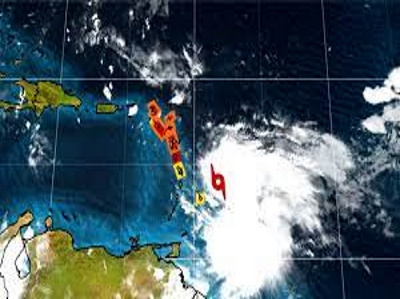 A tropical storm warning remains in effect for Dominica and Barbados.
The Miami-based National Hurricane Center (NHC) said that Hurricane Tammy is moving
towards the west-northwest near seven mph and this general motion is expected to continue through this afternoon
“A turn towards the northwest is anticipated by this evening, followed by a north-northwestward and northward turn Saturday night through Sunday night. On the forecast track, the center of Tammy will move near or over portions of the Leeward Islands tonight and on Saturday, and then move north of the northern Leeward Islands on Sunday,” the NHC said.
Several islands, including Antigua and Barbuda and Dominic have closed schools, and the inter-regional airline, LIAT, has cancelled several scheduled flights on Friday.
The NHC said that data from NOAA and Air Force Reserve reconnaissance aircraft
indicate that the maximum sustained winds are near 75 mph with higher gusts.
“Gradual strengthening is forecast during the next couple of days,” the NHC said, adding that hurricane conditions are expected in the hurricane warning area by late
tonight or early Saturday.
Tammy is expected to produce four to eight inches of rainfall with maximum amounts of 12 inches in the Leeward Islands and between two and four inches in the Northern Windward Islands.
“ Swells generated by Tammy will continue to affect portions of the Lesser Antilles during the next few days. These swells are likely to cause life-threatening surf and rip current conditions,” the NHC added.
CMC/af/ir/2023