
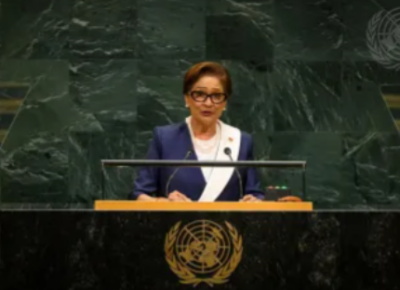
UNITED NATIONS, Sept 22, CMC -Trinidad and Tobago Tuesday said it would use its tenure on the United Nations Security Council to push for greater cooperation in the fight against the illegal drugs and weapons trade, even as it acknowledged that confidence in international institutions is under strain
Addressing the 81st session of the United Nations General Assembly (UNGA), Prime Minister Kamla Persad-Bissessar said that the theme chosen for the global event “Restoring Trusts, Managing Transformation, and United Nations that Delivers for All” speaks directly to the challenges confronting the global community.
“We must understand we depend largely on the organisation’s ability to respond effectively to the needs of the entire global community. At a time when we should be strengthening partnerships through mutual respect and cooperation, confidence in international institutions is under strain.”
Persad-Bissessar said that for small developing states such as Trinidad and Tobago, “trust depends on institutions applying agreed rules consistently, honouring commitments, and ensuring that those most affected by decisions have a meaningful voice in shaping them. “Transnational organised crime continues to pose a serious threat to the security and development of small island states. Small states face serious challenges from sophisticated criminal networks that move people, that move weapons, that move narcotics, and illicit finance across national borders.
“For Trinidad and Tobago, this is not an abstract threat. These networks directly endanger our citizens, they endanger our institutions, and they endanger our development,” she told the UNGA, adding that restoring trust and managing transformation, therefore, must ultimately be about results.
“Ideally, the transformation that is required involves a United Nations that is responsive, that is effective, and capable of making tangible differences to the safety, security, and well-being of people.”
She said that since coming to office in April last year, her government has pursued a people-centred agenda focused on safer communities, productive investment, modern public services, and expanded opportunity.
“A central part of our agenda has been restoring security to our communities. To this end, we have strengthened cooperative efforts with the United States and other partners to dismantle criminal syndicates that have wreaked havoc across our country and across our region.
“This is why we have profound gratitude to President (Donald) Trump for his invitation to Trinidad and Tobago earlier this year to be part of the newly formed Shield of the Americas and Americas Counter Cartel Coalition.”
Persad-Bissessar said that she remains confident that this partnership will continue to promote freedom, security, and prosperity in the region.”
She told the global community that Trinidad and Tobago appreciates and recognises the responsibility bestowed on it as a member of the UN Security Council, adding “we regard that overwhelming expression of confidence not simply as an achievement, but we see it as a very solemn responsibility on the part of Trinidad and Tobago”.
She said the Caribbean Community (CARICOM) country was returning to the Security Council after more than four decades and will “will carry to the Council the commitment on which we sought your support.
“We did so and we committed to building consensus for realisation of sustainable peace and security. The Republic of Trinidad and Tobago intends to bring the perspective and experience of a small island developing state to the Council, whilst remaining guided by the UN Charter, by international law, and the principle of the peaceful settlement of disputes.
“We will bring those principles to every matter before the Council, whether the crisis lies within our region or far beyond it. We will approach our tenure with an independent and practical outlook, working constructively with all members of the Council, and seeking common ground wherever possible.”
She said that Trinidad and Tobago intends to place particular emphasis on the curbing of the illicit trafficking of small arms and light weapons, issues involving women and children as well as peace and security.
The Trinidad and Tobago Prime Minister said she wanted to agree with President Trump, who had earlier told the UNGA that artificial intelligence (AI) should be renamed superintelligence, SI.
“We commit to that,” she said, noting that on the priority area of super intelligence and global security, Trinidad and Tobago will encourage a greater consideration of the implications of SI and emerging technologies for international peace and security, including cyberattacks, disinformation and deepfakes, autonomous weapons, criminal misuse of SI, and threats to critical infrastructure.
“We acknowledge that these technologies can support conflict prevention, early warning, peacekeeping, and protection of civilians,” she said, adding that the illicit flow of firearms and narcotics is a major security concern for Trinidad and Tobago and the wider Caribbean.
“Although the region does not manufacture these weapons, their availability fuels gang violence, organised crime, drug trafficking, and loss of life across our societies.”
She said while serving on the Security Council, Trinidad and Tobago will advocate for greater international cooperation to address the sources, movement, and diversion of illicit weapons, stronger tracing mechanisms, information sharing, border and maritime cooperation, and deeper cooperation among source, transit, and destination countries.
“Trinidad and Tobago will bring the experience of the Caribbean to the Council, where the impact of illicit firearms demonstrates how transnational organised crime can threaten the security and stability of states, even in the absence of traditional armed conflict.
In her address, Prime Minister Persad-Bissessar said the situation in Haiti remains of particular concern for the entire global community.
“Trinidad and Tobago stands in full support of international efforts to help restore security and stability in Haiti, whilst maintaining that the country’s political future must ultimately be Haitian-led and Haitian-owned.”
She said security assistance is necessary, but lasting stability will also require functioning institutions, economic opportunities, and a credible political process.
“So therefore, as Trinidad and Tobago prepares to serve on the Security Council, we will continue to bring attention to Haiti and to the wider security concerns of the Caribbean, whilst working with CARICOM and other international partners towards practical and sustainable solutions,” Persad–Bissessar said.
CMC/gh/ir/2026