
UNITED NATIONS, Sep. 24,CMC –The Prime Minister of St. Vincent and the Grenadines, Dr. Ralph Gonsalves says it is time for the world to embrace fresh hope even as there is an “increasing sense of despair.
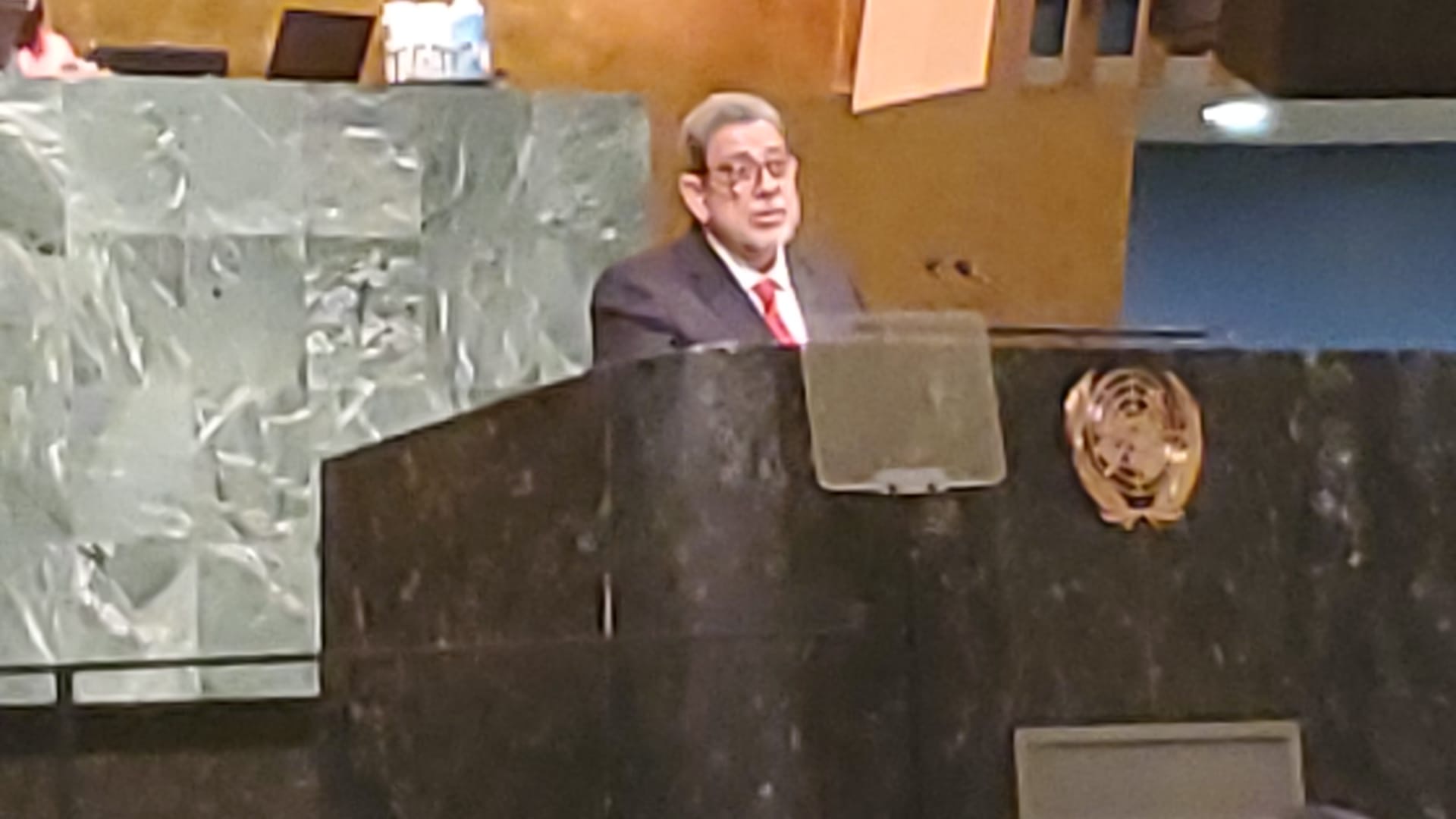 “This existential longing that touches the human spirit and soul, goes beyond a mere amelioration of our current travails,” the Vincentian leader told the 77th Session of the United Nations General Assembly. “It demands correctives or reformations of a structural or fundamental kind, and fresh thinking. Without fresh hope, a desecration of our future awaits us.”
Dr. Gonsalves said fresh ideas are a core foundation of fresh hope, stating that, over 130 years ago, the Cuban patriot José Marti advised that “weapons of the mind…vanquish all others.”
“Through Marti we learn that ‘a vital idea set ablaze before the world at the right moment can, like the mystic banner of the last judgement, stop a fleet of battleships’”, the prime minister said.
“Our tumultuous times demand fresh ideas and an invigoration of those which have stood the test of time in the march of civilisations into modernity and uplifting governance. Unfortunately, stale and outmoded thinking too often shapes, and dominates, the global outlook and conduct of the most powerful nations to the detriment of peace, security and prosperity for all,” he said.
For example, the Vincentian prime minister said “at least one mighty state affirms wrongly that it possesses an exceptionalism grounded in a manifest destiny to rule the world; another considers,also wrongly, that its population size, growing wealth, enlarged military prowess, and a civilisation that goes back to near antiquity, justifies its quest for global hegemony; and still others, not quite behemoths, conjure up ancient glories and historic empires as the illusory bases to reconstruct the past, oblivious to the fact that any such presumed future of unalloyed grandeur is actually behind them. Amidst all this competitive jostling for power and vainglory, confusion reigns and the overwhelmingly majority of the world’s population suffers,” Dr. Gonsalves said.
“It is instructive to note that the contemporary circumstances of the global political economy and society have prompted the powerful and some ‘wannabe’ powerful countries to proclaim the necessity to construct a ‘New World Order’, each with its own peculiar agenda. But from the global periphery, which encompasses most of humanity, I ask the relevant and haunting questions: what’s new? which world? and who gives the orders? The future of humanity depends on satisfactory answers to these queries,” he added. In this maelstrom, Gonsalves said the center cannot hold, stating that “things are falling apart.”
“Yet, we must not wring our hands, metaphorically, in learned helplessness,” he said. “The principals are certainly not innocent of the extant condition, and there are bundles of credible ideas in our multilateral system to fashion possible lasting solutions in pursuit of peace, prosperity, sustainable development, and security for humanity as a whole. So, where do we go from here?”
Central to a credible, equitable path forward for humanity and civilized life, living and production, the prime minister said is the “requisite of quality global leadership.”
“It is a truism that, usually, men and women make history only to the extent that the circumstances of history and contemporary reality, permit them so to make,” he said. “But it is also true, indeed necessary and desirable, for global leadership to transcend the existing circumstances, given and transmitted from the past, and to push the boundaries of possibilities, for humanity’s sake, beyond the normally-considered outer limits.
“I am satisfied that the world’s peoples are demanding a quality global leadership which not only inspires them, but draws out of them their goodness, elemental yearnings of humanity, and nobility of purpose; oft-times to draw out of them this goodness, humanity and nobility, which the people themselves may not as yet know that they possess,” he added.
The Vincentian leader questioned why the “illegal, unjust economic embargo, undeclared war, and criminal interventions against Cuba permitted to continue without let up, despite overwhelming, near-unanimous denunciation by this General Assembly?”
He also asked: “Why do we not resist unequivocally the sordid attempts by imperialism to subvert the duly-elected governments of the Bolivarian Republic of Venezuela and the Republic of Nicaragua? How can we stand askance, in relative silence, and contented inaction, in disregard of Taiwan’s legitimate right to exist in accord with the wishes, and will of the Taiwanese people? Why do we not encourage peace and security across the Taiwan Straits by, among other things, permitting Taiwan’s participation in the specialized agencies of relevance in the United Nations’ system such as the World Health Organisation and the International Civil Aviation Organization?”
Dr. Gonsalves said all these, and other, 20th century quarrels and contentions have potentially viable solutions, or at the very least, mutually acceptable levels of dissatisfaction, lodged within a framework of peace and security.
“Quality global leadership, in communion with the world’s peoples, credible ideas for resolution, and a coherent multilateralism grounded in international law, constitute the only viable way forward for humanity,” he said. “In short, let us give mature diplomacy a chance to succeed.”
The prime minister said St. Vincent and the Grenadines has had to face immense challenges since March 2020, and continuing.
In March 2020, he said the COVID-19 pandemic arrived “like the proverbial thief in the night.
“Although we did not close our country down, not even in the darkest days of the pandemic, much of the world locked down on us,” he said. “Life, living, and production were, and still are, badly affected.”
In April 2021, Dr. Gonsalves said his small country suffered 32 volcanic eruptions, which caused widespread destruction of property, immense social dislocation, “immiseration of our people”, and the evacuation of one-fifth of the population into emergency shelters.
He noted that, in early July 2021, Hurricane Elsa struck resulting in further loss and damage, and, in late February 2022, open hostilities between Russia and Ukraine erupted, “which exacerbated the economic turmoil which was already brewing, globally.
“The knock-on effects of the Russia-Ukraine war has been terrible for faraway St. Vincent and the Grenadines, and our Caribbean,” Gonsalves, stating that prices of basic commodities, such as imported fuel, food, fertiliser, and hand tools, have “gone through the roof.”
“Still, we are a resilient people; we are not a people of lamentations; and we are recovering and embracing fresh hope,” he added. “We in St. Vincent and the Grenadines are working hard and smart, but without a fair and just economic order globally, an especial regard for ‘small island exceptionalism’, a global architecture of enlightened multilateralism, and internationalist solidarity, our herculean national efforts are unlikely to yield the requisite abundant fruit. Trying to go up a fast-moving down-escalator is a challenging exercise.”
Accordingly, the Vincentian prime minister said he adopted and adapted the poetic words of the iconic Barbadian, Edward Kamau Braithwaite, from his “Awakening”: “I will rise and stand on my feet; ever so slowly I will rise and stand on my feet…. I am learning, just let me succeed.”
“Just let St. Vincent and the Grenadines and other developing countries succeed,” he urged, expressing his “profound gratitude for the regional, hemispheric, and international solidarity accorded it at its time of real peril during, and immediately after, the series of volcanic eruptions last year.”
Gonsalves, however, said that “episodic support must metamorphose into structured, ongoing solidarity if Small Island Developing States (SIDS) are to survive and thrive in this increasingly hostile world in which the metaphoric elephants trample with very little regard for the proverbial ants who make up much of humanity and are vital to the well-being of our global civilisation’s landscape and seascape.”
He said the agenda for Small Island Developing States is well-known, stating that some major planks in it are: Concerted global action on climate change, inclusive of a sufficiency of resources for adaptation and mitigation measures; availability of optimal financing for development, including the roll-out of a multi-dimensional vulnerability index and a compensation mechanism for loss and damage; an especial and meaningful carve out for SIDS in international trading arrangements; the cessation of the unacceptable weaponising of the financial system; an appropriate reformation of the United Nations to reflect the interests of SIDS; and efficacious implementation of the 17 Sustainable Development Goals, particularly in relation to eliminating hunger, poverty, and inequality.
Prime Minister Gonsalves said of especial concern, too, for the Caribbean is “the urgent issue of reparations from the European states for their commission of native genocide and the enslavement of Africans that has caused painful legacies of underdevelopment.
“Time has surely now come for this issue to be addressed urgently,” he urged. “Reparations is a just and juridically-grounded demand; it ought not to evoke confrontation, but support.”
Dr. Gonsalves said the continuing deteriorating situation in Haiti demands focused attention from the United Nations.
He said the Caribbean Community (CARICOM), to which Haiti belongs, is “pained at Haiti’s circumstances and the relative neglect by the international community of this nation of inestimable value.
“Together, we must do better with, and for, Haiti in concert with the Haitian people, based on their own home-grown solutions, and led by them,” Gonsalves said, stating that St. Vincent and the Grenadines has been actively engaged on this issue within both CARICOM and the United Nations.
“Haiti’s eleven million people deserve better; further, a safe and prosperous Haiti means a far more secure and peaceful Caribbean,” he added.
In the Caribbean, beyond the Haitian issue, Dr. Gonsalves said national and regional efforts are stymied by the “unfairness and relative unresponsiveness of the global political economy.”
“Oft-times, too, the unintended consequences of the actions by the centers of imperialism or hegemonic forces induce suffering, or hold back our progress,” he said.
For example, the prime minister said the Caribbean has had its correspondent banking arrangements compromised or withdrawn by the application of rules which their governments have had little or no role in making.
Similarly, he noted that “black lists” or sanctions are imposed or threatened by “faceless bureaucrats in imperial centers, for this or that matter, without any regard for multilateral rule-making or settled international law.”
“Meanwhile, interference in the internal affairs of our nations persists through external state agencies or private entities of imperialist or hegemonic centers bent on imposing their wills to their advantage,” he said. “Oft-times their relentless misuse and abuse of the modern means of information technology with falsehoods and misrepresentations galore have the effect of polluting democratic discourse and undermining democracy itself. The United Nations must address this issue urgently!”
At the same time, the Vincentian leader said the United Nations, too, must reform itself “to do its work better.”
In this regard, he said the reform of the Security Council “ought not to be delayed any further.
“Many sensible ideas for reform are on the table,” Dr. Gonsalves said. “Let us get on with it and not make perfection the enemy of the good.”
CMC/nk/kb/2022