
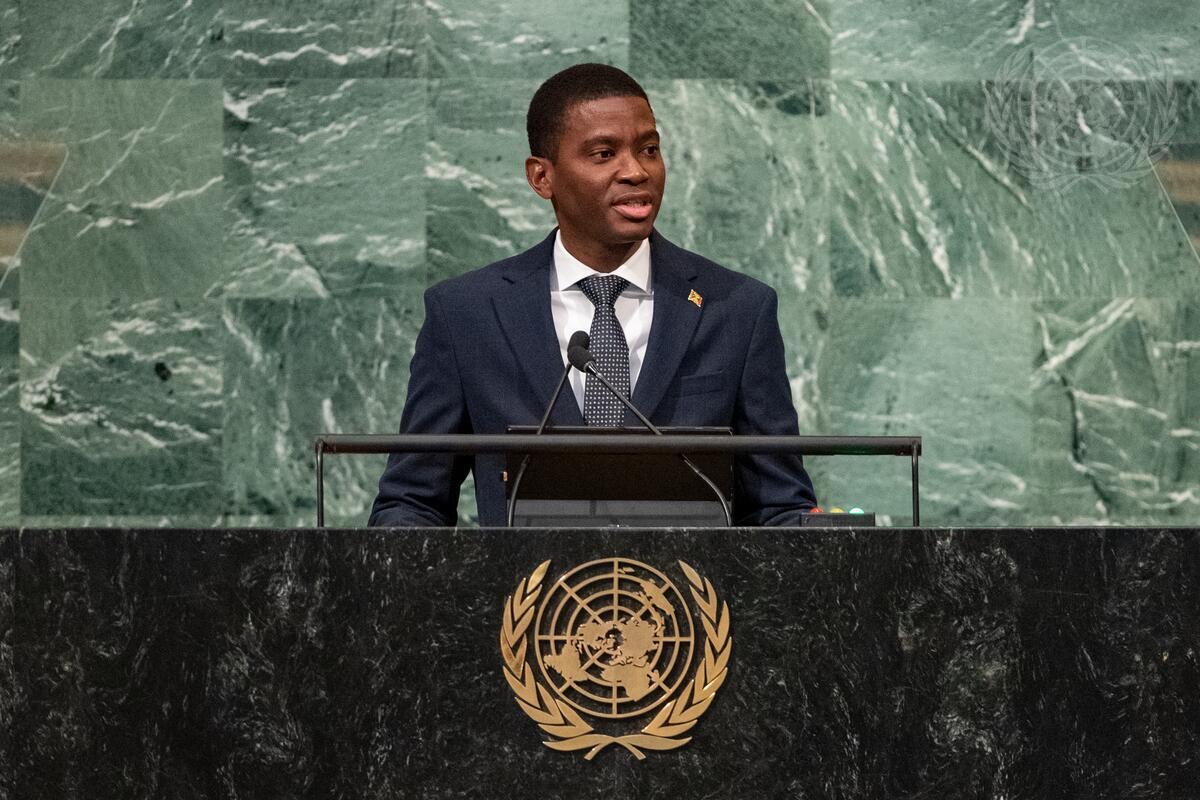
UNITED NATIONS, Sep. 27, CMC – Grenada Prime Minister Dickon Mitchell says education is the only force that can turn innovation into inclusion, conflict into cooperation.
“That is the simple, yet profound, truth: education is the single greatest social, economic and creative equaliser we possess,” he said in addressing the 80th Session of the United Nations General Assembly Debate on Saturday.
“It transforms circumstance into possibility. It turns the child of a labourer into a leader, the daughter of a seamstress into a scientist, the son of a fisherman into an innovator.
“This is the heart of my message: education is not a narrow path to employment, it is a broad road to resilience, to innovation, and to peace,” he added. “It saves people – not just from economic poverty, but from the poverty of diminished possibility.
“I have seen this. I have lived this. And now, I am privileged to lead this, in and for my country,” Mitchell continued. “For me, education was a bridge from limitation to possibility. It was education that carried me from a small hillside village in Saint David, Grenada, where my family fetched water from a public standpipe, to this Assembly Hall today.
“It was not wealth that brought me here,” he said. “It was not privilege. It was access. Access to teachers who believed in me. Access to opportunities that were modest, but life changing. Access to the chance to learn, even when the path was uncertain.”
Mitchell said his story is not unique, stating that it is “echoed in the resilience of Caribbean families who sacrifice for their children’s schooling, in the ingenuity of students who make the most of scarce access and even scarcer resources, and in the determination of communities that rebuild schools after every hurricane.”
He said this is the shared story of the Caribbean Community (CARICOM) – “a story of people who have learned to adapt, to innovate, and to persist – always with education as our anchor.”
And yet, today, he noted that the definition of education itself is changing.
He said education can no longer be defined solely by university lecture halls or college campuses, stating that, around the world, young people are shaping their futures in new ways through technical training, vocational education, and digital skills.
Mitchell said a certificate in coding can be as powerful as a law degree.
“A credential in renewable energy can open doors as wide as a medical license,” he said. “A diploma in advanced manufacturing can transform not only an individual’s future, but the economic trajectory of an entire community.”
The prime minister said this broader vision of education is “the reality we are embracing in Grenada and across the Caribbean.”
He said his government has embarked on “transformative reforms to strengthen our education system and expand opportunities for students at all levels.
“We have established universal secondary education and passed legislation to raise the mandatory school age to 18, ensuring that more of our young people remain engaged in formal education – not as charity, but as a matter of justice and national survival,” he said.
He said his government has also “modernised school curricula to prepare our students for the future,” stating that coding and technology clubs are now part of the school environment, and all students leaving primary school are assessed through electronic testing, “prioritising both digital literacy and problem-solving skills.”
Mitchell said his administration has placed student well-being at the heart of its reforms, hiring additional counselors, school feeding officers, and attendance officers to strengthen support for student mental health, nutrition, and engagement.
“We have also expanded our special education department and increased the number of early childhood officers, ensuring greater support for students with diverse learning needs, because, in a small island state, every child’s potential is a national asset,” he said.
Additionally, and importantly, the Grenadian Prime Minister said his government has taken “bold steps to make education more affordable and inclusive, eliminating school fees at the pre-primary, primary, and secondary levels.”
He said free tuition is now also available at our two main technical and vocational institutions, widening access to post-secondary training and future skills development.
“Across the Caribbean Community, we are investing in skills for the new economy such as digital literacy, renewable energy, climate adaptation and advanced technologies,” he said.
“In the case of advanced technologies, we are considering the teaching, understanding and use of AI and AI related skills to enhance education access, delivery and outcome, as understand that the jobs of tomorrow cannot be met with the skills of yesterday,” he added.
Through the Caribbean Future Skills Fund, conceived with Guyana, Mitchell said his government is pioneering an endowment model for education: “one where international contributions are matched by local investment.
“This ensures that our young people gain not just training, but also a sense of ownership and responsibility,” he said. “It is education with skin in the game from both donors and recipients.
“This is not education as an abstract ideal,” he added. “It is education as a lifeline, as resilience, preparing us to withstand the shocks of climate change and economic volatility. It is education as innovation, equipping us through powerful digital tools to turn necessity into opportunity.
“And it is education as sovereignty, ensuring that our destiny is not dictated by external forces, but shaped by the skills and creativity of our own people,” Mitchell continued. “And when Grenada, Jamaica, or Dominica rebuilds a school after a hurricane, we are not just rebuilding classrooms; we are rebuilding futures.”
He said education thrives when ideas and systems are shared across borders.
“Partnerships build better schools, yes, but more importantly, they build better citizens of the world,” he said. “For small states like mine, partnerships bring the reach and resources we cannot muster alone. They open doors to technologies and opportunities far beyond our shores.
“For larger states, partnerships with us offer something equally valuable: lessons in adaptation and creativity forged on the frontlines of hurricanes, pandemics, and economic shocks,” Mitchell added. “Together, these halves create something greater than either could achieve alone: an education system global in vision but local in impact.
“That is why we call on donor countries, multilateral institutions, and the private sector not only to fund, but to co-create,” the prime minister continued. “Not only to give, but to learn, because education is not charity. It is collaboration. It is investment in the kind of world we wish to leave behind.”
CMC/nk/kb/2024