
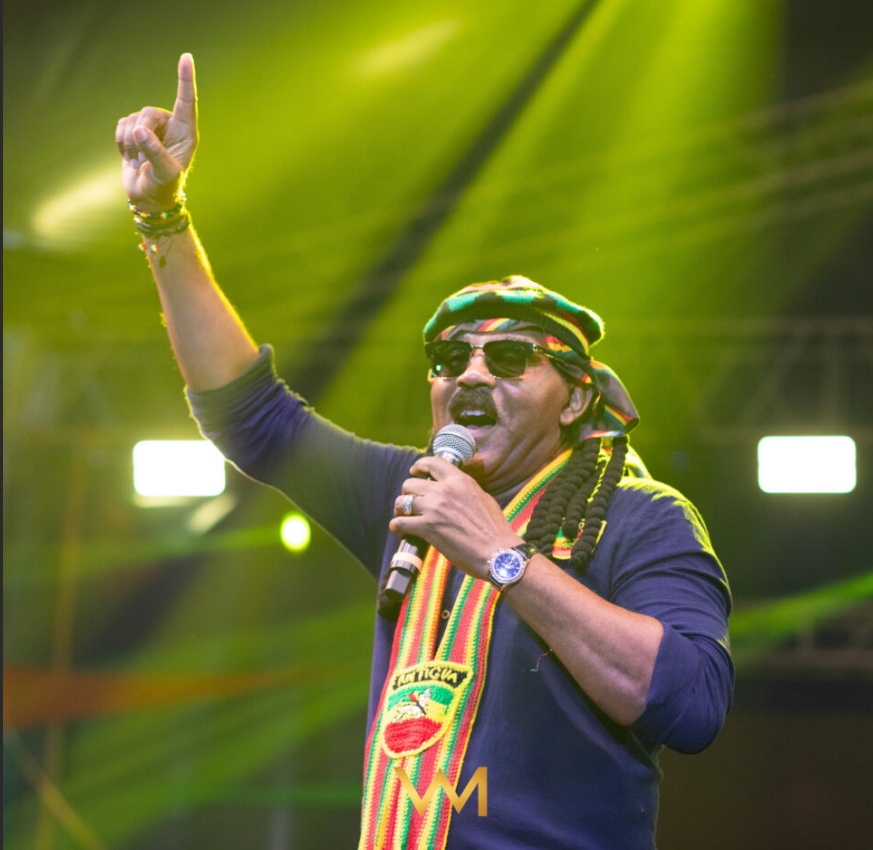
By Gassy Dread, The Rasta Dreadman and Reparationist Republican*
ST. JOHN’S, Antigua, Nov 10, CMC – The controversy surrounding our call for reparatory justice is not simply a debate about the past, that should remain in the past. Nor is about going to European powers cap in hand to seek charity.
It is a question about justice in the present, responsibility across generations, and the kind of world we wish to bequeath to those who will follow us.
For too long, the transatlantic slave trade and the system of chattel slavery that sustained it, have been treated as historical events whose consequences should simply fade with the passage of time.
But the passage of time does not extinguish injustice, erase its consequences, or absolve those who continue to benefit from its proceeds.
For more than four centuries, millions of African men, women and children were violently uprooted from their homelands, stripped of their humanity, sold as property, subjected to unimaginable cruelty, barbarically killed and forced to labour without compensation.
Families were destroyed, communities devastated, and entire societies exploited to generate extraordinary wealth for European empires. The United Nations has recognised the transatlantic slave trade, as one of the gravest crimes against humanity.
Its brutality was not incidental to the system; it was fundamental to its operation and entrenched by European powers.
Yet, while the enslaved were denied their freedom, their free labour undisputedly created immense wealth.
That wealth helped finance Britain’s industrial revolution, strengthen its financial institutions, build its commercial and trading empires, and establish institutions of learning that continue to enjoy the benefits of accumulated capital today.
Meanwhile, the Caribbean was left with underdeveloped infrastructure, distorted economies, entrenched poverty and structural vulnerabilities that continue to constrain our development.
This is the fundamental contradiction at the heart of the reparations debate; those who inherited the benefits of slavery cannot simply disclaim the liabilities that produced them.
They cannot approbate and reprobate.
We cannot accept a principle under which wealth may be inherited across generations, while responsibility for the injustices that created that wealth conveniently expires with the generation that committed them.
If modern institutions and societies can legitimately inherit the assets accumulated through centuries of exploitation, then surely there must also be a corresponding obligation to confront the consequences of that exploitation.
This is not about assigning personal guilt to contemporary British citizens. It is about recognising institutional continuity, historical responsibility and the enduring economic consequences of an injustice, that helped shape the modern global economy.
There is also a compelling contemporary reason why reparatory justice matters.
We are witnessing an international environment in which established norms are increasingly challenged, international law is disregarded, and powerful states sometimes resort to aggression and the violation of the sovereignty of others.
Whereas, the war in Ukraine is one stark illustration of the fragility of international peace and security. It is obvious that powerful countries have become more brutal and are not constrained by international law in committing atrocities.
We must therefore ask ourselves, what deterrent exists against the commission of grave atrocities, if those responsible can simply rely on the passage of time to escape accountability?
If the international community establishes the precedent that crimes of extraordinary magnitude carry no enduring consequences, we risk encouraging future generations of political leaders, to believe that the liabilities of their actions will disappear when they leave office.
That cannot be the standard of international justice. Definitely not. This reinforces the relevance and justification of reparations as a deterrent.
Reparatory justice must therefore be understood not merely as an attempt to correct historical wrongs, but also as a means of strengthening the international principle that grave violations of human dignity and human rights must carry consequences, even across generations.
Justice must not have an expiry date, simply because the victims and perpetrators belong to different generations.
At the same time, we must approach this matter with maturity, pragmatism and a genuine commitment to reconciliation.
Antigua and Barbuda and the wider Caribbean are not seeking charity, nor are we approaching this question with hostility towards Britain
We seek a constructive partnership founded on truth, acknowledgement, justice and meaningful action.
A formal apology would be an important expression of moral responsibility.
We welcome any British leadership prepared to engage honestly with this painful history and to acknowledge the suffering inflicted upon our ancestors.
But an apology, however sincere, cannot by itself repair the economic and developmental consequences of centuries of exploitation.
An apology must be the beginning of a process of reconciliation, not a substitute for restitution.
We recognise the fiscal and political challenges confronting Britain. We are not insisting that contemporary British taxpayers should face additional taxation, or that Britain should incur new borrowing to address this historical injustice.
There is a practical and constructive pathway.
Britain already maintains an Official Development Assistance budget.
A portion of these existing resources could be systematically redirected towards a dedicated Caribbean development programme, in keeping with its ten point plan on reparatory justice.
This programme should be executed with clearly defined objectives, predictable financing and measurable outcomes.
Such a programme could support climate-resilient infrastructure, renewable energy, education, healthcare, technology, economic diversification and sustainable development, which are included in the ten point plan.
It should also facilitate meaningful debt restructuring and relief for vulnerable small-island developing states, whose development prospects are frequently undermined by the disproportionate costs of climate disasters and their limited access to affordable financing.
This would not be charity.
It would be a deliberate investment in correcting structural disadvantages created by historical exploitation.
Antigua & Barbuda welcomes the proposed structural dialogue by UK Prime Minister, Andy Burnham.
We will make our contribution to the proposed structural dialogue and will be prepared to engage in structured negotiations, to develop an appropriate framework, with clear timelines, measurable commitments and mutually agreed mechanisms for implementation.
The Commonwealth, in particular, of which Antigua & Barbuda is the chair-in-office, provides an appropriate forum for this engagement.
The Commonwealth must not only endorse this structured dialogue, but influence a positive outcome, thereby demonstrating that it is more than an association bound together by history and sentiment.
It must be an institution capable of confronting difficult historical truths and translating shared values into practical outcomes.
Ultimately, this debate is about the kind of commonwealth and broader global civilization we aspire to build.
Science reminds us that humanity shares a common African ancestry and that the divisions used to justify racial subjugation were artificial constructs. We are one human family, with a common mitochondria DNA, with each human being, irrespective of the colour of their skin; entitled to the same dignity, freedom and protection under the law.
We cannot profess universal human rights, while treating some of humanity’s greatest historical violations as matters that should simply be forgotten.
We cannot advocate accountability for contemporary aggression, while refusing to confront the enduring consequences of historic atrocities. And we cannot credibly champion equality of nations, while ignoring the structural inequalities inherited from colonial exploitation.
Our position is therefore clear: reparatory justice is not about revenge; it is about responsibility.
It is not about reopening wounds; it is about healing them. It is not about diminishing Britain’s achievements; it is about ensuring that the relationship between Britain and the Caribbean is founded on honesty, fairness and mutual respect.
Let us move beyond defensiveness and historical denial. Let us embrace a process that acknowledges the past, addresses its consequences and builds a more equitable future.
The measure of our civilisation is not simply how we celebrate our achievements, but how courageously we confront our injustices.
History has already recorded what was done to our ancestors. Let our generation be remembered for its enlightenment of having the courage to do what is right.
Much love & blessings.
(*Antigua and Barbuda Prime Minister Gaston Browne, writing as his Alter Ego, Gassy Dread, The Rasta Dreadman and Reparationist Republican).
CMC/gb/ir/2026