
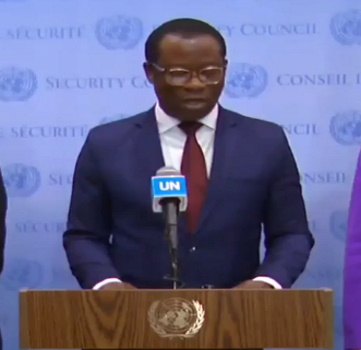
UNITED NATIONS, Feb 13, CMC – Guyana joined some members of the international community in expressing concern that climate change can aggravate existing threats to international peace and security.
Addressing the opening of the United Nations Security Council (UNSC) open debate on the impact of climate change and food security on the maintenance of international peace and security, Georgetown said it is concerned that the increasing occurrences of extreme climate defence “are severely impacting access to vital resources such as water and agricultural lands.
“There is increasing evidence between the inter relationship of climate change, food insecurity and conflict with each directly and indirectly impacting the other,” Foreign Affairs and International cooperation Minister, Hugh Todd said, noting also the inter communal conflicts especially in the most vulnerable regions of the world.
“The science is compelling and we are of the strong view that this issue requires a systematic and strategic approach by the Council. Food and water insecurity and hunger are among the primary pathways through which the effects of climate change on peace and stability and enjoyment of human rights manifest”.
The Guyana Foreign Minister said just as with land based agriculture, blue food insecurity contributes to a number of the current security challenges.
“Conflict can in turn exacerbate food crises and environmental degradation creating a vicious cycle, “ he said, noting that of the 10 countries most sensitive to climate change risks, nine are food insecure.
“Low income, fragile, vulnerable conflicted affected countries and communities are most at risk of being overwhelmed by climate impacts.”
Todd said as temperatures continue to rise, increasing unpredictable rainfall patterns, sever droughts, floods, sea level rise and changing agricultural patterns result in food insecurity, as well as disruptive livelihoods and migration are among the key factors driving conflict and violence.
“Climate change in this regard is considered a risk multiplier. Women and youth, children and other persons are among the most disproportionally affected while indigenous peoples, who for decades have long been considered guardians of the environment and many of whom rely on nature for their subsistence”.
He said faced with the realities of being displaced and forced to seek not only refuge, “we therefore cannot afford to ignore the inter link nature of these three phenomena and call on the Security Council and the wider multilateral system to take a holistic view of these challenges.
“We note that the Security Council has recognised the adverse effect of climate change on stability in resolutions on the mandates in peacekeeping operations and political missions. However, the Council must endeavour to adopt a long term strategy based on comprehensive risk assessments, utilising data and analytic to build resilience.
Todd said Guyana, which is a member of the UN Security Council, stands ready in joining other members to consolidate “our efforts to advance systematic response, inclusive and evidence based approach”.
In his address to the opening ceremony, UN Secretary General, Antonio Guterres, praised Guyana “for bringing us together to focus on the impact of the climate crisis and food insecurity on global peace and security.
“Climate chaos and food crises are serious and mounting threats to global peace and security.
It is only right that they are addressed by this Council. A global food crisis is creating a hellscape of hunger and heartache for many of the world’s poorest people. ”
Guterres said that the climate crisis is accelerating with a deadly force , recalling that last year was the hottest ever.
“Both these facts undermine peace. Empty bellies fuel unrest,” he said, adding that climate disasters and conflict both inflame inequalities, imperil livelihoods, and force people from their homes.
“That can strain relations, stoke mistrust, and sow discontent. While diminished resources and mass displacement can intensify competition. Conflict can easily be sparked where tensions are high, institutions are weak, and people are marginalised,” the UN Secretary General said, adding “women and girls pay the highest price, just as they do when food is short and climate disasters hit”.
He said that climate and conflict are two leading drivers of the global food crisis.
“Where wars rage, hunger reigns – whether due to displacement of people, destruction of agriculture, damage to infrastructure, or deliberate policies of denial. Meanwhile, climate chaos is imperilling food production the world over.
“Floods and droughts destroy crops, ocean changes disrupt fishing, rising seas degrade land and freshwater, and shifting weather patterns ruin harvests and spawn pests. Climate and conflict were the main causes of acute food insecurity for almost 174 million people in 2022,” the UN Secretary General said, noting “and in many cases, they collide to hit communities with a double blow”
He said he is dismayed that the world today is teeming with examples of the devastating relationship between hunger and conflict, adding that every one of the 14 countries most at risk from climate change are suffering conflict. Thirteen of them face humanitarian crisis this year.
“In Haiti, hurricanes combine with violence and lawlessness to create a humanitarian crisis for millions. In Ethiopia, drought comes hot on the heels of war. Almost sixteen million people are estimated to require food assistance this year.
“And refugees from the conflict in neighbouring Sudan are adding pressure on already scarce resources. In the Sahel, rising temperatures are raising tensions,” he said, adding “drying-up water resources, wrecking grazing land, and ruining smallholder agriculture – the staple of local economies.
“Against a backdrop of longstanding political instability, conflict between farmers and herders is the result.
“Meanwhile, globally, we risk a resurgence of food inflation as droughts sap the Panama Canal and violence hits the Red Sea – throwing supply chains into disarray.”
CMC/gt/ir/2024