
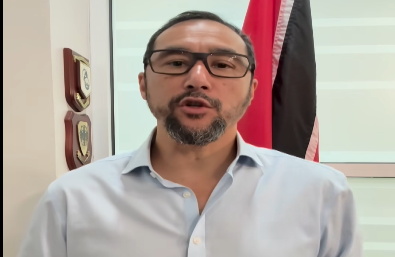
PORT OF SPAIN, Trinidad, Sept 15, CMC -Former prime minister Stuart Young Tuesday said he is “certain” that a number of innocent people had been detained under the state of emergency (SoE) due to expire on Thursday and called for opposition to the government’s plans to reintroduce Zones of Special Operations (ZOSOs) legislation after the previous attempt to pass the controversial crime-fighting measure failed in the Senate earlier this year.
Young in a video statement posted on his Facebook page, said that the current Kamla Persad-Bissessar government had over the past 12 months implemented the SoE, which suspended “all of our constitutional rights.
“As you’ve seen, it allows the state to lock you up without an arrest warrant, to keep you detained under preventative detention order,” said Young, who served as eighth head of government from March 17 , 2025, to May 1, 2025.
Young told his audience that it is a government minister, who has the sole power to issue a preventative detention order, a PDO, “thereby detaining any one of us.
“Let’s look at the statistics. Apparently, over 800 PDOs were applied for. The minister approved over 700 of them. Over 500 PDOs were executed, meaning 500 persons were detained and put into detention centres without the right to bail, without the right to habeas corpus, once you’re under a PDO.
“Importantly, out of that 500 plus people who were detained under PDO, only approximately 200 were criminally charged. We have seen in the last 12 months a number of citizens being detained, and they have been denied their rights.
“And we now know that a number, it is possible and I am certain, a number of innocent citizens were detained under PDOs,” Young said, accusing the ruling administration of abusing constitutional rights under these states of emergency.
He said the government is now focused on reintroduucing the ZOSO legislation questioning whether the government with its track record can “be trusted with these pieces of legislation that affect our constitutional rights, the movement of constitutional freedom of speech, etc.
“The answer Trinidad and Tobago is no. So don’t let them fool you that this is about putting pressure on, bullying the opposition and bullying the independent senators,” Young said, noting that the government “has shown us without a shadow of a doubt, they cannot be entrusted to uphold our constitutional rights”.
Last Friday, the government signaled its intention to revive the ZOSO legislation with Homeland Security Minister Roger Alexander saying the legislation will form part of the government’s strategy to tackle crime after the SoE ends on Thursday September 17.
He said ZOSOs would combine security operations with community development in designated areas, providing what he described as “special measures to uphold the rule of law, public order, citizens’ security and public safety”.
Alexander said the approach should not be viewed solely as a law enforcement measure, arguing that security interventions must be paired with efforts to address conditions in affected communities.
“The Zones of Special Operations is not simply about sending law enforcement into a community. It is about security and community development working together,” he said.
The government’s move follows the defeat in January of the Law Reform (Zones of Special Operations) (Special Security and Community Development Measures) Bill, 2026, after it failed to secure the required three-fifths majority in the Senate. Parliament records the bill as defeated.
The bill had faced criticism over human rights concerns and safeguards surrounding the proposed powers. Under the bill, the Prime Minister would have been able to designate communities as Zones of Special Operations, with joint police and Defence Force operations permitted within those areas.
The proposed measures included warrantless searches, curfews of up to 72 hours and detention powers. The bill also provided for a Social Committee to coordinate interventions including housing, healthcare and infrastructure.
Opposition Leader Pennelope Beckles has already criticised the government’s decision to bring the legislation back, describing the move as an attempt to create a permanent expansion of State power.
CMC/ed/ir/2026