
PORT OF SPAIN, Trinidad, Sept 18, CMC – The main opposition People’s National Movement (PNM) Friday dismissed government’s allegations that it does not favour legislation to deal with the crime situation in Trinidad and Tobago maintaining that new legislation is unconstitutional.
Attorney General John Jeremie in piloting the Special Operations Bill, which the government introduced to replace the failed Zones of Special Operations (ZOSOs), said the constitutionality of the legislation is based on the balance that it strikes between the enhanced security powers granted to the services and the protection of fundamental rights and the rule of law.
“It allows for temporary security measures, cordons and curfews, to be established or declared in closed areas, but there is a large measure of oversight,” Jeremie said, noting that “while the bill gives security forces special powers, warrantless searches under specific circumstances, it is designed to be a limited and temporary measure and it is distinct from a state of emergency”.
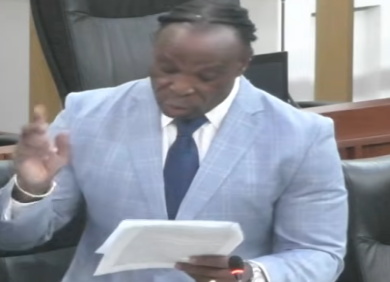
But as he led off the opposition’s response to the debate, Senior Counsel Keith Scotland told Parliament “it is not true to say that this opposition has not supported the government when it brought legislation that we see was good for Trinidad and Tobago, but this legislation is not good for Trinidad and Tobago.
“People of Tobago must not be presented with fear where we feel that we are living with a knee upon our neck. We are under pressure from this government,” Scotland said, adding that “effective policing and fidelity to fundamental rights are ideas that we aspire to”.
He said that law enforcement ought to be strengthened and not weakened, noting that through this legislation, which the government says requires a simple majority, “what they’re trying to do is to weaken law enforcement and just put seven zones policing area and say, go lock them down.
“The Constitution assumes its greatest importance precisely when public fears makes expediency attractive. This is when the Constitution and constitutional rights and morals ought to be upheld.
“It guarantees these rights and it exists so that liberty of even the unpopular person, the impoverished community and the citizens resided in an area afflicted by crime does not depend upon the grace or the discretion of the constitution protects and does not diminish because of a person’saddress,” Scotland said, adding “that is what this bill seeks to do.
“The bill asks parliament to authorise restrictions of the highest order. Why is leaving on critical limits to executive discretion? Madam Deputy Speaker for the opposition, we say, if there is good legislation, we will support it, but we say no to tyranny, we say no to unconstitutionality, we say no to hubris and we say no to ZOSO,” Scotland said.
He told legislators that Section 14.1 of the Constitution states for the removal of doubts it is hereby declared if any person alleges that any provision of this chapter has been, is being, or is likely to be contravened in relation to him, then without prejudice to any other action with respect to the same matter which is lawfully available, that person may apply to the HighCourt for redress.
“This is very important because it is mouthed at this sort of temporary nature of certain parts of the provision, makes it proportionate, that cannot be true, has been, is being, or is likely to be contravened means something and must mean something.
“So that is where we put our stall to say that this bill is unconstitutional and the fact that they have not adhered to Section 13 and put the contravention of Sections 4 and 5 in the recital does not render it constitutional.
Scotland said that the opposition will alert the population about “what we say is a runaway tyrannical government that cannot rule in normal circumstances”.
He said that the government has been in office for approximately 530 days with 491 of those days being under a state of emergency.
“What have they done? They have used these expansive powers, locked up persons, and then at the end of the day had to release them. Had to release most of them, and here’s the most, the unkindest cut of all.Up to now we can’t get proper statistics to show how many were charged, how many were detained, how many have been prosecuted”
Scotland sad that the legislation is a “sprawling assault” on several rights of the citizens of Trinidad and Tobago insisting that there are several existing pieces of legislation including the Offences Against Persons Act, the Anti-Gang Act and the Firearms Act to deal with criminal activities.
“There are already things in place for this government to deal with the same situation that the Honourable Attorney General said that this legislation is attempting to cure. It is then our submission that incompetence should not be a placebo and it should not be a panacea for unconstitutionality.
“Use what you have and see if it yields results. But to come time after time after time to trample on the rights of the citizen is plainly wrong,” Scotland said, adding “this bill is not merely excessive legislation, it is legislation and a legislative machinery of a runaway and increasingly tyrannical executive..which invokes fear to enlarge its powers.
“ What the government presents here as decisive action in substance is legal architecture capable of converting entire communities into places where liberty is no longer a right, but a privilege exercised by official permission.
“Trinidad and Tobago, be careful,” Scotland said, adding that the legislation will also devlaue the properties of persons within the areas designed as crime hotspots.
“That is a constitutional infringement under the right of property, and there’s no amount of proportionality argument that can withstand the seals of that. So, let there be no ambiguity about our position.
“We say that we support the police service of Trinidad and Tobago. We support intelligence-led operations and the interdiction of firearms and the dismantling of criminal organisations. What we do not support, however, is the dismantling, piece by piece, of our fundamental rights and the way of life in Trinidad and Tobago. We do not support that.”
The debate is continuing.
CMC/jh/ir/2026