
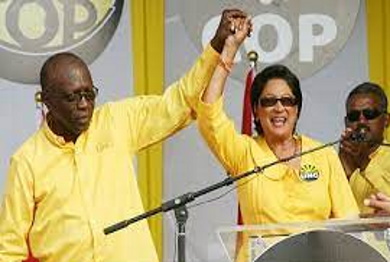
LONDON, Nov 13, CMC – The London-based Privy Council, Monday ordered former Trinidad and Tobago government minister, Austin Jack Warner and two other defendants to repay over TT$1.5 million (One TT dollar=US$0.16 cents) to a Trinidad-based company, Real Time Systems Ltd.
In addition, the Law Lords said that payment of the TT$1, 505, 493 would include interest at the statutory rate from 15 May 2018 until repayment.
In 2007, the appellant, Real Time Systems Ltd, paid to the respondents a total of TT$1.5m by instalments, claiming that the sums were a loan which was due to be repaid even as Warner and the other respondents claimed that the sums were not loans.
They said that the appellant provided the funds to finance an election campaign on behalf of the now opposition United National Congress (UNC) of which Warner was a member.
In 2018, the High Court found the payments were loans based on a series of factual findings about the reasons for the payments.
But Warner and the respondents appealed to the Court of Appeal on the basis that the High Court had made factual findings and drawn inferences which was not open to him on the evidence.
In February 2020, the Court of Appeal agreed that the High Court judge had made an important finding for which there was no evidence and that he had failed to properly assess oral evidence given in the hearing. The appeal was allowed and the orders of the High Court Judge were set aside.
But in their appeal to their appeal to the Privy Council, Warner argued that that the Court of Appeal erred in finding it was entitled to set aside the factual findings of the High Court Judge.
The Privy Council was told that the appeal arises in the context of proceedings brought by Real Time Systems Ltd against Renraw Investments Ltd, CCAM and Co Ltd and Jack Austin Warner in which the company sought to recover the multi-million dollar debt.
“The issue at trial was whether, as the claimant alleged, the money was paid by way of a loan to the defendants repayable on 28 February 2008, or whether as the defendants alleged, the money was a gift by the claimant to the defendants, in the form of a donation to finance a political party, the United National Congres (UNC) in respect of its 2007 general election campaign.
Warner and his companies argued that the judge was entitled to make his findings on the evidence and that the test for establishing apparent bias on the part of the judge has not been satisfied.
But in its 30 page ruling, the Privy Council, Trinidad and Tobago’s highest and final court, noted that before it was whether the majority in the Court of Appeal correctly applied the test by finding that there was a real possibility of bias by the judge against Warner.
“In relation to the first stage—that is, ascertaining all the circumstances which have a bearing on the suggestion that the judge is or would be biased—the Board considers that the circumstances include several relevant matters.”
The Privy Council said that the judge did not come to the trial with “preconceived and partisan views.
“He had not expressed any particular views on the subject of unregulated campaign financing prior to the trial. Rather, the judge was reacting to the case which was made by the defendants in their pleading and during cross-examination of Mr (Krishna) Lalla,” the owner of the company that had sought to recover the loan.
The Privy Council also ruled that there was no complaint about the way the judge conducted the trial, noting “rather, the judge carefully heard and then analysed all the evidence having had the benefit of and engaged with detailed closing submissions.
“Third, the judge’s antipathy to unregulated campaign financing….was not only directed at politicians who accepted campaign financing but was also directed at those who financed campaigns in order to “purchase goodwill and exercise undue influence over politicians and political parties”. The Board considers that the majority in the Court of Appeal wrongly characterised the judge’s antipathy as being directed solely at Mr Warner. It was not. “
In addition, the Privy Council said the defendants’ notice of appeal to the Court of Appeal dated 27 June 2018 did not cont
”The contention that there was an appearance of bias emerged in the defendants’ written submissions to the Court of Appeal dated 5 April 2019. The Board considers that the delay in making the contention of an appearance of bias reflects the fact that those who were present and understood the dynamics of the trial did not consider the comments made in the judgment raised a real possibility of bias.”
The Privy Council also said that the comments made in the judge’s speech to the Trinidad and Tobago Transparency Institute did no more than repeat what was contained in his judgment.
The five member Law Lords also said they were in agreement with the reasons given by one of the Court of Appeal judges “considers that a fair-minded and informed observer, having considered the facts, would not conclude that there was a real possibility that the judge was biased”.
They said as the judge held “a fair-minded and informed observer would: (a) appreciate that “the case made out by the [defendants] was directly relevant to the issue of campaign financing and as such it was not inappropriate for the judge to … express his views on the issue”,,,,t; (b) “there was nothing in the findings made by the judge or the language used which would point to the fact that the judge’s views on campaign financing caused him to prejudge any of the issues in the case”…and (c) “the comments made by the judge was a criticism of the behaviour of both sides”.
“In relation to the last factor, the Board agrees that the judge’s comments captured both Mr Lalla and Mr Warner equally so that there was no predisposition to decide the case for one side or the other.”
CMC/ag/ir/2023