
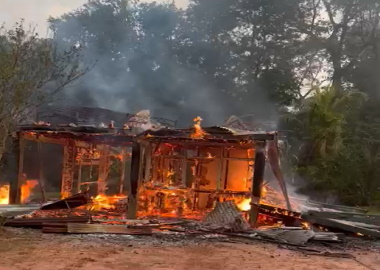
PARAMARIBO, Suriname. Nov 15, CMC – The Indigenous Collective Suriname (IKSur) Friday called for the release of six men who have been on trial in relation to the riots in Pikin Saron in May 2023. A verdict is expected to be delivered later on Friday.
Two men were killed during a shootout with police after gunmen fired upon and set fire to a police station in Pikin Saron, south of the capital Paramaribo on May 2, last year. The police said then that a number of employees of the state-owned mining company, Grassalco which operates a gold mine in the area, had been taken hostage by the gunmen.
Police said that the insurgents belong to the Kaliña Amerindian tribe who rioted because they are dissatisfied with the alleged treatment of the indigenous people by the Surinamese government.
In a statement, IKSur chairman, Lloyd HF Read, said that the living conditions of the indigenous people in 2024 are subject to all kinds of discrimination and unjust actions by the Surinamese government.
“As the first inhabitants, we were driven from the coastal plain to the interior by the colonials. After Independence, all governments continued discrimination and unjust behaviour, through educational disadvantages, inadequate medical facilities and a lack of sustainable
economic development.
“Now even the areas to which we were driven without any recognition of our land rights are being issued to multinationals and local entrepreneurs. Friends and family of politicians also benefit from obtaining our land,” Read said.
He said that in 2015, the State of Suriname was internationally condemned through the Kalina Lokono Verdict, but that the Dutch-speaking Caribbean Community (CARICOM) country “ignores its obligations under the verdict and continues its practices of exploitation and oppression”.
In the case Kaliña and Lokono Peoples v. Suriname, the Inter-American Court of Human Rights (IACHR) ruled in favor of the Kalina and Lokono peoples, finding that Suriname violated their rights in several ways.
IACHR said the state failed to grant title to the Kalina and Lokono peoples’ territory, violating their right to collective property. The court ordered the state to consult with the peoples to establish the boundaries of their territories and grant them title.
In its statement, the IKSur said taking action against these forms of discrimination, restriction of freedom of movement, environmental pollution and poisoning of our waters, has resulted in the murder of two captured indigenous people by the police on May 2, 2023.
“Following the murders, indigenous organizations and social groups have appealed for an independent forensic pathological investigation, which has been refused for inexplicable reasons to date, while forensic research has provided valuable information in other murder cases in Suriname.
“The police, or the investigation department, have identified six men as suspects. These suspects have been in pre-trial detention for 1.5 years, which is unacceptable under Inter-American Law, and are in detention under appalling conditions.”
The IKSur said lawyers have tried several times to obtain provisional release for the suspects, but this has been firmly rejected by the judge.
“Without a thorough investigation of the murders and the events, the Public Prosecutor is of the opinion that the natives have violated the rights of entrepreneurs and should be made an example of by means of the most severe demand possible (15 years) and all conceivable charges (34).”
The IKSur said that while the authorities are “busy” trying to convict the six men, the investigation into the deaths of the two Natives Dijksteel and Wolfjager village “has still not started and the requested independent modern forensic pathological investigation is being ignored”.
It said that Surname has labelled the men as “terrorists solely to influence society,” adding “this shows how the government treats us as a very vulnerable group and we do not think and hope that you will look away from this injustice.
“The only thing we as indigenous people ask for is equal treatment and therefore also in the area of justice. We also ask the religious and social organizations to make their voices heard now and in the future.
“We ask Tamushi/Adajali, or the Supreme Judge, to grant the earthly judge all wisdom in making a decision that is based on justice, established facts and circumstances,” the IKSr added.
CMC/ag/ic/ir/2024