
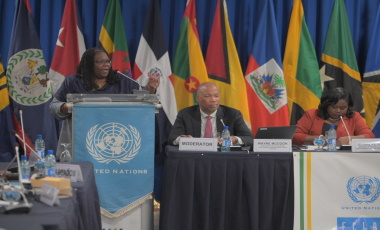
PARAMARIBO, Suriname, Oct 14, CMC – The seventh Caribbean Development Roundtable (CDR) has ended here having focused on recovery and repositioning with a view to finding practical and viable solutions to invest in resilience, economic recovery and sustained growth.
In addition, the CDR also received an update on the progress made towards the creation of the Caribbean Resilience Fund (CRF).
The two-day meeting held under the theme “The Caribbean: Recovery and Repositioning inr he context of COVID-19 and beyond” was convened by the Economic Commission for Latin America’s (ECLAC) sub-regional headquarters for the Caribbean and sponsored by the Suriname government.
CDR outgoing president, Keisal Peters, the Minister of Foreign Affairs of St. Vincent and the Grenadines, said the event was conceived as a forum to discuss critical issues that pose a fundamental challenge to development in the Caribbean ”and to explore solutions that will ultimately support inclusive growth and higher standards of living for our people, while protecting our environment”.
She told the CDR that the coronavirus (COVID-19) pandemic has reversed some of the hard-won gains in the growth of the economies of the Caribbean countries, and in the reduction of unemployment and inequality. .
“The pandemic hit our main sectors, in particular tourism, trade and distribution. In addition, the sub-region was rocked by natural disasters. The La Soufrière eruption had a devastating impact on my own country, St. Vincent and the Grenadines, while here in Suriname and in neighbouring Guyana there were major floods, there was an earthquake in Haiti and numerous storms that crossed the Caribbean,” she said.
Director of the ECLAC sub-bregional headquarters for the Caribbean, Diane Quarless, underscored ECLAC’s position on the need for economic diversification in the Caribbean, which, she said, is an integral part of the lasting recovery and development of the resilience.
“At ECLAC we have long been promoting the idea of long-term planning and the development of industrial policies aimed at identifying new sectors and actors, and new sources of financing. This implies the need to improve the business environment, with a closer association dynamics between the government and the private sector,” Quarless said, noting that this requires investment in production and industry, and therefore investment in people.
ECLAC said that the CDR recognizes that while the prospects for the Caribbean to adequately meet its development needs have been severely limited, new opportunities have emerged, both international and regional. These can provide potential support to the sub-region’s efforts to find a strong recovery, and to become more resilient, through global partnerships.
Quarless said that the first area of considerable interest is the creation of innovative financing instruments to access development finance, especially in areas of need such as renewable energy and risk insurance.
“We encourage everyone to recognize our efforts towards the establishment of a Caribbean Resilience Fund, in response to the need to create instruments that provide long-term and low-cost financing, in order to alleviate the burden of debt service and the liquidity constraints that have been choking investment in innovation and resilience in heavily indebted middle-income countries in the sub region,” he said.
The two-day CDR explored the potential for effective advocacy, in order to tap domestic and concessional funding sources, and explored how these programs could be scaled up to be effective.
A statement issued here said that five important areas were discussed, in separate panels including vulnerability, debt and liquidity in the Caribbean; vulnerability in the small middle income countries of the Caribbean; data needs and statistical capacity of the Caribbean; as well as global partnership for repositioning, recovery and resilience in the Caribbean; and restructuring and economic diversification to deepen the integration of the Caribbean in Latin America and in the global economy.
“The first theme of the panel identified that issues of vulnerability, debt and liquidity are at the heart of the Caribbean’s challenge to address sustainable development. Long-term, easily accessible and affordable financing is urgently needed to invest in recovery, resilience, economic transformation and growth.
“The response proposed by ECLAC to this need is the CRF, which will ensure the availability of resources for the Caribbean to invest in adaptation and mitigation initiatives. ECLAC has also launched a series of liquidity management operations to address growing debt and liquidity problems in selected pilot countries,” the statement noted.
Addressing the closing ceremony, Peters expressed her support for the CRF proposed by ECLAC, describing it as a tool to leverage long-term and affordable financing to face the challenges of climate vulnerability and limited liquidity.
“I have particularly liked the debt restructuring and liquidity enhancement proposals, which will be well received by cash-strapped governments. The importance and value of parametric insurance provided through CCRIF SPC in offering more Optimizing climate risks was also a very welcome part of our dialogue.
“We note that CCRIF is innovating in offering new products, including its micro insurance scheme for small farmers and fishermen in response to shocks,” she told the CDR that brought together regional and international development thinkers and professionals, leaders and high-level political leaders from ECLAC member states as well as representatives of the United Nations system, regional financial institutions, academia and civil society.
CMC//gf/ir/2022