
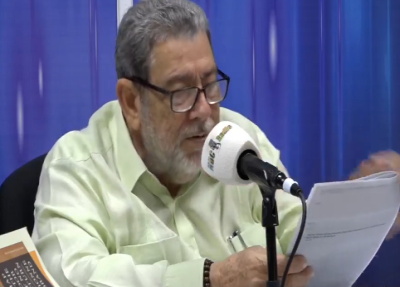
KINGSTOWN, St. Vincent, Mar 5, CMC -St. Vincent and the Grenadines Prime Minister Dr. Ralph Gonsalves Wednesday said even after the International Court of Justice (ICJ) delivers a judgment in the decades old border dispute between Guyana and Venezuela “ which ever way they go, you’re still going to have tensions”.
Gonsalves, who serves as an interlocur, based on the Argyle Agreement signed between the two countries here in December 2023, said that the ICJ may deliver its judgment “sometime later this year or early next year.
“I don’t know. I don’t know. I’m not too up to speed on the progress of the litigation, and I know the ICJ will take some time to write the judgment and so forth, because they have had hearings already,” Gonsalves said as he spoke on the latest dispute between the two countries on his weekly radio programme.
Last weekend, Guyana alerted the Caribbean Community (CARICOM) and the international community to the presence of a Venezuelan naval vessel that was near its oil assets for about four hours.
Since then, the United States, France, CARICOM, the Commonwealth as well as the Organization of American States (OAS) have all called on Venezuela to not engage in further provocation by threatening ExxonMobil’s Floating Production Storage and Offloading (FPSO) vessel.
But Venezuela has dismissed comments made by Guyana’s President, Irfaan Ali, saying it “categorically repudiates the baseless remarks” of the country’s leader, whom it said “lies brazenly when he claims that units of the Bolivarian Navy of Venezuela are violating the maritime territory of Guyana”.
Caracas said that Ali is “hiding the fact that those waters do not for, part of Guyanese territory , since it is a maritime zone pending delimitation in accordance with international law”.
Guyana and Venezuela are before the ICJ concerning the Arbitral Award of October 3, 1899 with the ICJ warning Caracas against the “annexation” of Essequibo, an oil-rich region that makes up about two-thirds of Guyana and is home to 125,000 of its 800,000 citizens.
The case, which was filed by Guyana in March 2018, seeks the court’s decision on the validity of the Arbitral Award which finally determined the land boundary between the two countries. The court has already ruled that it has jurisdiction over the controversy and will decide the issue on the merits of the case.
In January, the Guyana government expressed “grave concern” over what it claimed to have been “recent actions and statements” by Caracas that constitute ”clear violations” of the Argyle Agreement and the binding order of the ICJ, both of which came into effect in December 2023.
Georgetown recalled that the Argyle Agreement, signed in St Vincent and the Grenadines in December 2023 in the presence of regional and international interlocutors, unequivocally commits Guyana and Venezuela to refrain from escalating any conflict or disagreement arising from the territorial controversy between the two States.
It said that this includes refraining from actions that could aggravate tensions or alter the current situation in the disputed territory, pending resolution in accordance with international law.
Gonsalves told radio listeners that he had received the report on the latest dispute between Guyana and Venezuela last Saturday when President Ali said a patrol boat from Venezuela had come into Guyana’s waters.
“That’s what the President said. Of course, Venezuela disputes that it’s Guyana waters. They had an interaction with the floating production, storage and offloading platforms,” he said, adding “these are undoubtedly under Guyana’s jurisdiction, because that’s for the purpose of …taking the oil out from the below the sea bed”.
Gonsalves said that immediately the Argyle Declaration had to be activated, because under the accord, he, who was named by the Community of Latin American and Caribbean States (CELAC), Dominica’s Prime Minister Roosevelt Skerrit, the immediate pass CELAC chair and President Luiz Inácio Lula da Silva of Brazil or his representative, and whoever is the current chair of CARICOM, “constitute the mechanism which is to be activated for any kind of stress and dissonance, particularly of a serious kind, in the relations between Guyana and Venezuela regarding the matters touching and concerning the border controversy”.
Gonsalves said he had been in touch with Barbados Prime Minister and CARICOM chair, Mia Mottley and that “we had to be involved in a tag team all into the night with the various personalities”.
He said both Guyana and Venezuela had “very different” views on the matter and what the mechanism had to do “is to make sure that there’s a peace and a calm and that there’d be no provocation.
“Because clearly, immediately you saw the US State Department issued a press release. You saw the the OAS issued a press release. The secretariat of the Commonwealth in London issued a press release. I know that President Ali had been in contact with various allies. “Naturally, the United States would have been very deeply involved, because it’s a US company, Exxon and there are US workers there, along with other workers. You have to have peace,” he said, noting the “tense situation” that existed.
“Anything can happen and matters spiral completely out of control, and the next thing you know, there’s a conflagration, military operations and what have you, and so on and so forth. You don’t need an imagination to know who that will go. so that and this mechanism has worked with and of course, letter flying hither and hither.
“We still have to meet to have this matter thrashed out so that we don’t have a repetition of this. It’s not the first time since Argyle that matters have had to be be muted by us and I’m referred to as a principal interlocutor”
Gonsalves said that several people had taken “the Argyle declaration for a joke” insisting that the agreement and the mechanisms therein “have assisted in keeping the peace and lessening tensions”.
Gonsalves said he is privy to letters and statements “made of a very harsh kind by one side or another, and they’ll be sent to me, and I will pass them on to the other side, and I will have communications myself and interface with CARICOM and, of course, with our foreign affairs ministry, so that they keep in touch with CELAC, the current Presidency of CELAC, which is Honduras”.
Gonsalves said he takes his role in the situation “seriously” warning “if you have a configuration, a number of people are likely to die, get injured, damage to property, going to have migration.
“And when you having, migration is not only good people coming in. I’m talking about refugees, some real terrible people, because we are living in a dangerous neighbourhood.”
Gonsalves said that it could also lead to other parties connected to one side or another getting involved and depending on their interference “it doesn’t require imagination as to the turmoil that can be caused in the Caribbean and Latin America and in our hemisphere.
“So the Argyle declaration works,” Gonsalves said.
CMC/kc/ir/2025