
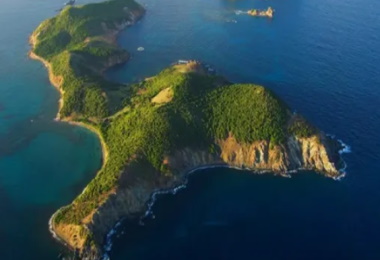
KINGSTOWN, St. Vincent, Mar 10, CMC – Prime MInister Dr. Ralph Gonsalves says that the historic significance of Balliceaux, a 320-acre privately-owned island in the Grenadines to which indigenous Vincentians were exiled two centuries ago, does not mean it cannot be developed.
For years, the owners of the uninhabited island, located close to Mustique and Bequia have been trying to sell it and it is now listed for sale for US$30 million.
Gonsalves, speaking on his weekly programme on the state-owned NBC Radio flagged the issue of any potential foreigner obtaining an alien land holding licence to acquire the prperty.
He said that while the island has been listed for sale, “the government itself wouldn’t know what is happening until somebody, either the potential purchaser or the vendor says, ‘Listen, it looks as though we are going to get somebody to buy it.’
“There have been several false dawns with this,” Gonsalves said, noting the asking price of US$30 million.
“Well, that asking price is, in some respect, for a person who has money,” he said, telling radio listeners that even if the person has the money, “there are big issues which would follow.
“Are you going to get an alien land holding licence? because it depends on who the person or persons are who are going to buy.
“What development plan you are going to have?” Gonsalves said, as he continued to list the issues his government might consider in granting an alien landholding licence.
“What about space being set aside for an appropriate memorial for the Garifuna who were transported there, over 5,000 and where half of them died within a six-month period and the rest were exiled into the Bay of Honduras and Roatan Island?” Gonsalves said, adding “so, there are sensitive historical issues which have to be addressed.”
He said that the government would not grant an alien landholding licence to someone who is not reputable.
“Straight off, for instance, you are not going to have somebody who is involved in high class criminal activity globally or money laundering or [a] terrorist or somebody like that being able to buy it,” Gonsalves said, adding that the buyer would also have money to develop the island, which has no infrastructure.
“You have to have facilities for water, facilities for electricity, garbage collection and disposal. You have to build the roads. What development you are going to have there?” he said, noting that the advertisement said the island could be a place for a rich person to have a house.
“Well, are you going to give an alien landholding licence for somebody to just come and build one big house there or one big compound for their family?
“If you are going to do that, if you are going to have development taking place there, what type of development it is going to be? So, there are all sorts of questions which would have to be asked and answered and those are only some of the questions. There are others. But those are some of the critical ones.”
Gonsalves said that no one has come to the government saying that they have a potential buyer nor has a potential buyer asked about the government’s appetite for a particular type of development on the island.
“So, in addition to the transaction between vendor and purchaser — seller and purchaser –there are a lot of questions of a planning nature, of a developmental nature which would have to be answered,” Gonsalves said, adding there are matters which touch and concern, too, the historic sensitivity of Balliceaux.
“There are some persons who say we should deny anybody doing any development there. Well, I wouldn’t go on that journey and say don’t have any development there because there are places all over the world of great historical significance and where there have been much pain and suffering where you develop. But it has to be done sensibly.”
He said that in St. Vincent and the Grenadines and every Caribbean country there has been a lot of historic pain, including native genocide and the enslavement of African bodies.
“But yet the places where you have the native genocide and the enslavement of African bodies we have had to de development because we live in the space called St. Vincent and the Grenadines.”
Gonsalves said he knows it can be said, with some justification, that Balliceaux is special because of what happened to indigenous people there.
“… but at the same time, you can take account of that historical issue, the sensitivity issue and having a development which is not inconsistent with it, with an appropriate memorial; put aside part of the land for that purpose and when you get to discussion on that, how much of land of that on Balliceaux and the size of the memorial, the type of the memorial,” Gonsalves said.
He said that decision would have to be made about the specific memorial.
“Not just an iron man, a cenotaph-size memorial or just the obelisk. I would say something more befitting the circumstance and historical sensitivity and reflecting of the pain and the suffering and how that historical legacy, which we are bearing, is remembered and manifested and if you a development there and you have appropriate memorial, it would be a magnificent thing is you have descendant of the Garifuna holding important positions in running the thing,” Gonsalves said.
CMC/kc/ir/2023