
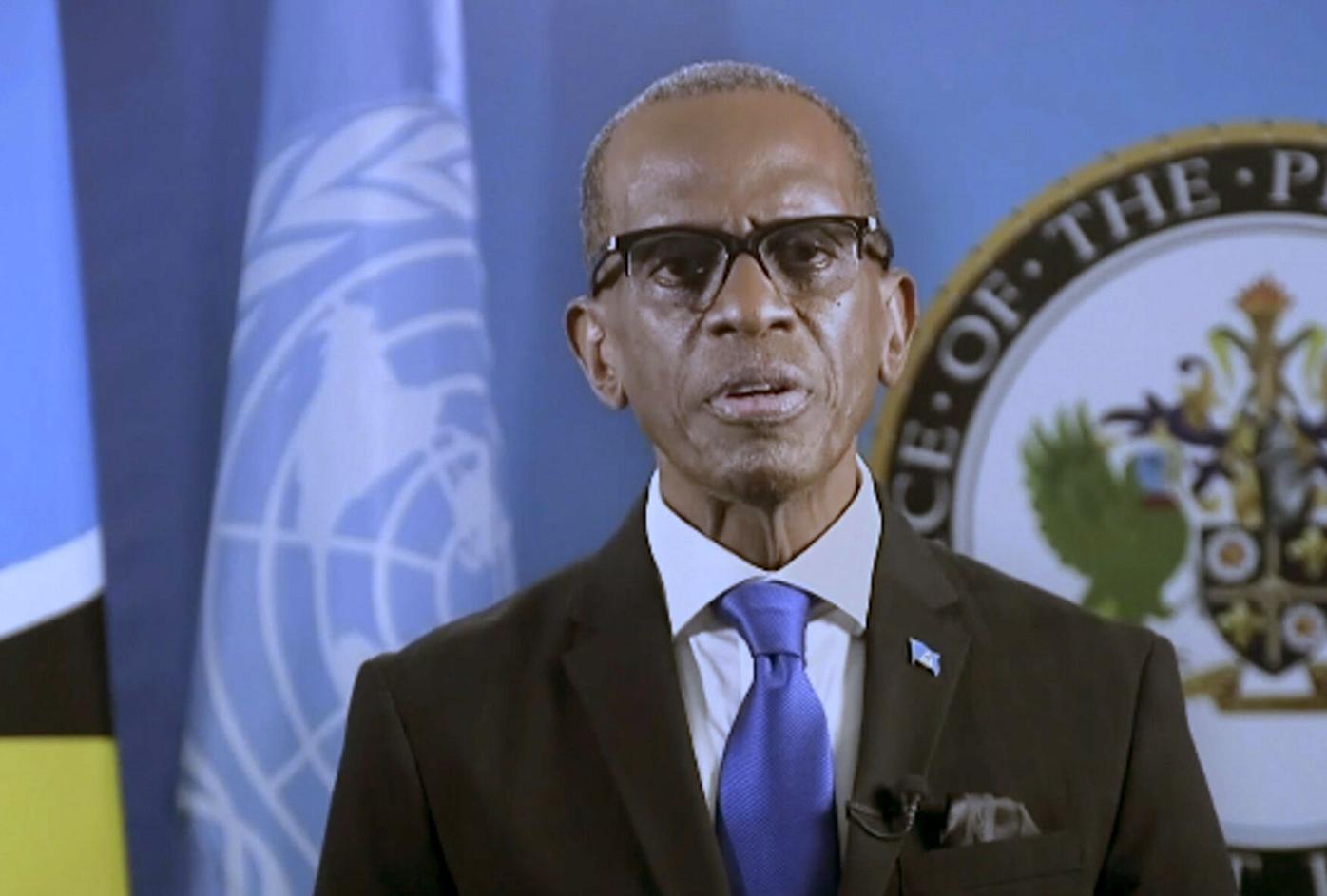
UNITED NATIONS, Sept. 26, CMC –The Prime Minister of St. Lucia, Philip J. Pierre, says while the novelty and evolving character of the COVID-19 pandemic are baffling, it has enlarged and worsened the issues confronting Small Island Developing States (SIDS).
“We continue to contend with the near-impossible balancing act of preserving lives and livelihoods,” said Pierre in his maiden address to the 76th Session of the United Nations General Assembly Debate on Saturday.
“The insidious nature of the virus has allowed it to sneak across even the most heavily patrolled borders, and St. Lucia has experienced waves of highs and lows in managing this pandemic.”
In that regard, Pierre extended St. Lucia’s gratitude to international institutions, such as the COVAX Facility and many bilateral partners such as India and the United States of America, “for their commitment to ensuring that we in St. Lucia and, by extension, the Caribbean region, were not further disadvantaged by our inability to access vaccines.”
But the St. Lucia prime minister said that, as his country tackles. this pandemic, “there is another global threat that runs parallel to it, by the name of ‘misinformation.’
“The Government of St. Lucia has embarked upon a robust education program to encourage our population to get vaccinated, as realistically, this is the only way to reduce, eliminate and eradicate the risks and restrictions caused by this pandemic, and permit us to rebuild our economies and societies stronger,” he said.
“However, we have witnessed in dismay the politics at play even in the midst of this pandemic, as various countries create their lists of recognized and unrecognized vaccines, with certain privileges awarded to global citizens who have opted for certain branded vaccines over others,” he added. “We have witnessed vaccine apartheid in various forms and not only in terms of production and distribution. Some countries which have stockpiled vaccines are now in the middle of debates about third doses and boosters, while other countries watch helplessly as COVID-related deaths continue to rise for want of a jab.
“In St. Lucia, we recognize all vaccines that are endorsed and administered by a country’s respective government, as we have entrusted sovereign states with the responsibility of following the science,” Pierre continued. “In this regard, we call for standardization of vaccine privileges across the global community, as it relates to quarantine, isolation and other related requirements.”
Like many other countries, the prime minister said St. Lucia is grappling with a decline in investment, trade, remittances and growing debt burdens.
He said there is an urgent need to accelerate global momentum towards the ambitious targets across various international agreements and development agendas.
Pierre said a common thread across these instruments is the need to address the unique vulnerabilities and special circumstances of SIDS.
He said St. Lucia and all SIDS continue to face huge spending needs to finance the immediate health responses that are well beyond their capacities.
“These indicators erroneously paint a picture of ‘national prosperity’ that lies in stark contrast to existing realities,” said Pierre, calling for the adoption of a global vulnerability index by international institutions.
He said this index should include variables, such as vulnerability to adverse weather systems and natural disasters, historical disadvantages arising out of plunder, colonialism and exploitation, and the vagaries of the economic activities, which such states depend for survival.
“Such a global vulnerability index would ensure that access to concessional development finance is granted based on criteria that consider the true contexts of our fragile economies, which are constantly under threat of regression, due to natural, man-made or political disasters,” the St. Lucian leader said.
He also called for immediate measures to safeguard the solvency of SIDS, which, he said, “have been disproportionately affected during the pandemic.”
Pierre said these measures must include debt restructuring and write-off, support to strengthen health systems, more equitable distribution and access to vaccines, and assistance for recovery that meets the demands of the development model adopted in the beneficiary country, “and is consistent with our current socio-economic environment.”
He said while the pandemic seems to have slowed down everything but the deterioration of “our beloved planet earth, climate change continues to wreak havoc across all areas of the globe.”
With less than a decade left to achieve the 2030 Agenda, Pierre said the UN’s Decade of Delivery requires “urgent and adequate solutions towards salvaging our global living quarters.
“The resilience we need, and the adaptations required system-wide to respond to COVID-19, are directly relevant to the resilience and adaptation required for climate change,” he said. “It can be argued that the COVID-19 pandemic and the climate change challenge confront us with an intermeshed problem of symptom as cause and cause as symptom. It provides us with a harsh and timely reminder that human health and planetary health are linked.
“Sadly, the cost of meeting these challenges and undertaking the resilience activities, whether it be for health or climate, is way beyond the financial reach of our small islands,” he added. “We, therefore, appeal to all, especially those ablest financially, to contribute towards our recovery efforts, and to pay their commitments to the Adaptation and Mitigation Funds, so that SIDS can benefit.”
On the eve of the United Nations Conference on Climate Change in Scotland, known as COP26, Pierre urged the larger economies, “the often-major contributors to greenhouse gases, to honor their financial pledges.
“This would allow us, the smaller vulnerable economies, whose contributions to greenhouse gases are often negligible, the fiscal room to build climate-resilient societies,” he said.
Pierre said his government is committed to improving the lives of young people, especially the most vulnerable, and is working with all citizens to assist them in transforming their lives and to make viable contributions to the economy.
In this regard, he invited the international community to “discuss and engage with us strategically, on mutually beneficial relationships and projects to promote The Youth Economy, as we seek to build a better and more sustainable future for all.”
The prime minister noted that St. Lucia remains among a handful of countries that maintain official relations with Taiwan.
“We continue to plead the case to advance their cause to be accepted as a legitimate participant in the global decision-making process,” he said.
Pierre said the development of St. Lucia will continue to be compromised, “as long as the development of our sister nation of Cuba continues to be frustrated by global political considerations.
“In this regard, St. Lucia encourages a revisiting of the chapter in history not too long ago, where diplomatic reconciliation had commenced between the United States of America and the Republic of Cuba, under the Obama-Biden administration,” he said noting that, in fact, then Vice President Joe Biden was the chief envoy of the United States to Cuba.
“And it would be a signal achievement, if as President of the Biden-Harris administration, he (Biden) was to bring his work on Cuba to its logical conclusion with the normalization of relations,” he added, stating that Cuba continues to “punch above its weight with its humanitarian efforts, playing its part in the global COVID-19 response, despite its disadvantaged position in the international community.”
Pierre said St. Lucia, therefore, joins the Caribbean Community (CARICOM) and the global community in renewing calls for the United States to normalize its relations with Cuba, and for the abolition of the existing embargo, “which only serves as a hindrance to economic growth in Cuba and an obstacle to realizing full regional economic integration in the Caribbean.
In addition, Pierre said the situation in Venezuela “concerns St. Lucia tremendously.”
As one of the first nations to establish diplomatic relations with St. Lucia after it gained independence in 1979, and as a beneficiary of Venezuelan economic cooperation, Pierre said St. Lucia considers Venezuela “a loyal and legitimate friend and partner.”
“The virtual economic blockade which has been imposed on the democratically elected government of Venezuela by a few big and powerful countries is unacceptable in this international system.,” he said. “It is even more outrageous that prominent members of this international system, who pride themselves on their democratic traditions, have sought to recognize an alternative president who did not even contest elections, and who has no political legitimacy whatsoever.
“Further, the act of seizing and freezing Venezuelan Government gold, cash and assets, while preventing access by the Venezuelan people to basic food, medicines and supplies during this pandemic, could quite conceivably qualify as modern-day piracy, economic terrorism and crimes against humanity,” the St. Lucian leader added. “St. Lucia and CARICOM cannot in good conscience continue to be part of this unjust attack against the Venezuelan people.”
He said: Now is the time for a change, the time to act, the time to overcome our challenges through global solidarity and mutual assistance.
“The future of every nation and country is at risk,” he said. “We need the global economy to work for the 99 percent, and not just the wealthy and powerful 1 percent.
“I appeal to the international community to remain focused on working in partnership with SIDS like St. Lucia,” he said. “For the balanced development of the global community, we need the powerful to behave responsibly and cooperate more effectively to enable a more inclusive and sustainable humanity for all, and to ensure that no one is left behind.
“Caribbean countries, like ours, which were exploited and underdeveloped to finance the development of Europe, have put forward a case for reparations for slavery and native genocide, and we expect that case to be treated with the seriousness and urgency it deserves,” he added. “There should be no double-standards in the international system in recognizing acknowledging and compensating victims of crimes against humanity.
“And so, St. Lucia urges that the principles, which have applied to other victims of mass slavery and such forms of exploitation, be applied with equal force and sincerity, and seriousness of purpose to Caribbean nations, who suffered more than three centuries of slavery and native genocide between 1492 and 1838, by the colonizing powers of Europe,” continued Pierre, stating that St. Lucia fully endorses the stance of the CARICOM’s reparations Commission that the ‘Reparations Movement is a moral, legal and political response to the crimes against humanity committed during the European imperial project – specifically the genocide against the native population and the trading and enslavement of enchained bodies of Africans.’
“This is an open wound crying out for justice, healing, compassion and closure,” he said. “And it continues to fester with every decree or decision of the OECD (Paris-based Organization for Economic Cooperation and Development) and such other groupings. If the international system is to work fairly for all nations, wrong cannot continue to be strong and might cannot continue to be right. Let us, therefore, return to our core principles of peace, harmony, fairness, tolerance and non-interference in the internal politics of sovereign states. Let us be guided by the golden chord of mutual respect and universal fraternity, particularly in these perilous times which demand that we recognize our common humanity above anything else.”
CMC/nk/kb/2021