
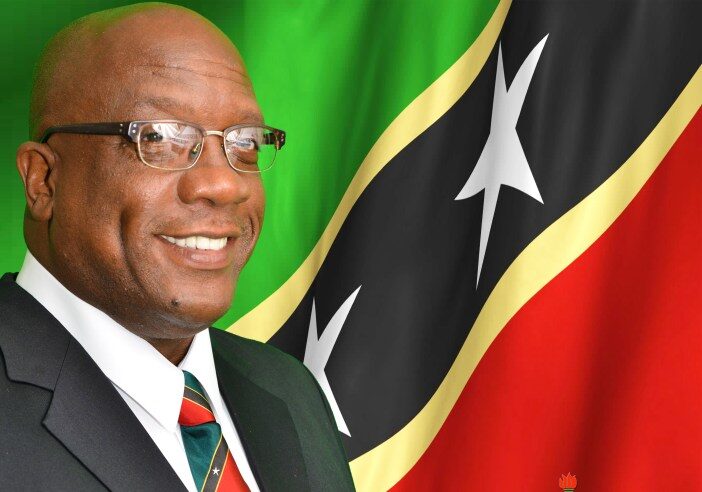
UNITED NATIONS, Sep. 25, CMC – Stating that the past 18 months have challenged everyone, St. Kitts and Nevis Prime Minister Dr. Timothy Harris says the battle against the COVID-19 pandemic is still very far from being over.
“The battle against COVID-19 is not yet won, and its devastating impact on our societies and economies continues,” said Dr. Harris is addressing the 76th Session of the United Nations General Assembly on Friday. “We believe strongly that no one is safe until everyone is safe, that requires equitable access to vaccines and other medical products and technologies.”
 The prime minister commended the international community for its response to calls for vaccine equity, stating that he was pleased that St. Kitts and Nevis is just one of the many countries that have benefitted from the COVAX facility established by the World Health Organization (WHO) at the start of the pandemic.
“I also wish to thank our bilateral partners for their generosity in providing us with vaccines,” he said, adding that 66 percent of the adult population in St. Kitts and Nevis is fully vaccinated and over 75 percent of the target population has received the first dose.
“We are endeavoring to improve these statistics in the near future,” Dr. Harris said. “Our citizens responded selflessly to our calls for social distancing and adhered to other COVID-19 protocols, playing an active role in curbing the COVID-19 pandemic and helping to overcome community spread.”
He said healthy lifestyles remain a central element in the twin-island federation’s fight against COVID-19, particularly as it continues to prioritize the delivery of health care to people living with non-communicable diseases who, given their higher risk, are most vulnerable to the disease.
“The need to continue investing in a resilient health system and comprehensive public health services is paramount,” the St. Kitts and Nevis prime minister said. “Mental health and wellbeing are also vital, which is why we delivered a comprehensive mental health plan to provide psychosocial support through the National Counselling Center.”
He lamented that the economic impact of the pandemic will be felt for years to come.
“When it began, tourism our biggest economic driver ground to a halt, causing significant unemployment and underemployment,” Harris said. “Businesses suffered as a result of lockdowns. We took action, providing social protection programs for those in need. We implemented an EC $120 million COVID-19 stimulus package, reduced corporate income tax for employers who retained 75 percent of their workforce, and introduced VAT and import duty waivers for pandemic related products.
“The impact of COVID-19 on development more widely, in particular the 2030 Sustainable Development Goals, has also been significant,” he added. “But instead of walking away from them, we need to work, collectively, even harder to achieve them.”
The St. Kitts and Nevis Prime Minister said climate change and climate-related events continue to threaten the existence of Small Island Development States (SIDS) such as his.
“As the climate crisis intensifies, we witness the erosion of coasts owing to rising sea levels; fisherfolk struggling to maintain their livelihoods from waning oceanic diversity; families forced to relocate away from coastal areas due to the strength, intensity and relentlessness of each passing hurricane season,” he said.
Dr. Harris said the UN’s Sustainable Development Goals 13, 14 and 15 are of particular significance “as they require us, among other things, to improve education and awareness of – as well as human and institutional capacity on – climate change mitigation, adaptation, impact reduction and early warning.”
He said a less negative outcome of the pandemic has been its effect in “turbo-charging the digitization of our workplaces and societies.”
But he said not all countries – particularly SIDS – have the infrastructure, capacity and workforce skills to fully benefit from this revolution.
“Rebuilding sustainably requires us to re-evaluate digital accessibility, affordability and technical assistance, so that every country, regardless of income level or geographic location, can exploit the digital economy in one properly networked world,” Harris said.
He said another barrier to development is the criteria employed to determine aid and financial support.
The St. Kitts and Nevis leader said the singular benchmark for measuring development – gross domestic product (GDP) per capita – is critical.
“But sadly, due to bias and the omission of factors, is simplistic and flawed,” he said. “For St. Kitts and Nevis, it ignores vulnerabilities and prevents us from accessing critical development assistance.”
Harris suggested that a set of more adequate and relevant measures – encompassing social, environmental/climate-related and economic factors – should be used to regulate entitlements.
He said the use of a Multidimensional Vulnerability Index, for example, would be “a far better judge of development than simply GDP per capita.”
In addition, the prime minister said the protection of life from violent crime is also of fundamental importance, stating that discussions surrounding Small Arms and Light Weapons “remain critical to our democracy.
“Our position remains that the uncontrolled proliferation of the illicit trade of Small Arms and Light Weapons has significant impacts on the health and well-being, socio-economic development, human rights and human development of every citizen in the world,” he said.
Dr. Harris said the new challenges faced as a result of technological developments must also be “taken into consideration and confronted.
“We will also continue to lend our voice and support to the work of the United Nations with a view to bringing about an end to the misery caused by these weapons,” he said.
Harris said St. Kitts and Nevis prides itself on continuing to build strong alliances and increasingly expand its international footprint.
He said his country’s diplomatic ties are founded on mutual respect for and adherence to the United Nations Charter, the rule of international law and on the appreciation of the value of human life and dignity.
For this reason, he called for the lifting of the economic, commercial, and financial embargo against Cuba and “the incalculable damage it causes.”
Harris noted that, during the last four years, the blockade against Cuba has been reinforced with more than 240 “coercive economic actions and measures, reaching unprecedented levels of hostility.”
The prime minister said the Government and people of Cuba have contributed much to the federation, the Caribbean and the world, “especially during these unprecedented times.”
“One can only imagine the potential of their contribution to the international community were the embargo lifted,” said Dr. Harris, also renewing his call for Taiwan’s inclusion in the international community.
“We strongly believe Taiwan has an important and continuing role to play in international development strategies given their great success in many areas,” he added. “Taiwan has demonstrated that it can be a true partner in health, and we have seen its exemplary response to the pandemic firsthand in St. Kitts and Nevis and other parts of the world.
“My country looks forward to Taiwan being included in the UN system and its meetings, mechanisms and activities.,” the prime minister continued.
Stating that untold suffering and evil were inflicted on millions of men, women and children of African descent as a result of the transatlantic slave trade, colonialism, apartheid and “many of the other ills of our history and other crimes against humanity” Harris welcomed the establishment of the Permanent Forum for People of African Descent, “which will serve as a consultation mechanism for people of African descent and other interested stakeholders, and as a platform for improving the quality of life and livelihoods of people of African descent.”
As other Caribbean Community (CARICOM) Heads of Governments did in 2013, the St. Kitts and Nevis leader reiterated “a clarion call” for reparations and reparatory justice.
“We subsequently formed the CARICOM Reparations Committee and the establishment of the 10-point plan that outlines the path to reconciliation and justice for victims of crimes against humanity and their descendants,” he said. “We hope that this meeting has invoked a renewed momentum to pursue action to right the wrongs that are still manifested today.
“We are all in this together,” Dr. Harris added. “My hope is that we will emerge from COVID-19 stronger and more united than before.”
CMC/nk/kb/2021