
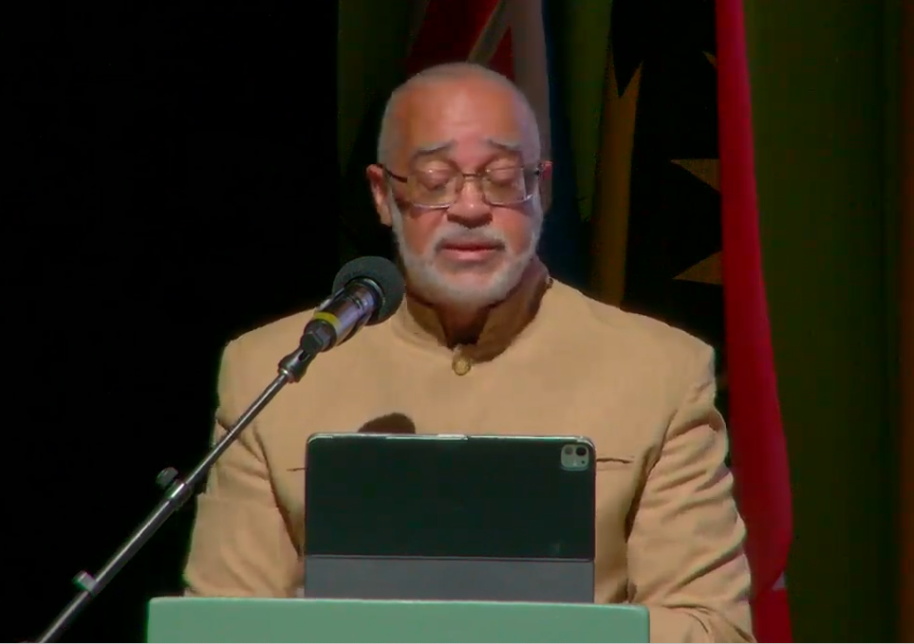
BRADES, Montserrat, Oct 27, CMC -The Director General of the Organisation of Eastern Caribbean States (OECS) Dr. Didacus Jules is urging the sub-region to rethink who sets the agenda for the health of of its people, noting that “for too long the very honest answer has been someone else.
“We have lived under a model of disparate project funding. A partner arrives with its own priorities, its own timelines and its own reporting forms,” Jules told the opening ceremony of the 39th OECS/Pools Procurement Service (PPS) Annual Policy Board meeting and 12th meeting of the Council of Ministers of Health.
The OECS groups the islands of Antigua and Barbuda, Dominica, Grenada, St. Lucia, St. Vincent and the Grenadines, St. Kitts and Nevis, Montserrat, Anguilla and the British Virgin Islands.
Jules told the ceremonial opening on Monday night that was attended by Governor of Montserrat: Harriet Cross, Premier Reuben T. Meade and the outgoing chairman of the Council of Ministers, Philip Telesford of Grenada, that when the foreign partners arrive “we get a project on this disease, another on that system and a third on some other gap.
“Each comes with its own consultants and its own steering committee. Our small ministries spend precious hours servicing the people of partners when they should be serving patients. Then the funding cycle ends, the consultants leave, the equipment has no maintenance budget, the staff we trained are recruited away and the problem that the project was meant to solve is still there waiting for the next proposal.”
Jules told the ceremony that short-term project money tastes nice on signing day and that the “bitterness comes later when we discover that we have built an archipelago of projects, islands of activity that never connect into a system.
“The model, that model cannot carry us through what is coming and what is almost here. The OECS must set its own agenda. Our partners remain welcome and we value them deeply but from now on we must invite them to our table to support our plan, build on our priorities, measured by results in the lives of our people.
“What does setting our own agenda mean in practise? It means moving from scattered projects to one converged regional health and social programme, multi-dimensional, integrated and focused directly on improving people’s lives.”
Jules said that the sub-region must think of it as the difference between a house plan and a pile of bricks where “today partners deliver bricks of every shape and size and we try to make a house with whatever arrives.
“Tomorrow we draw the plan ourselves and every partner knows exactly which room their contribution builds,” Jules said, adding that this year, the St. Lucia-based OECS Commission began what “we call the pivot, a deliberate change in how the Commission itself thinks and works and its principles apply with full force to health”.
He said that the first principle is convergence over silos and that health cannot be fixed by the health ministry alone.
Jules said diabetes is also an agriculture question and a school feeding question.
“Disease surveillance is also a tourism question. A hospital that floods is also a climate question. Our programme will join these pieces deliberately, not by accident.
“The one health approach which links human, animal and environmental health is exactly this thinking at work. Second, region first, before we sign on any initiative we will ask one plain simple question. Does this advance a priority that the member states set together? “
Jules said that if the answer is yes, “we welcome it with open arms. If the answer is no, we will have the confidence to say thank you, but not now.”
He said that during the third lasting value, the OECS will ask a second question.
“What does this leave behind that we own? A trained and retained workforce, a functioning data system, an institution, a budget line. If the answer is nothing, then it is not development, it is simply a visit.”
Jules said that the fourth issue is one of pooled capacity.
“The Commission exists to be the shared capacity that no single member state can build alone. One team, one platform, one negotiating voice. When we buy together as we do with the PPS, when we plan together and negotiate together, a small region gains the strength of a large one.”
He said anothet issue is the fact that the sub-region is measured by people, not by paperwork.
“The test of this programme will not be how many reports we file or workshops that we hold. It will be shorter waiting times, a diabetic mother who keeps her foot, a child whose eyesight is checked in time, a family who does not go bankrupt because of a cancer diagnosis.
“That is the programmatic agenda .Partners fund parts of a whole that they help to strengthen but do not dictate. That is what strategic partnership in the spirit of Sustainable Development Goal 17 actually means.”
Jules told the conference that some may say that this is ambition without evidence, “but I say look at what we have already done.”
He said that this year, the OECS Pharmaceutical Procurement Service celebrates 40 years “buying medicines together at prices none of us could get alone and having done so on a self-financing model, not dependent on any donor cycle owned and sustained by us.
“If anyone doubts that the OECS can set and run its own agenda, the PPS is the answer.It is a template for everything that I am describing tonight. We have strengthened quality assurance through accredited testing so that the medicine in the bottle is the medicine on the label.”
Jules said the Commission continues to update its harmonised essential medicines list and essential diagnostics list so that every member state works from the same standard.
Jules said that the sub-region has increased its cooperation with the French sister states in Martinique and Guadeloupe, opening pathways to specialised diagnostics, cancer care, including cyclotron access, and referral services that none of the OECS can sustain alone.
He gave credit to Premier Mead for “opening that doorway for Montserrat and other territories in the northern OECS with the French territories.
“Each of these is a partnership on our terms, serving our priorities.That is the model we must now make the rule and not the exception. The agenda for the next few days is built around that converge programme.
“We will consider the OECS child policy, which brings health, education, social protection and justice together around the child.We will look at investment in climate resilient health facilities, at adolescent and community health, and at preserving the eyesight of our people. “
Jules said that the OECS would continue to work with its international partners as well as examine shared regional services in cancer care and paediatric care, “because no island should have to build alone what all of us can share.
“We will look ahead to genomics and precision diagnostics so that our region is not left behind by the next revolution in medicine. We will test our emergency preparedness and readiness for acute care.”
Jules said that the ministers at their caucus will focus on three urgent matters,namely foot care for people living with diabetes, emergency medicine and streamlining the many separate cancer controlinitiatives into one coherent regional effort and “we have too many projects and not enough programme.
“To make this week count, I want to suggest four imperatives before us. One, that we leave Montserrat with a binding consensus. Not another communiqué that gathers dust, but clear decisions on health and medicines that every Member State owns and acts on.
“Secondly, protect what we have pooled.The PPS has lasted 40 years because Member States have kept their commitments. Its future depends on each of us continuing to pay on time and buy together. Buy together, not separately.A pooled mechanism is only as strong as the weakest commitment to it.
Third, finance preparedness, not just emergencies. We cannot keep scrambling for money after the disaster has struck.Public health infrastructure and climate resilient facilities need dedicated, sustained lines in our national budgets. That is what owning our agenda looks like in a budget speech.
“Fourth, own our health data.We need standard ways of collecting health information and agreements to share it across our borders so that decisions are made on real-time regional evidence. Data about our people should be collected by us, governed by us, and used by us.
“Without our own data, someone else will always define our problems and someone else will set our agenda,”Jules warned.
CMC/lk/ir/2026