
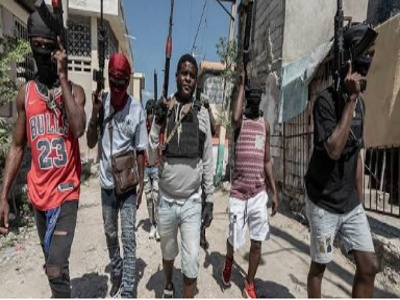
UNITED NATIONS, Sept 30, CMC – United Nations Secretary General, Antonio Guterres, Wednesday condemned the latest mass killing incident in Haiti that left at least 11 people dead and several others injured in the Gros-Morne’s third communal section on Monday.
Among those killed were four members of the same family who were transporting a sick woman to hospital when they were caught in violent crossfire. Three suspected members of the Kokorat San Ras armed gang were fatally wounded.
The interim Mayor, Hubert Cénéac, said the killings followed a confrontation between the Kokorat San Ras gang and a Sri Lankan contingent of the Gang Suppression Force (GSF) in the nearby Savane Longue communal section.
He said security forces raided the area to clear a stretch of the national road linking the Northwest and Artibonite departments, where the armed group had set up a checkpoint to extort drivers and passengers.
On Monday, the United Nations Security Council voted to extend the mandate of the 5,500 strong GSF by a number six months as Haiti prepares for elections in December.
“I can tell you that the Secretary-General condemns the reported gang attack on Monday in Gros-Morne, which is one of the communes in that department, which reportedly left at least 11 people dead,” said Stéphane Dujarric, the spokesman for the Secretary-General..
“This horrific attack is another reminder of the heavy toll that gang violence continues to take on Haitians living in areas under the control or just under the influence of armed gangs,” he said, adding “it also underscores the urgency of strengthening security efforts in Haiti”.
Dujarric said this includes the full deployment of the GSF “which is there in Haiti in support of the Haitian National Police, as well as we need to improve the broader efforts to address the drivers of violence and instability that we have seen in Haiti.
“According to our colleagues at the Human Rights Office, more than 3,000 human beings were killed in Haiti between January and June of this year,” Dujarric said, adding “we and our partners continue to provide food, healthcare, psychosocial support, and emergency cash assistance.
“However, humanitarian needs continue to outpace available resources. As you can imagine, more funding is needed.”
Meanwhile, Haiti’s Catholic Bishops have in a statement said that the French-speaking Caribbean Community (CARICOM) country’s “descent into hell causes us increasing alarm every day.
“The general situation is deteriorating before our horrified eyes: on one hand, the alarming advance of armed groups occupying our neighborhoods and the surge in kidnappings—which traumatize our families and disrupt the functioning of schools and universities; and on the other, the spectacle of failing governance, unable to restore public peace or protect the population.”
The Bishops say that Haiti is “facing profound confusion, a glaring lack of leadership, and an absence of long-term vision.
“The population has been left to fend for itself. The horrific Kenscoff massacre remains fresh in everyone’s minds, and the blood of the victims cries out to heaven for justice,” they said.
A brutal gang attack on the farming community of Kenscoff on August 23–24, 2026, left at least 47 to over 164 people dead and dozens kidnapped according to the authorities.
The Catholic Bishops said amidst this bleak picture, they questioned whether the gradual arrival of the GSF offer concrete help to the country.
“Will the Haitian National Police and the Haitian Armed Forces truly be able to regain control of the cities and neighborhoods abandoned to armed gangs ? Will the promises so often reiterated by the international community finally be fully kept?”
“However, we must acknowledge and commend the significant efforts of these public security forces, whose members sometimes pay the ultimate price with their lives. Their commitment on the ground has undoubtedly helped avert the worst.”
The Catholic Bishops say they view “with deep concern the evolution of the national situation, marked by the growing grip of violence on the country’s life and its decisive influence on the political landscape.
“In these disastrous circumstances, the future remains fraught with uncertainty as an election—itself uncertain—approaches,” they said, adding that “we must ask ourselves in all honesty : in what context and under what conditions will these elections be held ?
“Will they be truly inclusive, impartial, and transparent ? What security guarantees are being offered to ordinary citizens so that they may exercise their civic rights without risking their lives ?
They said amidst this political impasse, “the Church cannot approve the formation of narrow ruling groups which usurp the power of the State for individual interests or ideological ends” adding “a return to constitutional order through the ballot box is an absolute necessity. The free choice of our leaders is a pillar of democracy.
“Indeed, politics must once again become what it is by vocation : a noble form of charity in the service of the common good. Without a peaceful environment, without the neutrality of state institutions, and without a sincere consensus, the election risks spawning new crises rather than bringing the desired stability.
“It is not enough simply to call for elections; the conditions that give them their full democratic value must also be created. The safety of the citizen takes precedence over the voting process itself. No one should be forced to choose between exercising their civic rights and protecting their life.”
The Bishops say this is “why we call for a firm, shared commitment from State authorities, political forces, civil society, economic actors, and international partners to assume specific obligations.
“The goal is to protect the population, address the humanitarian emergency, restore State authority, and create the conditions for credible elections,” they said, adding “it is urgent to move beyond petty factional squabbles, narrow self-interest, and fruitless hatred.
“Let us join hands, reconcile, and save Haiti, our shared homeland. Our Nation must relearn the art of dialogue and mutual forgiveness rooted in justice and truth,” the Catholic Bishops added.
CMC/has/ir/2026