
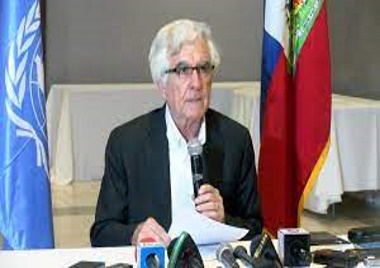
PORT AU PRINCE, Haiti, Sept 19, CMC – The United Nations expert on human rights in Haiti, William O’Neill, says he is “ extremely alarmed” at the decision of the Dominican Republic to completely close the land, air and sea borders with Haiti last Friday as the two countries that make up the Caribbean island of Hispaniola continue to be at odds over the construction of an irrigation canal in Haiti.
“I urge the government to reconsider its decision which will have serious impacts on people on both sides of the border. I further urge both governments to return to the negotiating table and follow the process outlined by the Joint Declaration of 27 May 2021 to reach a peaceful resolution of this dispute,” O’Neill said.
He said that on the Haitian side, the impact will be even more dire.
“Due to the insecurity and gang violence in Haiti, many essential products like food, medical equipment and medicines are imported from the Dominican Republic,” he said, noting that
Haiti receives at least 25 per cent of its food from the Dominican Republic.
“Many schools in the border area purchase the food they use to provide lunch to their students. Access to water will also be further hindered. I urge the Dominican Republic to allow the delivery of all forms of humanitarian assistance and essential goods to Haiti to avoid further exacerbating an already grave crisis that especially endangers the most vulnerable, including children and the elderly.”
But the Dominica Republic Ministry of Foreign Affairs said the Spanish-speaking Caribbean country “categorically reject O’Neill’s biased and unfortunate statements.
“First of all, we reaffirm that any dialogue with Haiti is conditional on the effective cessation of the unilateral and illegal construction of the canal on the Dajabón River. The joint declaration of May 27, 2021 to which Mr. O’Neill refers was based on this condition,” it said.
It said also that it had taken note of the request to allow the delivery of humanitarian aid to Haiti, “but reiterates that the immediate and definitive solution to this problem is in the hands of Haiti, when it decides to end construction of the canal.
On Sunday, President Luis Abinader defended his decision, saying that the border closure will continue until the construction of the canal is suspended.
Water from the canal comes from the Massacre River which flows between the two countries.
“We neither wish nor seek confrontation, but we are faced with uncontrollable people who maintain insecurity in Haiti and who, because of their private interests, are now also conspiring against the stability of their government and the security of our resources in water,” he said, adding ‘this is not a conflict between two peoples, because neither the Dominican people nor the Haitian people want confrontation”.
Last weekend, Haiti said that as a sovereign nation it will decide on the “exploitation of its natural resources.
“The Republic of Haiti will always favour dialogue; dialogue which was underway and on a good track between the Haitian delegation, duly mandated, with their Dominican counterparts of the Binational Commission, at the Dominican Chancellery, in the Dominican Republic, when the announcement of the Dominican President to close its borders was made,” the government said in a statement.
Port au Prince said, it has, like the Dominican Republic, with which it shares the Massacre River, “the full right to take catches there, in accordance with the 1929 agreement.
O’Neil said he was urging both countries to share all relevant information on the water table, hydrological studies, environmental impacts and other information outlined in the May 2021 Joint Statement to achieve a peaceful and quick end to this crisis.
“If such an agreement cannot be reached, I encourage both parties to agree to an international arbitration to resolve their differences,” he added.
But the Dominican Ministry of Foreign Affairs said it is important to clarify that it is premature to speak of international arbitration “when there is no conflict between two governments, since the crisis was generated by Haitian private actors”.
It said the security crisis in is also affecting the ability of the Haitian government to enforce the rule of law.
CMC/ag/ir/2023