
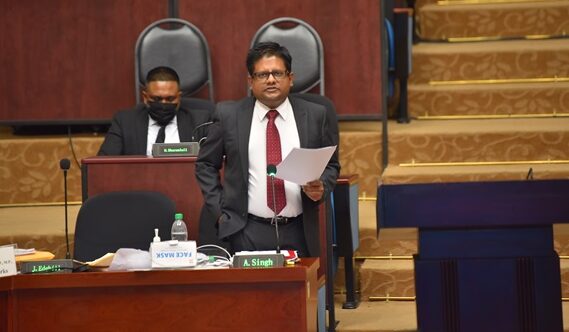
GEORGETOWN, Guyana, Dec 30, CMC – Government has insisted that the controversial amendments to the Natural Resources Fund Bill were lawfully passed, as the opposition A Partnership for National Unity and Alliance for Change (APNU+AFC) charged that the Bill was null and void because no legal vote was taken.
The Opposition had called on the People’s Progressive Party (PPC) government to postpone debate on the legislation to replace the Natural Resources Fund Act of 2019. The administration said the amended legislation paved the way to significantly improve management of Guyana’s oil revenues to ensure greater transparency and accountability, but the Opposition registered objection to the reduction of an oversight committee from 22 to nine, the inclusion of a Board to manage the Natural Resources Fund to be appointed by the President, and the formula being used to determine how oil revenues will be saved and spent.
However, the Bill was passed on Wednesday without debate, during a chaotic session that saw APNU+AFC coalition legislators chanting, banging on the tables, blowing whistles and even attempting to take the Speaker’s Mace – which represents the authority of Parliament – from its place.
In a statement issued late Wednesday, the APNU+AFC said the Bill “was not legally passed” since the Mace which must be present throughout the sitting of the Assembly when a law is to be passed, was not there, and all Government MPs were not seated as required by the Standing Orders to vote.
“The Standing Orders state that a Member of the Assembly must be in his or her seat to vote in the National Assembly. Most of the Government MPs were out of their seats, especially the Prime Minister who was on his feet waving. It is therefore clear that there was no legal vote,” the Opposition charged.
“Clearly all of the aforementioned circumstances rendered the passage of the Bill null and void. Yet, the PPP in its quest to denude the NRF Act of 2019 so that it can pillage and plunder the Natural Resource Fund, went ahead and purported to have repealed the 2019 Act. The Act was not repealed.
“What is alarming, is that the Speaker who should know better was complicit in this gross violation of the Standing Orders, Principles and Conventions associated with the good conduct of Parliamentary affairs.
“The APNU+AFC wishes to inform the Guyanese people that the prevailing law continues to be the Natural Resource Fund Act of 2019 because no legal vote was taken,” it added.
However, in a statement issued on Thursday morning, the government insisted all proper procedure had been followed and the Bill was passed despite the Opposition’s “despicable and reprehensible behaviour” to block its passage.
“It must be noted at the time when the vote was called every Member of the Government side of the house was seated and voted for its passage. The mace was also in place at the time when the question was put to the house and the vote taken,” it said.
“The APNU+AFC coalition and the rest of the opposition Members of Parliament should examine the video footage and other recordings of the events in the National Assembly that prove that the Natural Resources Fund Bill was lawfully passed and is now binding and legal.”
The PPP government had said the previous Natural Resources Fund Bill was illegitimately passed by the then APNU+AFC government on January 3, 2019 after a no-confidence motion was passed in Parliament against it on December 21, 2018.
“The 2019 Act stands successfully repealed at the moment and has been replaced by this hallmark piece of legislation which will ensure the security, transparency and accountability that Guyanese need in order to benefit from the oil and gas revenues. The Bill provides for a governance structure of how these monies will be used with continuous public disclosures, audits and Parliamentary approvals,” the government statement said.
It further condemned the APNU+AFC coalition Parliamentarians’ “lawlessness and defilement of the National Assembly, the Speaker, the Clerk and staff never seen before” and urged the Speaker to do what is necessary to avoid a recurrence.
CMC/ed/2021