

GEORGETOWN, Guyana, Nov 4, CMC – Cabinet has granted approval for the auctioning of 14 oil blocks offshore Guyana, Vice President Dr Bharrat Jagdeo announced on Thursday.
The auction was initially slated for the end of September, however, the vice president noted that extensive preparatory work had to be completed. Government hired IHS Market as the lead consultant for this process.
The Ministry of Natural Resources will issue a new date for the auction in due course and Jagdeo assured that prospective bidders will be provided with the terms of the auction “long before” it is formally launched.
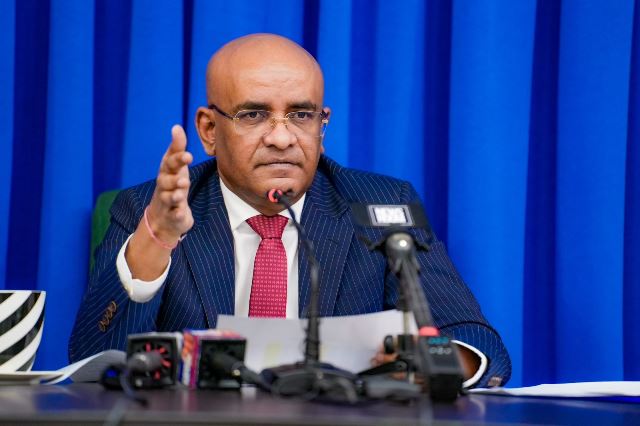
He explained that the government had decided to auction 14 blocks ranging from 1,000 to 3,000 square kilometres each, with the majority measuring closer to 2,000 square kilometres. Eleven of these blocks will be located in the shallow area, while the other three will be in the deep-sea area.
The vice president said the new fiscal regime will not only govern the award of the contracts with the successful bidders but also subsequent Public Sharing Agreements (PSAs) for any other exploration that is already taking place in other areas including Kaieteur.
“So, the 50/50 profit sharing will be retained…. The royalty rate will go to 10 per cent. There shall be a corporate tax of 10 per cent. The maximum for any given year going to cost oil will be 65 per cent. These are the key fiscal conditions,” he said.
“We have the consultants working to strengthen the PSA to be ready before the auction is concluded because we have to strengthen the PSA in many areas. The PSA will be amended to reflect these new fiscal terms.”
Jagdeo said the overall PSA will be strengthened and the laws of the country will also be amended to reflect, where necessary, these amendments.
“For example, the Petroleum Act, if there is anything inconsistent in the Petroleum Act, with what I just mentioned, that will be amended,” he clarified.
Jagdeo said one of the main objectives of the new fiscal regime is to ensure a greater profit share for Guyana. The other aim is to ensure that the country remains globally competitive in the context of net zero.
“We looked at the spectrum of countries and total government take, starting with those that have very small take and those that have major ones. We opted for a simple formula with fixed royalties. Some countries have variable royalties depending on the internal rate of return on the project, etc.
“We did not go down a complex system because it’s hard to monitor those. The fixed quality also protects you against the downside when oil prices drop. See you get as if you have a variable royalty, and when oil prices drop, you lose,” he explained.
Further, Jagdeo said, IHS Market which conducted most of the simulations had assured the government that the 10 per cent royalty and the 10 per cent corporate tax will ensure that the country remains competitive.
To make the bidding process more competitive, the government has also decided to allow local and international companies to bid, with minimum technical and financial qualifications required.
CMC/ed/2022