
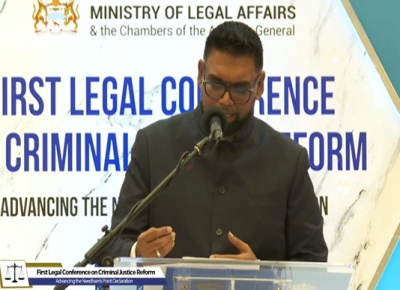
GEORGETOWN, Guyana, Jul 10, CMC – The first legal conference on criminal justice reform got underway here on Wednesday, with President Irfaan Ali warning that a “one size fits all” system is not the be it all for solving the problems facing the judicial system in the Caribbean.
“It is developing systems that are responsive to the situations under different conditions. It will be a great work if one is to do an analysis on a thinking process, the mindset between the same country men and women but living in two different areas.
“Unless the system supports this realignment then we will not be dealing with the criminal justice system in totality,” Ali told the opening of the two-day conference organised by the Guyana government, the Trinidad-based Caribbean Court of Justice (CCJ) Academy for Law and is part of the Inter-American Development Bank (IDB)-funded Support for the Criminal Justice System (SCJS) project in Guyana.
He told the regional and international delegates that “we can go and adopt all the legislation the IDB wants to recommend to us, we can bring all the best practices, but if we do not fix the ecosystem that is not only an issue for the judiciary or the dispensation of justice…it is a problem for all of us…
“Then I believe we will continue to plaster the problem and not address the foundation. The cracks would appear at different times in a different form. So it is important that a conference like this, just like the (CARICOM) heads of government, we looked at the problem and you know there was a lot of headlines on some of the comments that were made in relation to the judiciary, but it is good for debate. Watch video
“It is good for us to have these open discussions (and) that is why conference like this must go beyond the scope of what you do everyday , administer justice and point to some of these issues because you see it from a different lens…so that we can develop a holistic approach and construct an ecosystem that is relevant for this region,” Ali said.
He said in small societies like those that exist in the Caribbean, “we know everybody” noting that over the past few years he had taken photographs with almost everybody, including the good and the bad, and that these societies have different challenges.
“ Our challenges are more magnified. We have to learn to put our brain power together and we have enormous brain power in this region to design and develop solutions that meet our needs and problems.
“We can complain forever that the guns are coming in from outside our borders. All of us know that most of the guns coming in from the US,” Ali said noting that Washington had assigned a special prosecutor to deal with that situation.
“Maybe we should ask how many persons have been prosecuted. We are asked these questions from time to time because the indicators are pointing to the guns as a major cause of the problem and the root of the guns is extra regional.”
Ali said that the situation requires ‘a certain level of frankness and openness to deal with these matters and we have too”.
He said that prevailing ecosystem in the Caribbean also includes, building strong institutions, funding as well as having to deal with climate change and socio-economic situations brought on in some instances by severe storms such as Hurricane Beryl, a few days ago.
“If the institutions are not strong , if we don’t build relevant strong institutions, then we will not build for the future,” he said, noting that is why the focus must be on building institutions, urging countries that are not members of the CCJ, which has replaced the London-based Privy Council as the region’s highest and final court, to do so.
“Save and except the recent history of the US, one of the things the US prides itself of, is the strength of its institutions. Now, how do we build institutions that can withstand transition in governments.
‘We also have to change some concept. In the region, you say there is a change in government…but how do we move to an era where we can have transitions in government because that is a function of democracy…and that is an important aspect of political stability,” Ali said, no doubt hinting at the situation that confronted the country following the last regional and general elections here when the results were officially known several months later.
Ali said the challenges facing the region are magnified by single events.
“Hurricane Beryl in 45 minutes …has sent people from the middle develop class back to the poverty line. The entire fisheries sector in Barbados wiped out in 45 minutes. The beaches that are an important part of the revenue generation that is critical to rebuild, gone.
“Grenada, Jamaica, in an environment in which there is already great economic pressure our region is now faced with these difficulties. So how does the ecosystem respond and the ecosystem is not the executive, the ecosystem is everything because a problem affects the entire system.
‘If we don’t have crime, we have less load on the judges. The system works, but under these conditions there is greater likelihood of increased crime because of a new economic pressure that (Hurricane) Beryl would have brought”.
Ali said from an institutional perspective “we have to address this before it becomes a problem.
“But we are not trained historically to look at the problem from that perspective,” he said, noting also that climate challenges were also another factor for consideration in the justice reform exercise.
He said some of the most important cases in India on criminality are linked to biodiversity and climate issues.
“So this is something that you are going to have to address now and in the future, especially in a world where in the last 60 years we have lost more than 60 per cent of our biodiversity. So new environmental laws are coming on stream to protect our biodiversity,” he said.
The two-day event is being held under the theme “Legal Conference on Criminal Justice Reform- Advancing the Needham’s Point Declaration,” in the region and Ali said an examination of the Needham rulings shows it does not deal “only with the dispensation of justice.
“It deals with a system through which you can have efficiency and reliability in that dispensation and reduce costs,” Ali said urging that a step forward be taken to “examine how we can address the associated issues in relation to crime and criminality”.
The Needham’s Point Declaration covers key areas related to criminal justice reform, including policy and legislative interventions, prosecution, police representation for the accused victims’ rights and judicial interventions. The declaration emphasizes the need for swift justice for the guilty and protection of the innocent.
The Attorney General recently emphasised the importance of continuing legal education in Guyana. In this stead, and in keeping with the objective to educate, this Conference offers an opportunity for the continued discussion on best practices, experiences, and recommended actions for addressing critical issues within the criminal justice system.
The conference here will cover several topics, including but not limited to, eliminating case backlog, Criminal Procedure Rules, plea bargaining, Children’s Court experience, role and impact of Public Defender’s Office, Judge alone trials, dealing with DNA evidence in Court, Restorative Justice, the art of fact finding, sentencing guidelines and paper committals.
Download video – Guyana President Irfaan Ali
CMC/gt/ir/2024