
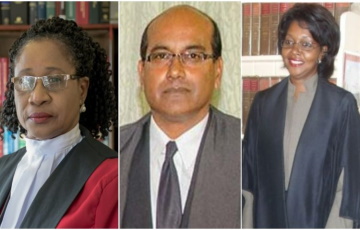
GEORGETOWN, Guyana, Dec 22, CMC – Attorney General and Minister of Legal Affairs, Anil Nandlall, says the ruling People’s Progressive Party/CIVC (PPP/C) is “convinced” that two of the Court of Appeal judges “erred” when they ruled in favour of the Court having the jurisdiction, or power, to hear an appeal filed against a January decision of acting Chief Justice, Roxane George to throw out an election petition.
Nandlall did not call for or support the public position taken by Local Government Minister, Nigel Dharamlall that the two judges, Justices Yonette Cummings-Edwards and Dawn Gregory, who supported the appeal, should be removed.
Justice Rishi Persaud was the dissenting judge in the 2-1 majority ruling handed down on Tuesday.
Nandlall, speaking on a PPP social media platform said Justices Gregory and Cummings “erred and we’re convinced that the Guyana Court of Appeal has no jurisdiction to hear or determine the appeal that is before it.”.
He said that “those are the same two judges who have ruled in this way today” and that a series of election-related cases had caused “many things” to become clear and had led the public to conclude that the principles related to election laws were “peculiar” and “special.
“That is what is shocking about this Court’s ruling today because the Court, the two judges, who ruled in the way that they did resort to ordinary principles of law and they eked out a jurisdiction that in my humble and respectful view election jurisprudence says does not exist,” he said.
Nandlall said that the judges “violated those fundamental tenets and canons” although the Constitution and the law did not give the Guyana Court of Appeal jurisdiction.
But he made it clear, no one enjoys the luxury of suggesting that the judges acted improperly.
“The judiciary is not immune from criticism without fear of being cited for contempt. The judiciary is to suffer the scrutiny of the ordinary man and sometimes outspoken criticism of the ordinary man. However, one can’t attribute an improper or an illicit motive to the judiciary for a particular decision,” said Nandlall, warning against scandalising the court or disrespecting he judges.
Following the Court of Appeal ruling, Dharamlall took to his Facebook platform calling for the removal of the two judges.
“Same two judges who ruled that 33 is not the majority of 65. Their bias is obvious. They should be defrocked,” he said.
However, opposition parliamentarian Annette Ferguson said Dharamlall’s comments were disrespectful of the separation of powers between the executive and judiciary.
“I condemn Mr. Dharamlall’s vile attack on the Justices and therefore call on Mr. Dharamlall to publicly offer an apology to both Justices Cummings and Barnes (Gregory),” she said.
Ferguson who was last weekend elected to serve on the 15-member Central Executive Committee of the main opposition People’s National Congress Reform (PNCR), said Dharamlall was “disrespectful and out of order” and that Justices of Appeal Cummings and Gregory would not buckle uder pressure. “He should also be reminded that the Justices are professional and law abiding Officers of the Judiciary and should not be subjected to political pressure and ridicule,” Ferguson said.
The Court of Appeal in its majority 2-1 decision ruled that it has the jurisdiction, or power, to hear an appeal filed against the decision of the acting Chief Justice Roxane George to throw out an elections petition brought by Monica Thomas and Brenan Nurse.
But the Court agreed to “stay” or put a hold on its decision for two weeks so the respondents can determine whether they will go to the Trinidad-based Caribbean Court of Justice (CCJ) for final determination or if they will allow the appeal to go ahead.
In January, Justice George threw out the petition of Thomas and Nurse on procedural grounds, indicating that the petition had been served late on former president David Granger, Representative of the List for A Partnership for National Unity+ Alliance For Change (APNU+AFC).
Lawyers representing Thomas and Nurse had argued that the March 2, 2020 elections were unlawfully conducted due to unlawful acts or omissions such as discrepancies and irregularities and asked the Court to determine that President Irfaan Ali was illegally sworn into office.
But the Chief Justice had dismissed the case because she said that from the time the petition was served out of time on Granger it was a “non-starter.”
In his minority ruling, Justice Persaud felt the crux of the matter lay in the consideration of Article 163 (3) of the Constitution within the context of electoral laws and schemes.
Article 163 (3) states that an appeal to the Court of Appeal can be made “from the decision of a Judge of the High Court granting or refusing leave to institute proceedings for the determination of any question.”
Justice Persaud said the language of the article is crystal clear and is unable to attract ambiguity.
But Justice Cummings-Edwards, the acting Chancellor of the Judiciary, disagreed. She felt that the Chief Justice sat in an elections court and considered the validity of the petition in relation to whether it could go on.
She felt that the ruling of the Chief Justice was not simply on the procedural issue itself but on the petition as a whole and hence she said the ruling was a final one on the actual petition. Therefore, she determined that the Court of Appeal has jurisdiction to entertain the appeal.
CMC/gt/ir/2021