
GEORGETOWN, Guyana, May 20, CMC – The Guyana government Friday said that a study undertaken by the United Nations Food and Agriculture Organisation (FAO) has found that climate change instead of oil exploration is the major reason for a reduction in fish catch in the country.
Agriculture Minister Zulfikar Mustapha, speaking on News-Talk Radio Guyana 103.1 FM, said that “during that period that we had the low catches, it’s referring to same form of problem we had with climate change and we had heavy rainfall.
“The fresh water would have driven the fish off these normal fishing ground,” he said, citing the FAO study as one of the benefits of Guyana’s membership of the international body.
He said the evidence showed that there is increased fish supply again and that the yet to be released study has not found that oil exploration and production had been among the reasons advanced for the decline in fish catch.
“Nothing has been mentioned about that. I want to be very frank and you can confirm that with FAO too,” he said.
Local fisherfolk had complained about a dramatic reduction in fish catch and had claimed that the oil industry pollution and noise had been chasing away marine species from offshore Guyana.
But Mustapha told radio listeners that fish processors here have been reporting an upswing in catch. “We are seeing a trend that things are starting to increase,” he added.
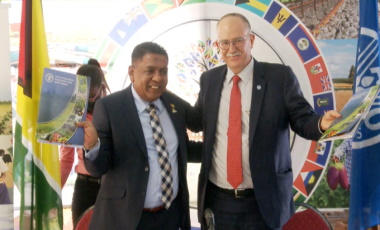
Speaking later at the signing of two agreements for the FAO-Guyana 2022-2026 Country Programme, he said follow-up work on the draft report on fishing is being undertaken.
“When we sign these agreements, we prioritise what is important for us as a government and as a ministry and that is what we ask FAO to collaborate with us, as a government to help us implement,” he said.
The thematic areas of the FAO-Guyana 2022-2026 Country Programme are transformation to more sustainable agricultural food systems, resilient value chains and agriculture communities with enhanced disaster risk management capacity, increased use of digitization and Information Communications Technology(ICT) to enhance efficiency and competitiveness and de-risking the agriculture food system.
The second agreement is a Memorandum of Responsibilities signed between FAO Assistant Director General, Julio Berdegué and the Minister of Foreign Affairs and International Cooperation, Hugh Todd. This agreement is in relation to Guyana’s hosting of the 38th Regional Conference for Latin America and the Caribbean in 2024.
Berdegué told the signing ceremony that Guyana is the place to be these days, adding “no other country in the Americas is conducting a transformation of its food systems to the extent or dynamism and [with the] level of political support that I have seen here in Guyana”.
He said that the FAO has been “working in this country for many, many years.
“We will continue to be here as long as the government and the people of Guyana believe we have something to offer to this country.”
CMC/gt/ir/2022