
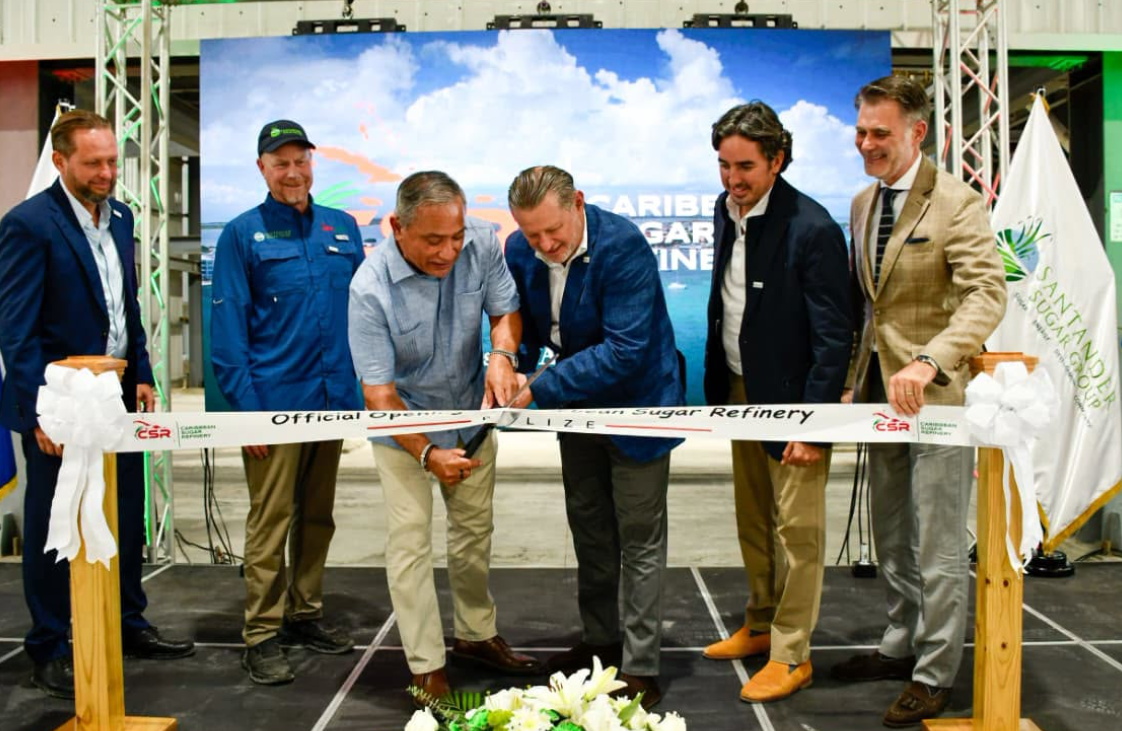
BELMOPAN, Belize, Nov 23, CMC – Belize has officially inaugurated the Caribbean’s first sugar refinery with the Belize Sugar Industries (BSI) says it it plans to invest BDZ$50 million (One Belize dollar=US$0.49 cents) over the next three to four years to increase production by 25 per cent.
The refinery at the Santander Sugar Complex in Valley of Peace, Cayo District, is a joint venture between Santander Sugar Group and Sucro Limited and represents an important investment in expanding value-added sugar production in Belize and strengthening the country’s capacity to supply refined sugar to the Caribbean Community (CARICOM) markets.
Prime Minister John Briceño said that the arrangement could improve returns by allowing raw sugar to be processed into a higher-value product before it reaches regional markets.
“By doing that, we are not exporting raw sugar; we are exporting a product that has higher value,” Briceño said, noting that the arrangement would also reduce shipping costs associated with transporting raw sugar, with revenues shared after marketing and other expenses are deducted.
A government statement said that the opening the refinery reflects its continued commitment to fostering private-sector partnerships, adding value to productive industries, and building a stronger, more resilient economy.
The newly commissioned Caribbean Sugar Refinery (CSR) is expected to supply refined sugar to manufacturers across the Caribbean, including soft drink bottlers, bakeries and snack producers.
The investments come as the Sugar Association of the Caribbean (SAC) reported last week that regional production capacity has surpassed 300,000 tonnes.
The SAC, which held its board of directors meeting in Barbados last week, described the development as a major step towards regional self-sufficiency, noting that Caribbean producers recorded 241,500 metric tonnes during the 2025–2026 crop and are estimating production of more than 330,000 tonnes for the 2026–2027 season.
“Through tens of millions of dollars in private sector modernization and strategic alignment across our member states, we are proving that the Caribbean can feed and supply itself, provided we back these investments with full adherence to our regional trade mechanisms,” said SAC chairman and BSI executive, Mac McLachlan.
Mac McLachlan also announced that the SAC had move from Trinidad and Tobago, where the organization had been based for nearly a century, to Barbados, placing leadership closer to the West Indies Central Sugar Cane Breeding Station
The meeting reaffirmed the chairmanship, discussed the CARICOM Monitoring Mechanism for Sugar, and noted ongoing investments in production, quality, and green energy across member states.
CMC/ah/ir/2026