
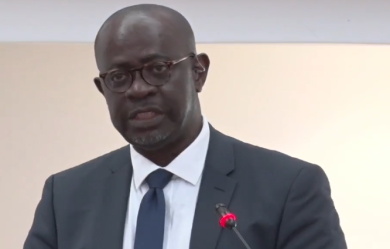
ST. GEORGE’S, Grenada, Sept 8, CMC -The Grenada Parliament was told on Tuesday that the Dickon Mitchell government was right when it terminated several agreements including a production sharing agreement (PSA) with the Russian-backed Global Petroleum Group (GPG) earlier this year after the company had failed to meet several of the targets that had been agreed upon.
Chairman of the Hydrocarbons Technical Working Group (HTWG), Nazim Burke, a former finance minister, said that the government had also decided to terminate the reservation agreement.
“By letter dated June 2, 2026 GPG responded to the notice of intention to terminate with their position being that they are not in breach of the agreements. By letter dated June 10 the government stated that it would consider GPG’s representations and invited GPG to meet on June 17 to provide GPG with another opportunity to be heard.
“Additionally the government invited GPG to email the Attorney General … by June 15 any and all other documents GPG believes supported its position and that GPG intended to refer to in the meeting that was arranged then for the 15th”.
But Burke told a joint sitting of Parliament that by email dated June 12, 2026 ” GPG stated that it would email copies of these documents that it intended to rely on and was going to refer to in the meeting.
“They said they will do so by June the 15th. The fact is no such documents were ever sent, no explanation was ever provided and the meeting on June the 15th proceeded without them providing any documents at all.”
Burke said that as required under the Grenada Petroleum and Natural Gas Deposits Act, the government thoroughly considered GPG’s position and each and every representation it made in its letter of June 2 nd and at the meeting.
He said that the government had also considered the lack of evidential support for many of the central representations made by GPG in its June 2nd letter and at the meeting and noted in particular that GPG had not taken any action to remove any of the ground determination as stated in the notice nor has GPG made any offer of adequate compensation in respect thereof.
Burke said further that GPG “had done nothing to correct any of the actions or to even give an assurance that these problems or difficulties will not occur again”.
“By letter dated July 27th 2026 the government terminated the Development Production Sharing Agreement and cancelled the development licence effective July 31st 2028”.
Burke said that as required by the Grenada Petroleum and Natural Deposits Act termination of the Development Production Sharing Agreement the Block Reservation Agreement and the cancellation of the Development Licence were published in the official Gazette on July 31st.
Burk said that the government had adopted an approach that gave GPG “every opportunity” to work with Grenada despite the many breaches to the agreement ”as government considered termination of these agreements should be a last resort.
“In the circumstances the government considers that termination of the agreement with GPG was a prudent and appropriate course of action. The Development Production Sharing Agreement provides that if GPG is aggrieved by termination of the Development Licence and the Development Production Sharing Agreement they may initiate arbitration proceedings pursuant to the rules of the International Chamber of Commerce”.
Burke said that the government is prepared to defend its actions ”if such proceedings are initiated,” noting that in anticipation of such proceedings ”the decision has been made to preserve the status quo as we currently have no intention to seek proposals from any oil operator in respect of those four blocks nor does the government intend to allow GPG to do anything on those four blocks or in relation to those four blocks.
“We have reviewed this matter very carefully and very closely with the International Council and we are prepared to defend the interests of Grenada against any claims that may be brought by the GPG,” Burke said.
Prior to delivering his 35 minute report to the joint sitting of Parliament, the leader of the Democratic People’s Movement (DPM), Peter David questioned the decision to allow “a body extant and outside of the House of Representatives “ to address legislators.
But the Speaker, Leo Cato, said that he was guided by the relevant authorities “given the fact that where Standing Orders remain silent then the practice is to look at what happens in Erskine and May.
“So we are will in order for this particular meeting and we consulted with the government on the preentation of the report today and we were told it is a highly technical report and that it is best presented by the experts,” Cato said.
The main opposition New National Party (NNP) legislators had announced since Monday that its members would be boycotting the sitting under the current arrangements.
“We understand also that several individuals with great knowledge and experience in parliamentary procedures have also advised the government and the Parliament accordingly. “We have absolutely no problem with the government updating Parliament on oil and gas exploration, but this matter must not be handled through a process that misuses Parliament and departs from proper parliamentary procedures and practises,” NNP and Opposition Leader,, Emmalin Pierre, told reporters.
The HTWG through its lead technocrat, Dr. Gibert Yevi, an internationally recognised petroleum energy, presented an update on its activities. The objectives of the group which includes experts from Trinidad and Tobago, the United States, Scotland, Australia and Spain, are to fully assess Grenada’s hydrocarbon potential and, if found to be commercially viable, devise a strategy and action plan to explore, develop and monetize such findings for the benefit of the country.
The technical group will also be required to develop a communication strategy to engage stakeholders, including communities, civil society organizations, and the private sector as well as outline recommendations for potential partners and investors, including a plan to attract and retain them.
Burke speaking after the HTWG presentation said that because of the nature of the oil and gas industry, there is significant upfront capital investments that is required and that due to the highly specialised technical nature of the work, ”Grenada needs to partner with credible, financially capable, and technically proficient oil and gas companies to develop a viable hydrocarbon industry”.
He said that work has already being done in engaging with companies such as Total and Shell and BP and Exxon, acknowledging that GPG “has had a presence here in Grenada long before the technical working group came into existence.
“That said, the mandate of the technical working group necessarily involves analysing the GPG in the same manner and by the same criteria that Grenada is doing for any potential oil and gas company wishing to operate in Grenada.
“That is to say, we have a responsibility to ensure that the GPG is credible, financially capable, and technically proficient,” he said, noting that fulfilment of that responsibility necessarily involves an analysis of the contractual arrangements that had been entered into between Grenada and the GPG as well as GPG’s performance under those arrangements and under Grenada’s laws.
“An analysis of these arrangements between GPG and Grenada can go as far back as 2003 when Grenada was involved in arbitration proceedings with Jack Reinburg of the RSM Production Corporation,” he said.
In 2008, the government provided GPG with a licence over 11 offshore blocks to explore for oil and gas and five years later, the company was granted a development licence and signed a production sharing agreement.
Burke said that an exploration licence is given to a company, which goes out, drill a well and do exploration.
“Based on what they see, they do an appraisal. If there’s a commercial find, the company must then put together a development plan of how it’s going to develop the hydrocarbon. It brings the development plan to the government.
“The government appraises it or assesses the plan for its efficiency, for its quality, and then the government issues a development licence, giving the developer the opportunity to develop the field and enter into commercial production along the way.
“So you cannot really have a development plan if you haven’t yet even dug a well because the plan really is to operationalise the discovery. In this particular instance, this did not occur with GPG.”
Burke said that on December 9, 2013, a development licence and a development production sharing agreement were granted by Grenada to the GPG over four of the previous 11 offshore blocks that they had held”.
Burke said that at that stage there had been “no drilling and no commercial discovery of any kind of oil and gas in Grenada’s waters,” detailing the problems the HTWG and the government encountered with GPG before deciding to terminate the agreements.
CMC/aj/ir/2026