
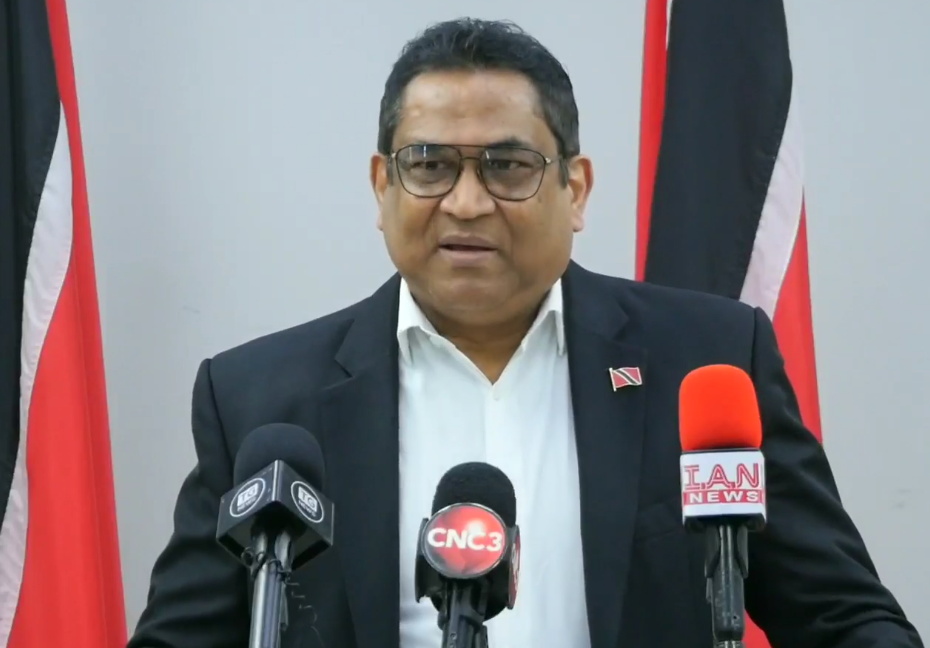
PORT OF SPAIN, Trinidad, Oct 23, CMC – Former finance minister Vishnu Dhanpaul is maintaining that the Trinidad and Tobago economy is in a recession and dismissed government’s reliance on statements issued by the International Monetary Fund (IMF) and other regional and international financial and rating agencies to dispute the “recession” debate.
Earlier, Prime Minister Kamla Persad-Bissessar, making her contribution to the ongoing TT$63.3 billion (One TT dollar=US$0.16 cents) budget debate told legislators that she was stating “very clearly, very confidently, unequivocally, to citizens who contribute to our nation, Trinidad and obago is not standing still.
“I’ll tell you why. This is not Kamlal saying it or one of my MPs saying it, listen to people. The IMF, one of the world’s most respected independent financial institutions, has projected positive economic growth for Trinidad and Tobago,” Persad-Bissessar said, insisting that the numbers are solid.
“ It is in the IMF’s May 2026, in the IMF’s May 2026, Article 4 report, the IMF projected growth of 0.8 per cent in 2026, that’s this year, the last fiscal gone by, accelerating to three per cent in 2027, and averaging approximately 3.5 per cent in 2028 and 2029.
“Where is recession in that? That is progression, that is progression. These are the projections of an internationally recognised institution. These are the figures manufactured for political convenience. This latest report…,” she said, as she responsded to Opposition Leader Pennelope Beckles’s criticism of the fiscal package.
“The Minister of Finance, either intentionally, or out of dereliction of duty, failed to present the true state of the economy. Instead, he attempted to deceive,” she said.
Dhanpaul, who served as finance minister from March to May last year, and is expected to lead the opposition’s response to the budget debate in the Senate, told a news conference that nomatter how they try to spin it “Trinidad and Tobago is in a recession”
Dhanpaul, who worked in several capacities in the public service, retiring as permanent secretary in the Ministry of Finance, said the official data shows that the oil-rich twin island republic is in recession.
“There are certain people going around stating that the IMF in its article report back in June stated that Trinidad and Tobago is expected to experience some measure of economic growth by the end of 2026.
“Now I want to clarify something to the nation and it is common knowledge in the Ministry of Finance and the Central Bank…in Trinidad and Tobago and this is very critical, the IMF is not an official source of data in Trinidad and Tobago.
“Trinidad and Tobago official statistics and national data are legally governed and compiled primarily through the Statistics Act, which establishes the Central Statistical Office as the primary national statistical agency responsible for collecting, compiling, analysing, and publishing economic and social data.”
Dhanpaul said that the CSO, operating under the Statistics Act, is legally mandated to conduct national censuses, household surveys, national accounts with the gross domestic product (GDP), and trade statistics.
He said the next official source, based on the law, is the Central Bank of Trinidad and Tobago which is authorised to publish official monetary interest rates, foreign reserves, balance of payments, and macroeconomic financial data.
He said that the Ministry of Energy and Energy Industries, responsible for official monthly and annual tracking of crude oil production, natural gas utilisation, and petrochemical metrics.
Dhanpaul said that the Ministry of Finance on fiscal data, which covers government’s revenue, public expenditure, national debt, and budget deficits, is legally governed by the Trinidad and Tobago Constitution and strict financial laws.
“The management and publication of this data are mandated primarily under the Exchequer Audit Act. So when someone comes and says, the IMF said the rate of growth will be 0.2 per cent at the end of 2026, irrelevant.
“Because the IMF is not an official source of data in Trinidad and Tobago, by law and another thing, the IMF doesn’t produce raw data in on 19th Street, Washington DC, where the IMF is located, they don’t produce raw statistics, you know.”
He said the IMF and other international and regional agencies rely on the figures supplied by the government and “so their conclusion is based on the data sent to them by the authorities in Trinidad and Tobago.
“So, there’s no way, and if, another thing, if the Minister of Finance was so sure about the IMF data, and that the IMF is seeing growth at the end of 2026, why did he produce the Review of the Economy, which by all counts …based on the law, is the official source of national income data, and based on the Review of the Economy, the country is going to contract by 2.2 per cent at the end of 2026,”
Dhanpaul said based on the officcial figues at the end of quarter four, 2025, the economy contracted by 1.2 per cent and the first quarter of 2026, two consecutive quarters, the economy contracted by 1.8 per cent.
“That is why we are faced with the Review of the Economy, which was laid in Parliament. If the government wants, they can recall the Review of the Economy, but that is what we have to work with.
“We cannot work with something that’s not in front of us. The Review of the Economy is in front of us,” he said, recalling that this is not the first time when a statement about the country going into a recession had been made in the last 15 years.
“You will recall on December 2, 2015, two weeks before Christmas, the then-Central Bank Governor, Jwala Rambarran, announced that this country is now officially in a recession,” he said soon after the then United National Congress (UNC) led People’s Partnership government lost the generalelection.
He said that the former central bank government soon after the People’s National Movement (PNM) under Dr. Keith Rowley had come to office told a monetary policy forum that continued declines in real GDP meant that the country “suffered a fourth consecutive decline, and then he said noticeable signs of recession will start to set in next year, as businesses begin to cut back on investments, consumers hold back on spending, and banks loans become fewer”.
Dhanpaul said that this current situation is a “coincidence, because if you use another official source, the Central Bank’s Economic Data Pack, September 2026, you will see that exactly what he said is coming to pass again.
“If you go to page 3 of the Central Bank’s Data Pack, you will see that credit to the private sector declined significantly from Q2 2025, from 8.6 per cent Q2 2025 to 3.5 per cent Q2 2026
“What does that mean? That means that people are just borrowing less credit to the private sector. Why are they borrowing less? It’s a confidence issue. Secondly, and I like to use this indicator of people showing confidence in the economy.”
Dhanpaul said that the Central Bank has also reported that in the fourth quarter of last year, the sale of new motor vehicles were 3,273 vehicles as against the first quarter of this year when 2,,226 vehicles were sold “ a clear indication that people are losing confidence in the economy”.
He said business spending has fallen significantly.
“You can feel it. So, if I am saying that there’s a recession because of two consecutive quarters of the contraction, it’s a fact,” he said, noting that a review of the economy laid in Parliament will be debated next week.
“So, as I said before, the Minister of Finance, when he presents documents in Parliament, he has to own those documents. Those are his numbers. Those are not ours. Those figures are not ours and when people say about – again, I repeat – when people say about the IMF projecting economic growth at the end of 2026, that’s fine, but it’s based on data sent from Trinidad and Tobago.
“…the IMF is not the official source of data in Trinidad and Tobago by law. Neither is the World Bank. Neither is the IDB (Inter-American Development Bank). Neither would be any credit rating agency. They can have their policies, they can suggest, they can make recommendations, but they are not the official source.
“…and I just want to quote from the review of the economy. The CSO review of the economy, CSO, I’m stressing the CSO, and the Minister has to own all these numbers. There’s no ducking out now.
“The economy contracted by 0.5 per cent in 2025. It’s projected to contract by 2.2 per cent at the end of 2026. The last quarter of 2025, it contracted by 1.2 per cent. The first quarter of 2026, contracted by 1.8 per cent and to add to that now, the Central Bank, another authority on data in Trinidad and Tobago, it’s projected at quarter two.
“So this will be three consecutive quarters. …So, as I said, you don’t have to believe me. You don’t have to believe the opposition. But the facts are facts. The economy is in recession,” Dhanpaul told reporters.
CMC/lk/ir/2026