
WASHINGTON, Jun. 26, CMC – The Electoral Observation Mission (EOM) of the Organization of American States (OAS) has issued preliminary findings and made a number of recommendations on Thursday’s general elections in Grenada.
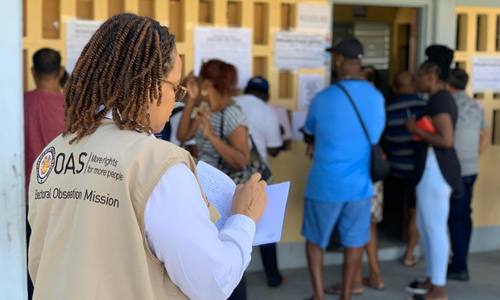 The EOM said the preliminary findings and recommendations are based on its analysis of the electoral system, as well as information it has gathered through discussions with national and electoral authorities, political parties, civil society and the international community prior to the elections, and its observations during the Special Police Vote and on Election Day.
The findings and recommendations include electoral organization, registries, boundaries and technology; and political finance and participation of women.
The EOM said the Parliamentary Elections Office (PEO) has a “crucial role” in the organization and conduct of elections in Grenada, stating that, as recommended by previous OAS Missions, “efforts should be made to strengthen the work of this critical body, through the allocation of greater human and financial resources, ideally in the form of an independent budget and a dedicated Supervisor of Elections.
“Increased resources will support the efforts of the Office to conduct its work in voter education and awareness throughout the electoral cycle and not only during an election year,” it said.
“A dedicated Supervisor of Elections would serve to deepen trust, promote continuity and afford a focused approach to the work needed to continue building and strengthening Grenada’s electoral management framework.”
The EOM said the dissemination of information regarding the electoral process must be “one of the priorities of Electoral Management Bodies.”
In addition to learning about their political options and their platforms, the EOM said voters should have easy access to accurate, verified information on the electoral regulatory framework and calendar, voter registration requirements, the hours of voting, and guidelines on how to cast a ballot, among others.
“Having an institutional website that consolidates this information allows the electorate to understand how, when and where to vote; receive trusted, non-partisan, official information; identify important dates in the election process; and understand their rights as citizens,” the EOM said.
It said it observed that data and guidance on the electoral process in Grenada are not available on the PEO’s website. Rather, it said it is dispersed across social media platforms and websites, and, in some cases, does not include basic information.
In this regard, the Mission recommended that the PEO continue making efforts to centralize essential electoral information and up-to-date material – literature, infographics, videos and documents – on its official website, along with links to other official government election-related content; and that the PEO consider developing permanent and fluid communication strategies between the electoral authority and the citizens and different political actors, even during non-electoral periods, “in order to provide greater certainty and transparency in the process.”
The OAS Mission noted that training for poll clerks is a key activity in any electoral process, “as it ensures efficiency and accuracy in the application of standardized procedures on the day of elections.”
For the 2022 process, the EOM said the PEO informed it that the training was mandatory for poll workers and carried out by constituencies.
According to the information received, the EOM said the sessions were, for the first time, broken into small groups, and trainers were instructed to emphasize the presentation of the Voter ID card and the inspection of the indelible ink.
On the day of elections, however, the EOM said observers noted that there was no standardized verification of the identification of voters.
The EOM said while the Representation of the People Act and the instructions provided to poll workers include special provisions for voting by persons who are incapacitated or blind, they do not provide for the prioritization of these voters, the elderly or women who are pregnant or accompanied by young children.
The Mission said there were no provisions for blind voters to cast their ballots with the same guarantee of secrecy that is constitutionally afforded to all other voters.
On the day of the elections, the Mission said it observed multiple cases where polling stations were not accessible, and priority not afforded to elderly voters, people with disabilities, and women who were pregnant or accompanied by young children.
During its deployment, the EOM said it heard several concerns regarding different aspects of the Voters’ List.
It said stakeholders with whom the Mission met noted that non-eligible persons, particularly from neighboring countries, might have been included in the list for the 2022 elections.
The Mission said it was able to confirm that the procedures followed by the PEO to register Commonwealth citizens include provisions that are “not always specified in the Representation of People Act and which do not always allow Registration Officers to accurately verify the eligibility of applicants to be registered.”
According to information received, the EOM said Registration Officers “tend to rely on their familiarity with persons in the constituency, second-hand information from other sources, or objections, which can result in improper or incorrect registrations.”
The OAS Mission said it also noted concerns about the cleansing of the Voters’ List, particularly with regard to the removal of deceased electors.
The Mission said it observed that, since 2014, death certificates have included the birth registration number of the deceased person, but added that this information was not included on the list submitted, “which hampers the work of the electoral authority.”
“Voters’ lists are in a perpetual state of flux, and it is the responsibility of the electoral institution to ensure that the document is as accurate as possible,” the EOM said.
In order to strengthen the registration process, and as recommended in the reports published by the OAS for previous elections, the EOM recommended amending the Representation of the People Act to specify that where a Commonwealth citizen wishes to be registered, but does not possess the documents indicated.
The EOM also recommended the issuance of regulations that provide “clear rules and guidelines for Registration Officers in the correct conduct of residence verifications”; and including the birth registration number of deceased persons as a unique identifier in the lists provided by the Civil Registry.
“This will facilitate the work of the electoral authorities in correctly matching and deleting the names of deceased electors from the Voters’ List,” the EOM said.
The Mission also recommended the utilization of more permanent geographic features in the delineation of boundaries.
The EOM noted that the Voter ID card system has operated for over 10 years without substantial upgrades, and that much of its hardware is now obsolete.
Moreover, it said the system lacks control tools to prevent duplicate registration, since it does not allow cross-checks across constituencies.
The OAS Mission, therefore, recommended redesigning the voter registration system in order to improve accuracy and inclusiveness, including a mechanism to carry out a verification process at a national level, avoiding duplicate registration; and including the picture of each elector in the Voters’ List in order to improve the control and verification of electors’ identity, and increasing transparency in the process.
Additionally, the EOM recommended implementing a software freeze mechanism for all applications before they are migrated to a production environment, ensuring that there are no changes to the source code or related resources; formalizing a procedure for zeroing and backing up the databases before the electoral process and, upon its conclusion, ensuring that systems have been wiped clean and contain no residual data when the election begins; and increasing efforts to encourage engagement by political actors involved in the electoral process in order to promote the oversight of party agents at the different stages of the electoral process.
The EOM also recommended the collection and publishing of the images of the statement of poll at a constituency level “so that citizens are able to examine, compare and audit election results.”
The EOM said the stakeholders with whom observers met expressed concern that the lack of oversight and accountability in the area of political finance can impact the transparency and equity of the electoral process, “an issue that was noted by the OAS Missions in 2013 and 2018.”
In order to promote transparency in the political campaign and to ensure a level playing field, the OAS Mission, therefore, recommended the creation of legal standards and tools for recording, managing and reporting political party contributions and expenditures; consideration of direct or indirect public financing for political parties and campaigns, including state subsidies for media access; and establishment of political financing oversight mechanisms, as well as penalties for non-compliance.
The Mission also recommended the establishment of limits on private donations from individuals, businesses and the media, and prohibition of both anonymous and foreign donations.
CMC/nk/kb/2022