
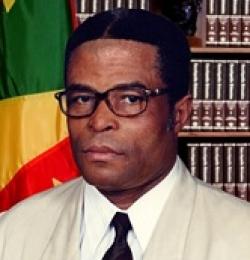
But George Brizan’s life in Grenadian public affairs was a life in two significant parts, during this Windward Island’s history on the cusp of independence and for two tumultuous decades since.
For Brizan, who died in St George’s on Saturday, February 18th, eight months short of his 70th birthday, not only made history as a politician but wrote about it as an historian. And before he did either, he was a teacher.
In Grenada’s fractious political history, Brizan was present at the creation of both of today’s two main opposing parties – the opposition New National Party (NNP) and the ruling National Democratic Congress (NDC).
BRIZAN THE EDUCATOR
Beginning a career in education in 1963, as a 20-year-old teacher at the Grenada Boys Secondary School, he would become a lecturer, later acting principal, at the Institute for Further Education, forerunner to the island’s state college, T.A. Marryshow.
Over two decades, through the island’s fitful years towards independence in 1974, he rose up the education ladder – as certified teacher, administrator, then student in Canada.
Canada in the 1970s was then a cauldron of political ferment for young Eastern Caribbean students who, spurred by Black Power politics, were already beginning to make a name for themselves – like Roosevelt Douglas of Dominica and St Lucia’s George Odlum.
At the University of Calgary, Brizan read History and Economics to postgraduate level. Winning a second fellowship, he studied International Economic Relations at Carleton University. By 1981, Brizan had received a third scholarship, Canada’s International Development Research Centre (IDRC) Award.
SECOND LIFE IN POLITICS
By 1984, the year after the bloody coup that toppled Maurice Bishop’s People’s Revolutionary Government, with his thinking already centred squarely on Grenadian economics, George Brizan was already well into his second public life in Grenada, as elective politics beckoned.
He had already established himself as one of the Grenada’s angry young men along with Maurice Bishop, Bernard Coard, Kenrick Radix, Unison Whiteman and Francis Alexis, whose New Jewel Movement (NJM) was in bitter opposition to the whimsical and unstable reign of the flamboyant and eccentric prime minister, Eric Matthew Gairy, in the years after independence in 1974.
But like Alexis, Brizan, too, would leave the NJM of Bishop and Coard, whose Marxist-Leninist ideology fuelled the coup that toppled Gairy in 1979 and set up the People’s Revolutionary Government.
Brizan, a moderate who leaned more to the centre-left, social democratic, political spectrum, became wary of the duo and their accolytes, who considered the NJM the vanguard of a Marxist revolution in Grenada.
He would watch the PRG go on to implode in conspiracy and bloodshed in October 1983, with Bishop dead and Coard captured by invading American soldiers.
NNP GOVERNMENT
By February 1984, with Nicholas Brathwaite as caretaker quasi-prime minister following the US invasion, Brizan formed the National Democratic Party (NDP). Six months later, he joined forces with Herbert Blaize and Alexis as three parties — the NDP, Blaize’s Grenada National Party (GNP) and Alexis’s Grenada Democratic Movement (GDM) -merged into the New National Party (NNP).
Four months later, the NNP was in government. The coalition of parties had succeeded in a joint bid to ward off a potential comeback by their nemesis, Sir Eric, who had returned from exile in the US.
The NNP carried 14 of the 15 seats in the House of Representatives, sending the 42-year-old teacher-turned-economist into the first of three straight terms as MP.
But soon, Brizan, who had been elected the NNP’s deputy leader in December 1985, became embroiled in competition, then rivalry, then outright factionalism. He had become disenchanted with the NNP under Prime Minister Blaize, and the contrasts could not be more stark.
To him, Blaize was now too autocratic in management style, too far tilted to the right, too keen on cozying up to the American government, and too old.
Three years into the NNP government, Brizan, the education minister, was heading out, part of yet another exodus of angry young men that began with the departure of Phinsley St Louis and Kenny Lalsingh. Joining Brizan were Alexis, who had quit attorney general and legal affairs minister, and Tillman Thomas.
The flashpoint was Blaize’s austerity measures that included the plan to lay off 1,800 public servants.
IN GOVERNMENT, AND AGRICULTURE
Together, they formed the National Democratic Congress. With further fractures in the NNP government, Blaize’s own declining health and his eventual death in December 1989, the NDC was on ascendancy.
Brizan gave way to Nicholas Brathwaite as leader of the NDC. Brathwaite, who was briefly chaired the government on the restoration of parliamentary democracy in 1984, took the NDC to victory in the elections of the March 13, 1990 – exactly 11 years to the day of the Bishop-led coup over Gairy.
The economist was now set to make his mark in Brathwaite’s cabinet room as Minister of Finance.
Two years later, he was shifted to the Ministry of Agriculture while remaining responsible for trade, industry, production and energy.
Brizan championed the role of the agricultural sector in general and his book “Grenada’s Black Gold”, outlined his enduring interest in and support for the Nutmeg industry, recalled Thomas following his death. Brizan, he said, became especially attached to Grenadian farmers while minister of agriculture.
He presided over the Council of Ministers in the African, Caribbean and Pacific (ACP) bloc, overseeing the Lome Convention with the European Community (now the European Union), and chaired the Standing Committee of Caribbean Community Ministers responsible for Agriculture.
With Braithwaite’s resignation from the party leadership in July 1994, Brizan returned to lead the NDC that September at the party’s annual convention. Leadership of the nation beckoned.
On February 1, 1995, Brizan succeeded Brathwaite as prime minister, taking the additional portfolios of external and national security, home affairs, agriculture, and personnel and management.
YESTERDAY’S MAN
But a two-decades-long path to the pinnacle of political power was truncated by the general election of June 1995. It was Brizan who would become one of Yesterday’s Men with Keith Mitchell’s rejuvenated NNP victorious – eight seats to the NDC’s five.
Brizan’s four months as prime minister would lead to four years as leader of the opposition.
With a further, cataclysmic, loss to Mitchell in the January 1999 general election which gave Mitchell all 15 seats and the Caribbean its first democratically-elected one-party parliament, Brizan stepped down from the NDC’s leadership and elective politics altogether.
It would be from the sidelines, as the NDC’s elder statesman, that Brizan would watch the party that he built returned to power in the 2008 general elections with Tillman Thomas at the helm.
And it would be from the same periphery that he would witness the same fractious political culture to beset Grenada for much of the last five decades engulf the current NDC administration, already pockmarked by cabinet defections and dismissals.
For his services to politics and education, Brizan was made Commander of the Order of the British Empire (CBE) in the Queen’s New Year Honours in 2009.
He remained a commentator on economics, politics and history, and considered himself in semi-retirement ill-health began to plague him.
He died at the General Hospital in St. George’s, less than two weeks after the island celebrated its 38th independence anniversary.
Issuing a statement from Canada, where he was celebrating independence with nationals abroad, Prime Minister Thomas said of Brizan: “I remember him as a friend and statesman, a man committed to his family. Although afflicted by sickness, he still found opportunities to contribute to discussions on national development.”
He continued: “Grenada has lost a great stalwart, who gave selflessly as a teacher, author, politician, historian, minister of government and prime minister.” Brizan was, Thomas said, a “patriotic Grenadian whose love for country was exceptional”, a man who was passionate about his country.
Born George Ignatius Brizan, on October 31, 1942, in the southeastern town of St. David’s, he was educated at Catholic schools, St. Dominic’s Primary and Presentation Brothers College. Trained at the Grenada Teacher’s College, he earned a Certificate in Education from the University of the West Indies before going on to his undergraduate and postgraduate studies in Canada.
A prolific writer and speaker on Grenadian history, he wrote “Grenada: Island of Conflict”, published by Macmillan Caribbean in 1998 and considered a seminal work on a turbulent island’s past, from the 17th Century European settlement to the 1983 coup and invasion.
He also wrote “Brave Young Grenadians: Loyal British Subjects”, on the island’s role in the two world wars, and an architectural study, “St George’s: Prettiest Town in the West Indies”.
CMC /2012