
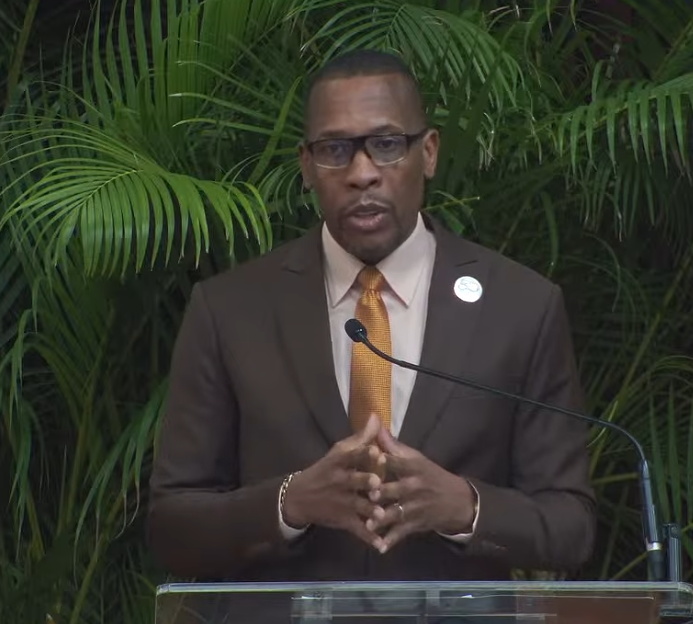
BASSETERRE, St. Kitts, Nov 13, CMC – The Governor of the Eastern Caribbean Central Bank (ECCB), Timothy Antoine, says Caribbean countries should consider pooling their resources and approach “the most competitive suppliers” as they seek to deal with the cost of living in “a concrete way”.
Antoine, speaking at the ECCB’s sponsored 28th Sir Arthur Lewis Memorial Lecture, gave as an example, the decision of the Organisation of Eastern Caribbean States (OECS) using the OECS pharmaceutical procurement service (PPS) “to procure pharmaceuticals far cheaper than we would if we did it as individual countries” over the past 40 years.
“I am saying, I believe the time has come. But we have to take some serious measures now. This is going on for far too long, with no end in sight. For us to adapt that model, and I would argue, identify a basket of essential goods, foods, buy together from the most competitive suppliers wherever they are in the world.
“I know some of you would say, well, what about the private sector? Well, we have to work with the private sector. And I believe this is an opportunity for us to do something about the cost of living in a concrete way.
“Because every day we have a choice. Are we going to curse darkness, or are we going to light a candle? We can’t simply keep talking about imported inflation. That is our reality. But what are we doing to change that reality?”
Antoine said another initiative would be to “ now seriously consider.” following examples of countries such as Mauritius, suggesting that the countries “publish food prices for that basic basket on a weekly basis.
“And we use that as a basis for people to, first of all, transparency, comparability, so that they can shop around. And it also allows us to identify excessive markups where they exist and to do something about it,” Antoine said.
The ECCB Governor said that the is a very important distinction between inflation and the cost of living and it was necessary for all stakeholders understand rhis in this region.
“…inflation is basically a measure of the rise in prices. Cost of living is essentially how we maintain our standard of living…and this is important because very often when the inflation numbers come out from the ministries of finance or from the Central Bank or from the International Monetary Fund (IMF) people say…where are these guys shopping?
“Which supermarket…because they cannot reconcile what they pay or their costs of living with what they say we see as inflation,” Antoine said, noting that within the Eastern Caribbean Currency Union (ECCU) inflation is one to two per cent.
“…but generally and the reason why inflation is that way is because of our exchange rate and the peg that we maintain with the U.S. dollar for 50 years. That is what helps us to deliver moderate to low inflation.
“But of course, cost of living is something completely different. Related but different, “Antoine said, noting that “so it is not just what we do on price, but it’s also what we do with our exponential, the Q, the quantity, how we spend. That’s an important point.
“So it means that even … for example, that food prices have gone up by 26 per cent over the last 45 years. For the average person, that means EC$100 (One EC dollar=US$0.37 cents) has now gone to EC$126 for the same basket.
“Well, the truth is that even when inflation comes down, you’re not going back to EC$100. It’s $126 and going up. It might be going up slower, but it is still going up,” he said, adding that there are important discussions needed in the region to better understand the situation.
“Now, yes, we have to get to the problems, but we have to first understand exactly what it is we’re talking about .It also helps us to really target policy because then governments can be more deliberate with respect to how they target policy around trying to minimise the pain and suffering that our people are experiencing, especially the most vulnerable in our midst.”
Antoine said that he also wanted to bring up another issue, in that, although prices are externally driven, it’s imported inflation.
He said that while 80 per cent of goods and services are imported the sub-region is “not without agency” making reference to customs, service charge, import duties, port charges, “and all of those things.
“Plus, of course, the question of markups and also where we source our imports,” he said, noting that of the “key findings” of a recent Caribbean Community (CARICOM) study done by the Caribbean Private Sector Organisation (CPSO) is “that if we change the source of our imports, we could lower the cost of imports to our region by around 40 per cent.
“That’s a significant finding. In fact, the study also found that for the OECS, we could save around US$261 million per year from diversifying the source of our imports,” Antoine said answering the question “what we can do to begin to address bringing down prices”.
Antoine said that within the Commonwealth, trade within the Commonwealth is 21 per cent cheaper than trade outside of the Commonwealth.
“So again, we have to look for where we can source our imports, because we have gone to traditional sources, because it’s convenient, but it’s very costly. And after a while, that cost is not so convenient for the pocket. So I think we have to look seriously at that.”
Antoine said that another aspect to be addressed is one of competition “and that is important, competition and consumer protection.
“So we talk about food tonight and groceries, but we could make the same argument for airfares, for example, and other aspects of the economy, where we need to be paying attention to not just the issue of competition.
“That’s one of it, but also consumer protection, because to me they go hand in hand. And that is an area where I think we are not without agency, we have to do more. And the final thing that struck me was a need for us to focus, even as we do the short-term measures …we have to provide short-term relief.
“And simultaneously, we have to pursue long-term solutions. And that includes, for example, increasing food production, that includes increasing productivity, that includes moving to renewables.”
Antoine said that the ECCB had undertaken a project regarding the generation of electricty from solar PV with battery storage.
“I’m advised (we are) the first central bank in the world to do that. And we are saving two million dollars a year as a result of that investment. So that oil prices, as difficult as they are, that is not the biggest concern of this Central Bank in terms of our campus…
Antoine said that the ECCB took the step to invest in renewables “and we have a whole programme on that, which I won’t go into,” adding the ECCB’s “Big Push” speaks to the long-term solution that “we have to pursue in this region.
He said that includes renewable energy, food insurance security, logistics, trade connectivity, and digital transformation.
CMC/kj/ir/2026