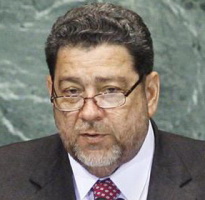
“St. Vincent and the Grenadines does not have unreliable travel documents,” Gonsalves told a standing-room-only Town Hall meeting on Saturday night in Brooklyn, New York.
“I say further tonight that the travel documents of Canada are not superior to those of St. Vincent and the Grenadines and if anybody wants to make a comparison, let us get the United Nations to look at our travel documents and their (Canada) travel documents and see which one is a superior travel document,” Gonsalves continued.
In announcing the new visa requirements, on September 11, Citizenship and Immigration Canada – Canada’s immigration agency, said that the changes will allow it and its partners “to ensure that those seeking to visit Canada intend to return to their country of origin, rather than overstaying or committing other immigration violations.
“In particular, criminals from these countries can legally change their names and acquire new passports,” added the immigration agency, stating that, in some instances, “people who were removed from Canada as security risks later returned using different passports.”
But Gonsalves said, when the Canadian government sent an official notification, on September 12, about the new visa requirements, no mention was made of “unreliable travel documents.”
He said the government mentioned two reasons for the immigration change: The excessive number of refugee applications and immigration violations in Canada.
The Vincentian leader said he wrote a four-page letter to his Canadian counterpart, Stephen Harper, a day after receiving the official notification, however, Gonsalves declined to reveal the contents of the letter .
In the interim, the Prime Minister said he contacted Canada’s High Commissioner Archibald in Barbados, who agreed that a mistake was made in lumping St. Vincent and the Grenadines “with unreliable travel documents.”
He said the High Commissioner told him that the Canadian government had not spoken to him about the “unreliable travel documents” .
In a meeting on Friday, on the margins of the 67th Session of the United Nations General Assembly Debate, with leaders of the sub-regional Organization of Eastern Caribbean States (OECS) and Canada’s Minister Responsible for Caribbean Affairs, Gonsalves said, as current chairman of the OECS, he again requested that Canada “withdraw from its website the declaration that we have unreliable travel documents.”
He said while putting several unidentified countries in the Caribbean on notice and giving them six months to “put their house in order,” the United Kingdom , on the other hand ,has given St. Vincent and the Grenadines’ travel documents a “clean bill of health.”
Gonsalves said St. Vincent and the Grenadines was the second Caribbean Community (CARICOM) country, after Suriname, to institute “brand new, machine readable passports of the highest safety and security for which we paid millions of dollars.”
He said his administration hired “the best company in the Western World,” a Canadian company, to print the Vincentian passport – the same company that the Canadian government hired to do the same.
Citizenship and Immigration Canada also said there has also been “an unacceptably high number of asylum claims from St. Lucia and St. Vincent, with about one and a half percent and three percent of the population of these countries making asylum claims in Canada over the past five years.”
Gonsalves said if Canada wants to have a “liberal refugee system in Canada and applies it liberally, that’s your business.”
He said he is baffled as to why Vincentians would apply for refugee status in Canada, stating that he has been warning nationals to refrain from the practice for the 11 years he has been in office.
The Prime Minister said St. Vincent and the Grenadines has “a system in place to deal with domestic violence” and no one is persecuted for sexual orientation, as claimed on some refugee applications.
“There is no reason why anybody should come from St. Vincent [and the Grenadines] and ask for refugee status in Canada,” he stressed.
“If you [Canadian government] want to tighten up there, that’s your business, but don’t say I have an unreliable travel document,” he added.
“I have told them, ‘you can come to St. Vincent [and the Grenadines] and examine our travel documents and if you see anything [that] I should tighten up, I will even tighten up more, but don’t besmirch the good name of St. Vincent and the Grenadines in relation to something we did not do.”
Canada’s Citizenship, Immigration and Multiculturalism Minister Jason Kenney said the changes were necessary because “all the countries concerned have an immigration violation rate of over 30 percent, well above the level we deem acceptable for countries benefiting from a visa exemption.”
He said applicants from St. Lucia and St. Vincent and the Grenadines can now submit their applications by mail or in person to the Canadian visa office in Port of Spain, Trinidad and Tobago.
Meanwhile, the St. Lucian government has joined its Vincentian counterpart and Vincentians in the United States in describing as an “unfortunate blow” the Canadian government’s decision to impose the new visa requirements.
St. Lucia’s Acting Press Secretary Winston Springer said the Kenny Anthony administration is recommending that Canada address, “in a collaborative manner, the issue of security and immigration violations, which is a mutual concern to both countries.
Springer said Castries is willing to enter into discussions with Ottawa in putting such initiative in place as quickly as possible, “and awaits further discussions and an appropriate response from the government of Canada.
Springer said Anthony will shortly be dispatching a letter to Harper, urging him to reconsider his government’s decision.
PM rejects Canada’s claim of ‘unreliable travel documents’