
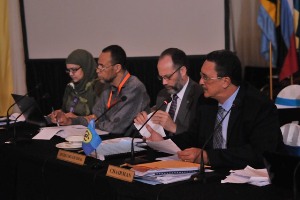
“One of the banes of CARICOM foreign policy is the very bad habit…of knowing that conferences are coming up …and waiting until the last minute, sometimes waiting when we are sitting at the conference itself to get together to determine what our contribution will be, what issues we will want to highlight.
“I made it very clear that Barbados is very dissatisfied with that. In fact I may have used the expression we are sick to the stomach about waiting until the last minute for CARICOM to sit down and to determine what its position is going to be in terms of the issues that we want to promote,” he told reporters.
But as the regional leaders emerged from their three-day annual summit here over the weekend, Stuart said there was “a new sensitivity to the need to treat foreign more seriously”.
St. Lucia’s Prime Minister, Dr. Kenny Anthony, the new CARICOM chairman said that the leaders had agreed that “foreign policy co-ordination is not only a guiding principle for CARICOM but it is a necessary tool to achieve effectiveness in foreign policy outcomes”.
CARICOM countries have already made it clear that while they do not intend to forego relations with their traditional partners in Europe and North America, there was need however to “consciously develop stronger relations with countries in the South.
“The global economy is undergoing rapid structural changes including the fact that growth is driven today by new and emerging centres of economic activity. These include countries that are geographically proximate to ours such as Brazil and with which we have historically strong relations such as China,” said Guyana’s President Donald Ramotar.
“Our region must respond to these realities by developing closer ties with these countries and also by exploring new frontiers of opportunity for beneficial bilateral relations,” he added.
Anthony has said that he will use his six month stint as chairman of the 15-member grouping to re-direct the region’s foreign policy at a time when the entire world has changed around CARICOM during its 40 year existence.
“The time has come for CARICOM to overhaul and redefine its foreign policy positions and postures,” he said, noting that the reality that beholds the region is that the prospects of global growth will be determined by decisions made in Beijing.
Anthony said China is on course to become the world’s largest economy in the next few years as well as being a superpower in its own right. More so, with 60 per cent of the global population residing in Asia with 22 per cent of the world’s gross domestic product (GDP) “and rising” it made sense for the Caribbean to look in that direction.
In addition, Latin America and Africa also provide opportunities for the Caribbean with Anthony indicating the potential exists to develop strong trans-Atlantic partnerships in trade, tourism, technology, education and cultural fusion.
The Caribbean countries have indicated a willingness to share overseas diplomatic missions “so that the region’s outreach could be wider, more diverse and more beneficial.
“This proposal was made before, but I think it is an idea whose time has come, indeed even long overdue,” said Ramotar
The new foreign policy initiative by the Caribbean is perhaps driven by the new direction of the European Union (EU) that according to the CARICOM Secretary General Irwin La Rocque could result in some regional countries being deprived of much needed funds for developmental projects as Europe contemplates graduating the region out of access to their current level of funding.
“This latest situation is added to the fact that the flows of development assistance to CARICOM countries gave been decreasing and at least in the short term will continue to do so,” he said blaming the global contraction in bilateral aid arising from the problems in the Eurozone.
“We are all aware that Europe now faces an economic crisis of unprecedented proportions. Europe will never be the same again. We need not be naive of the likely impacts that these may have on future assistance from the European Union,” Anthony noted.
The Caribbean leaders were addressed by the Secretary General of the African Caribbean and Pacific (ACP) grouping, Dr. Mohammed Ibn Chambas, who noted that Europe’s “Agenda for Change,” launched last year outlines a new framework for EU development policy in the years ahead.
“The aim is to streamline the EU’s development assistance and to ensure greater effectiveness and development impact in light of recent economic and geopolitical changes,” he said noting that a major concern in this connection has been the new discourse on ‘differentiation’, by which the EU is seeking to remove high middle income countries and countries with a gross domestic party (GDP) larger than one per cent of total global GDP from its Development Cooperation Instrument (DCI).
“We are aware that Europe itself is facing an unprecedented fiscal crisis. It seems clear that they are determined to rationalize the deployment of financial transfers to developing countries in a manner that could significantly undermine resource flows to high middle-income countries, many of which are in the Caribbean.
“We at the Secretariat have strenuously sought to explain to our European colleagues that over-reliance on blanket GDP figures do not tell the full story of poverty in our countries. Nor does it do justice to crucial challenges such as climate change and the structural vulnerability of many of our apparently more affluent ACP countries.”
Chambas said global re-alignments and major shifts in EU policy orientations have given rise to concerns of possible downgrading of the importance of the ACP-EU Partnership, noting that “the EU’s neighbourhood focus with regard to Eastern Europe and North Africa; and its rapprochement with Latin America and the general thrust of its development policy re-orientation has led to some anxiety among our ACP members.
He reminded the regional leaders of an old African saying, “When the music changes, so does the dance. “Clearly, the music is changing not only in Europe but also globally,” he added.
But even as they are getting ready to embark on their new foreign policy initiative, the Caribbean countries have indicated that it would be based on terms “defined by our strategic interests”.
“Economic and socio-cultural partnerships that benefit all parties are needed and these must allow CARICOM to share with the world as active participants and not as after thoughts,” Prime Minister Anthony added.
CMC/pr/2012