
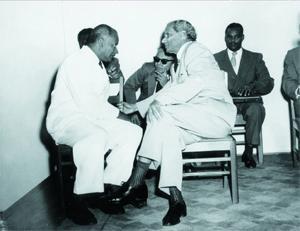
In the federal government’s last official act in its capital, Port of Spain, Sir Stephen Luke, the British interim commissioner for the Caribbean, despatched to wrap up the paperwork, signed the proclamation to dissolve the federation.
“Now therefore, I, Stephen Elliot Vyvyan Luke, Interim Commissioner for the West Indies by virtue of the power and authority in me vested hererby appoint the 1st day of June, 1962, as the day on which the Federation of the West Indies and, with it, the Federal Government, the Federal Legislature, the Federal Supreme Court and the other Federal authorities established by the Constitution… shall be dissolved,” the proclamation read.
London’s Colonial Office, the British ministry for its colonies, had sent out an interim commissioner to replace the Governor General of the West Indies, Lord Hailes. Federation Park, the green, leafy, Port of Spain suburb that was home to the federal civil servants and parliamentarians with its Antigua Drive, Jamaica Boulevard and Grenada Avenue, streets named for the ten island provinces, was a ghost town. The only Prime Minister of the West Indies, Sir Grantley Adams, had returned home, his party already voted out of office in Barbados in a general election the previous December.
But the 50th anniversary milestone of the federation’s demise passed largely ignored throughout the region, save for a dual legacy of familiar bickering among the larger nations while the smaller islands grow even closer.
Jamaica, whose withdrawal from the federation in a referendum triggered its collapse, has been trumpeting its 50th independence anniversary on August with national celebrations.
But for the man considered one of the Caribbean’s leading statesmen and regionalists, Sir Shridath Ramphal, May 31 1962 signifies not what was, but might have been – independence at the stroke of midnight for all ten nations that made up the English-speaking Caribbean’s only experiment in political union.
The 1961 London Conference on the Federation had set considered May 31 1962 as the date for the independence of the Federation from Britain.
“Well before we got there, Jamaica’s referendum and Trinidad’s mathematics had ensured that we never would,” said Sir Shridath in a November 2008 University of the West Indies lecture that commemorated a different 50th milestone – the anniversary of the Federation’s birth.
“The day the Federation of The West Indies was to become independent as one nation, May 31, 1962 – was the very day on which the Federation was formally dissolved. We had come that close to West Indian nationhood,” said Sir Shridath.
Trappings of nationhood
The federation held all the trappings of nationhood, with a federal flag and coat of arms, parliament, civil service and judiciary.
It had also begun the process of uniting scattered the islands’ people and goods through the West Indies Shipping Service’s Federal Palm and Federal Maple. Many older West Indians still recall being ferried up and down the region, as students to university campuses and island tourists visiting neighbours for the first time.
The union also sought to consolidate institutions long established by the imperial government, including the then University College of the West Indies, whose second campus at St Augustine was opened in 1960, and a single currency – the British West Indies, or Beewee, dollar.
The federal government had intended the takeover of British West Indies Airways, then a subsidiary of British Overseas Airways Corporation (BOAC), created in 1940.
And the West Indies cricket team, the sporting organisation that preceded the nation by 30 years, was already a potent icon of regional unity – and the source of inter-island bickering and favouritism of its representatives.
Historians generally agree – and political critics and supporters still often quarrel – over the reasons for the federation’s breakup and its portent half a century later for its twin successors, the 15-nation Caribbean Community (CARICOM) and the nine-member Organisation of Eastern Caribbean States (OECS).
Bitter taste
Historians say the British government bequeathed a weak federal structure in governance and administration. The Federation was barred from imposing direct taxation for at least the first five years of its life. A customs union to promote the free trade of goods between the island provinces was fraught with complaints by local businesses about perceived disadvantages at the expense of wealthier islands.
But despite being colonies of Britain, that had chased the dream of becoming a fully self-governing dominion within the British Commonwealth co-equal with the white colonies of Canada, Australia, the Union of South Africa, and the Irish Free State, the territorial governments became unwilling to cede sovereignty to the Federal Government.
Each island had varying but strongly held views on which federal taxes should be imposed and how.
But in newspaper editorials and letters to the editor, in chambers of commerce meetings and on the streets, the suspicions, distrust and outright ignorance of the islands’ three million people one of another, in an era of limited, expensive air transport and telecommunication, and little by way of regional media, swelled to weariness to proceed with what they already had.
And the bitterest fight, at the outset, was over the siting of a federal capital, with Jamaica bidding strongly against domination by a smaller island.
A commission eventually decided the matter and appointed Chaguaramas in western Trinidad, site of the wartime US naval base, as the federal capital.
‘One from ten leaves nought’
But the controversy left a bitter taste in the mouths of many Jamaicans. Not for the last time, opposition politics would filled the vacuum as the Jamaica Labour Party of Alexander Bustamante, initially a supporter of the Federation, became its most vocal opponent, and pushed for Jamaican independence.
Bustamante’s refusal to take part in a by-election to the federal parliament led to Premier Norman Manley calling for a 1961 plebiscite on Kingston’s continued membership in the federation.
The vote, decisively in favour of withdrawal from the arrangement, led to a national movement for independence, the very goal that had originally been on the cards for the entire region.
By then, Trinidad and Tobago, which had also acquired the taste for full independence on its own, indicated its intention to withdraw, too, as the Premier Dr Eric Williams, uttered one of the most enduring political phrases in Caribbean history: “One from ten leaves nought”. Trinidadian independence followed Jamaica’s three weeks later on August 31, 1962, taking for itself “Forged from the Love Liberty”, the Federation’s national anthem.
‘Little Eight’
Fast-forward 50 years and much of the same fear, doubt, hope and optimism that characterise the discussion of a united Caribbean remains appear on an axis of larger and richer nations versus the smaller countries.
The remaining eight smaller provinces of the defunct Federation of the West Indies, which struggled unsuccessfully to form a smaller federation of the so-called Little Eight, saw the independence dream deferred by a decade or more, after Barbados, too, under new political management, broke ties with Britain in 1966.
Seven nations in the British Leewards and Windwards remained: Antigua and Barbuda, St Kitts-Nevis-Anguilla, Montserrat, Dominica, St Lucia, St Vincent and the Grenadines and Grenada. They would move from being British colonies to the West Indies Associated States (WISA) in free association with Britain in 1967.
With the exception of Anguilla and Montserrat, they moved to independence in the 1970s and 1980s and to full membership of CARICOM as its lesser developed countries.
But by 1979, they had agreed to form the OECS, while CARICOM leaders shouted at each other across the Caribbean and refused to convene summits.
The OECS, formed in June 1981, has succeeded in transforming the legacy institutions of the federal government into bulwarks of Eastern Caribbean regional integration while the islands’ economic fortunes also blossomed.
The rump federal supreme court has become the Eastern Caribbean Supreme Court of Appeal — while all but three countries are yet to join the appellate wing of the Caribbean Court of Justice (CCJ), including the court’s host nation, Trinidad and Tobago.
The Eastern Caribbean dollar that succeeded the BWI dollar has become a stable, fixed-exchange rate currency managed by an independent, autonomous Eastern Caribbean Central Bank, while Jamaica, Trinidad and Tobago and Guyana, which stayed out of the federation, have seen the value of their currencies spiral downwards in multiple devaluations since the early 1990s.
And while the Eastern Caribbean states, like their larger counterparts, have shunned the notion of political union, they have pressed ahead with close, inter-island cooperation and on creating an economic union, allowing for unfettered intra-regional work and settlement among its nationals without need for a work permit. Already, OECS nationals need only photo identification to travel to each other’s member states.
CARICOM coda
In CARICOM, hopes for a single market and economy have only been realised at the market stage, with free movement of CARICOM nationals restricted to approved categories and qualifications, and governed by a complex web of registration, certification and verification. And dreams of intra-regional fiscal and economic consolidation, a single currency and free flow of capital remain just that.
Despite air links, telecommunications infrastructures and an expanded university education system that were mere dreams 50 years ago, many Caribbean people remain ignorant of each other, with the even deeper chasms between English, Spanish, French and Dutch speakers and a knowledge gap that is often filled with suspicion, scepticism and jingoism.
That popular scepticism is often met at the point of an airport immigration kiosk in tales of refusal, hassle and ejection. A Jamaican woman’s lawsuit over allegations of sexual molestation by Barbadian authorities on arrival is set to become a landmark case to determine the obligations of member states to fellow CARICOM nationals.
And in an ironic coda of history, the political rhetoric of a vintage era was given fresh voice on the front pages of the Jamaica Gleaner newspaper on Wednesday, as Jamaica’s ex-commerce minister, not yet six months in opposition, suggested that it was time for Jamaica to leave CARICOM over Kingston’s inability to obtain natural gas from Trinidad and Tobago – the owner of its iconic but loss-making national airline, Air Jamaica.
“The time is running out on us to make that decision,” Samuda told the Jamaica House of Representatives in a bald appeal for national self-interest.
“Enough is enough. They must be made to understand that we are not their breadbasket. They are not here to reap the benefits and give nothing back to the country which supports it with the size of market that they need to survive,” the Gleaner quoted Samuda as saying.
But Samuda’s call received tacit support from Anthony Hylton, his opposite number in the People’s National Party (PNP) government, long considered a pro-integration party.
Hylton said Kingston has made it “very clear that the way in which CARICOM is being implemented is to Jamaica’s disadvantage”.
But neither the government nor Jamaican manufacturers, who also complain of unfair advantage at the expense of cheaper Trinidadian goods, have signalled their intention to take their complaints to the CCJ, which has judicial oversight over the CARICOM Treaty.
Time was, historians and political analysts say, when for West Indians, then all under the British colonial yoke, nationalism and regionalism meant the same thing.
But that was 50 years ago.
CMC jg/2012