
table.MsoNormalTable
{
line-height:115%;
font-size:11.0pt;
font-family:”Calibri”,”sans-serif”;
}
Galbraith had said that “all of the great leaders have one characteristic in common. It was the willingness to confront unequivocally the major anxiety of their people in their time. This and not much else is the essence of leadership”.
Smith had argued that the anxieties of the Caribbean people are underpinned by a growing sense of vulnerability to economic shocks, natural hazards and climate related events as well as to the growing sense of personal insecurity because of unacceptably high levels of crime and violence.
So after 12 months of the job as the leader of the CDB, Smith believes that in keeping with the Galbraith doctrine, he has now grasp the “essence of leadership”.
But it is coming at a price.
Faced with a region still battling to overcome the global economic and financial uncertainty that has, and continues to take its toll on the region’s small open economies, Smith has had to inform CDB governors that the US-based Moody’s Investment Services had downgraded the regional bank’s credit rating from AAA to AA1.
And although he said it was not unexpected, he would have heard the concerns and fears of some Caribbean finance ministers, who knew instinctively that it meant more trouble for the region.
“The possibility of higher borrowing costs is a major concern. Indeed, for countries like Grenada, whose borrowing is constrained to very concessionary financing, this is a very worrying development,” said Grenada’s Finance Minister Nazim Burke.
And even though he pointed out that Antigua and Barbuda was “concerned but not alarmed” by the downgrade, the island’s temporary governor to the CDB, Whitfield Harris Jr. said the bank’s operations have been impacted by a tightening in the financial markets evidenced by investors’ loss of appetite for longer term instruments.
“We are optimistic that the consequential bunching in the bank’s payment profile will be mitigated in due course; however, this will certainly be attendant to CDB taking decisive and effective steps to upgrade its risk management and asset-liability management functions,” he said.
St. Lucia’s Prime Minister Dr. Kenny Anthony, who has taken over the chairmanship of the bank, said in the opinion of Moody’s, the shortcomings were inconsistent with the standards associated with “Triple A” rated banks and reflect deficiencies in the management of the bank’s assets and liabilities and in its financial planning.
“Nevertheless, the bank must move quickly to create a dedicated risk management function, adopt comprehensive asset-liability management policies and carry out other necessary reforms to ensure that all its fundamentals get back on track and are sustained,” he added.
But Moody’s was not the only international body sounding a warning to the Caribbean.
The Wall Street-based international credit agency Standard & Poor’s noted that Caribbean debt is increasing in light of the global economic crisis and in its latest report titled, “Caribbean Debt Is on the Rise”, said economic growth and foreign direct investment in the region have slowed, while the fiscal and debt profile of many countries have deteriorated.
“Compounding the economic decline and sluggish recovery are structural weaknesses, including lower national savings rates than those of other emerging market countries, persistent current account deficits, and a high reliance on external financing,” said Kelli Bissett, Standard & Poor’s credit analyst.
She said these factors increase the Caribbean nations’ vulnerability to external financial and economic shocks.
At the launch of the Caribbean Growth Forum (CGF) last week, official figures showed that in contrast to Latin America, which grew by six percent in 2011, Caribbean countries only grew by an average 2.3 percent. The CDB is projecting that economic growth in the region will be between 1.5 and two per cent this year.
The figures show Caribbean economies also face serious debt challenges. For some regional countries, public debt-to-GDP ratios have reached 100 per cent.
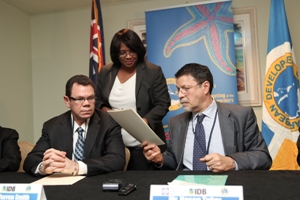
“Despite the great diversity and differences in economic performance, there are a number of common challenges the Caribbean countries face (including) the high cost of doing business, the challenging business environment and the business climate which leads to some inefficiencies in the delivery of public services, the high debt and the mis-match that currently exists between skills and jobs,” Hasan Tuluy, the World Bank Regional Vice President for Latin America and the Caribbean, said at the signing ceremony.
The one-year CGF is a partnership between the World Bank, the Inter- American Development Bank, and the CDB with support from the United Kingdom Department for International Development (DFID) and the Canadian International Development Agency (CIDA).
IDB representative for Barbados and the Eastern Caribbean Joel Bransk told the signing ceremony that economic growth is a requirement for the region.
“We see growth as one of the most evolving conditions that lead to improving the quality of life …alleviating poverty and maintaining macroeconomic stability,” he said.
Trinidad and Tobago’s Planning and Development Minister, Dr. Bhoendradatt Tewarie said that trends in growth in developed market economies, whether positive or negative, as well as developments in international commodity and financial markets, will affect the fortunes of the Caribbean.
“On average, regional growth still has not returned to pre-crisis levels as Caribbean economies continued to struggle in 2011 to achieve pre-2008 levels of economic growth, “ he said, adding estimates show that the average real economic growth for the region for the first half of last year was 1.7 per cent compared to 0.2 per cent for the corresponding period last year.
And even as Tewarie notes that projected growth for 2012 is “promising” he also acknowledges that “stimulating business activity, quickening the pace of investment decisions and unemployment all remain formidable challenges across the Caribbean region”.
But Smith believes there is hope for the Caribbean if governments embark immediately on a raft of reform policies that would enhance the environment for the production of internationally competitive goods and services.
“This is no easy task, but it lies at the core of developing a more resilient Caribbean economy,” he said, adding that the region also needed to pay close attention to the imminent commissioning of the expanded Panama Canal in 2014 that would facilitate the transit of mega ships from the expanding economies in the Eastern countries into the Caribbean.
“It will create opportunities for ports in our region to develop large transhipment facilities for vessels serving smaller ports in North and South America.
“It also holds the promise of these islands becoming logistic centres and industrial assembly nodes for Far Eastern businesses accessing South American ports and the nearby eastern seaboard of the United States. The job creation possibilities for our countries are enormous,” he added.
But even as he outlined his prescription for the region’s ailing economies, Smith had reason to issue warnings.
He recalled that after the 1973 oil crisis, the region in general “failed to implement with conviction the structural reforms that would have mitigated the impact of future increases in oil prices on the domestic economies.
“Indeed, the policies of some governments had the impact of reinforcing rather than building energy consumption behaviours. In some instances, across the board subsidies rather than those targeted at vulnerable groups were applied with predictably perverse results”.
And so as the region contemplates the current situation caused by the global financial and economic crisis, Smith is wary of a repeat of “history” defined in the main “by slow response and inadequate commitment to the reforms needed to render our economies and societies more resilient following major economic shocks”.
CMC/pr/2012