
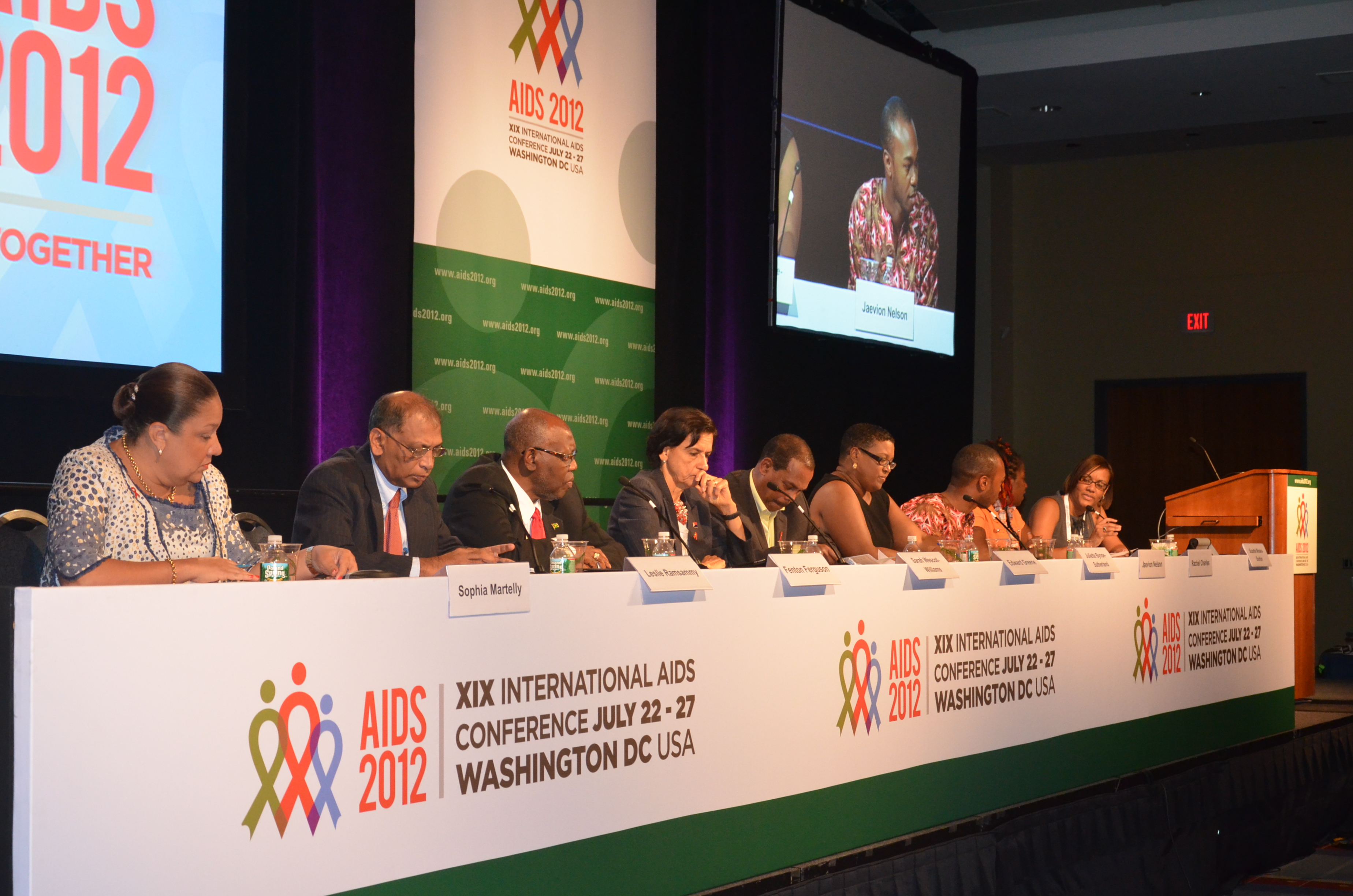
Mc Knight was furious that despite all the progress being made in the fight against the deadly virus that killed millions of people last year, the conference was not able to hear from those who are most affected.
In fact, as he addressed the addressed the final session of the six-day event, Mc. Knight said while “hubs” were important for allowing delegates to voice their opinions in small gatherings, Caribbean drug users and sex workers were not given that opportunity to voice their position in gatherings attended by scientists and other major stakeholders. The Caribbean, after sub-Saharan Africa, has the second highest incidence of HIV/AIDS.
U.S. President Barack Obama lifted a travel ban on HIV-positive travellers, but some sex workers say they were denied visas to attend the conference.
“It is nothing short of an abomination that they have been excluded from this conference and we want to say organising hubs is a good venture, but we need their voices and their issues here with us at this conference.
“So these half baked attempts at including people who use drugs and sex workers are tokenistic and it must stop now,” he said to loud applause”.
Executive director of the Barbados-based Caribbean Media Broadcast Partnership (CMBP), Dr. Allyson Leacock, had warned prior to the start of the conference, that while the Caribbean media had adopted a significant role in educating and informing the region about the HIV/AIDS epidemic, she was also fearful that the six-day event here would concentrate on efforts to eradicate the disease in other regions thereby isolating the Caribbean.
She said the challenge for the Caribbean is that its population is so small and donors and other agencies “tend to use these numbers when HIV has the same potential to decimate the region”.
Jamaica’s health minister, Dr. Fenton Ferguson went even further, appealing to the international community not to cut back on aid to the region as it deals with the HIV/AIDS epidemic.
“The move to make funding decisions based on limited criteria such as World Bank Country Rankings without wider economic and potential impact assessments will be judged and error by history if allowed to stand.
“These decisions threaten the very lives of the people we have just saved, “he said, adding that Jamaica, and indeed the region, despite their successes in dealing with the virus “cannot go it alone from here.
“We need the continued support of our international development partners, who if they abandon us now, in the words of Michele Sidebe (UNAIDS executive director) would be making a decision to let HIV regain a foothold and flourish in Jamaica and they would be making a decision to abandon the next generation of children to HIV”.
Ferguson said a recent study has shown that Jamaica would need some US$30 million annually in 2030 compared to US$15 million annually “today to sustain the HIV programme.
“We could therefore see a doubling of the cost to the response if the investments to mitigate its impact are not made now,” he said, adding “today Jamaica, like many other countries, is concerned about the potential impact of the global financial crisis on the sustainability of its national response to HIV”.
Mc. Knight said cutting back on funds was not an option adding that all the progress being disclosed at the conference on treating the virus “would be doomed to failure if we do not have the funding to do this work.
“None of it, none of it can ever happen without serious commitments and so we call again on our governments and say renew your calls to take ownership for this response and to make the investment necessary and to end AIDS,” he said.
When she addressed the conference, US Secretary of State, Hillary Clinton announced more than $150 million in new U.S. spending initiatives geared toward leveraging progress against AIDS already achieved through new drug treatments, programmes to stop mother-to-child transmission of HIV and the preventive effect of expanded voluntary male circumcision.
‘This is a fight we can win. We’ve already come so far, too far to stop now,’ Clinton said. ‘HIV may be with us into the future until we finally achieve a cure, a vaccine. But the disease that HIV causes need not be with us”.
But there were suggestions here that the US funds were geared more towards Africa than the Caribbean.
In a report titled “Together we will end AIDS” released ahead of the conference, UNAIDS noted that AIDS-related deaths in the Caribbean have declined by almost 50 per cent in 10 years.
It said that AIDS-related deaths have fallen to about 10,000 persons in 2011, nearly half what was seen in 2001, in almost 30 years since the start of the AIDS epidemic.
“This is in large part due to the relatively high antiretroviral treatment coverage of 67 per cent for the Caribbean as a whole. At present 230,000 people are living with HIV in the Caribbean. The estimated number of persons who were newly infected with the virus last year was 13,000.”
UNAIDS said that about 1,100 children became infected with HIV in the Caribbean in 2011 with the majority of these cases being in the Dominican Republic and Haiti, “which together comprise 68 per cent of the region’s HIV epidemic”.
UNAIDS said that many of the member countries of the Organisation of Eastern Caribbean States (OECS) “are close to achieving elimination targets for the prevention of mother to child transmission (PMTCT).”
But there is need for caution. UNAIDS Deputy Executive Director Programme, Paul De Lay, said a challenge for the international organisation is to come up with the right mechanism that would allow the media to properly interpret data on the HIV/AIDS global epidemic.
“We don’t want people to think that the AIDS epidemic is over because we have eight million people in treatment,” he said after participating in a panel discussion on “HIV/AIDS and the News Agenda-Implications for Ending the Epidemic”.
“We need to work with the media to ensure that we are putting the right spin on the data,” De Lay said, noting that while it is important to note that while eight million people were receiving medical treatment for the virus “underneath that figure is a lot of people who are not getting treatment”.
Professor of Gender Studies at the University of Michigan, Dr. Neisha Haniff, warned that Caribbean countries needed to ensure that data presented on the epidemic in the region adequately cover all categories of people, particularly women.
“I think what is happening is we are not paying as much attention to women and the categories of women and the numbers and the infection rate.
“We are using old information we need to generate new information and include groups that are difficult to access,” she said, emphasising the need “to continue the focus on women even though we are paying attention to other marginalised groups”.
Despite the concerns, Guyana has said it could become the first country in the Caribbean to completely end the mother to child HIV transmission.
“Guyana’s approach has worked. We have seen the prevalence of HIV in pregnant women falling from three to five per cent to 0.18 per cent and the general population prevalence falling from three to five per cent to 0.8 and one per cent,” said former health minister Dr. Leslie Ramsammy.
CMC/pr/2012