
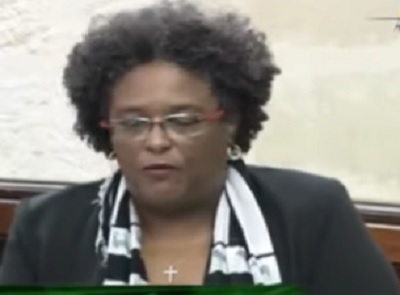
PORT OF SPAIN, Trinidad, Jul 9, CMC – Barbados Prime Minister Mia Mottley Friday said women have been missing from the “heyday of Caribbean development” and urged them to ensure they live their mark in a modern day Caribbean.
Mottley, addressing the “Women In Leadership 2021 Virtual Conference” hosted by the University of the West Indies (UWI) Arthur Lok Jack Global School of Business, said female leadership in the Caribbean has been a rarity
Mottley, the first woman to head a government in Barbados, said given the chance, she would have given up modern technology and conveniences in exchange for being an “influential adult during the period of birth of the modern Caribbean”.
She told the audience that when she was born in 1965, the Caribbean had already experienced significant achievements in politics and sports, referring to CLR James and the first Trinidad and Tobago prime minister, Dr. Eric Williams, who she said had already dispelled the notion that it was colonial charity that resulted in the end of West Indian slavery.
Mottley said that Barbadian Sir Garry Sobers would have broken the highest score for test cricket before she was born.
“So you now see what I mean when I said I missed the good stuff. But did you notice it. Something so insidious and commonplace that it may have slipped the attention of many of you,” she said, adding “ did you notice that amongst the undeniable iconic names associated with the heyday of Caribbean development, not a single one was a woman”.
Mottley said that despite more than half the population of the region being women, only five of the 15 Caribbean Community (CARICOM) countries have elected women leaders, and only four of the 13 UWI campus principals and six registrars of the Caribbean Examination Council (CXC) have been women.
“None of the five secretary generals of the Caribbean Tourism Organisation (and) six presidents of the Caribbean Development Bank have been women<’ she said, adding female leadership in the Caribbean has been a rarity.
“These terribly lopsided statistics scream inequity. They demand deep enquiry, for how can we, as victims of hundreds of years of uneven development and systemic discrimination, allow ourselves to become perpetrators of such imbalance?”
Apart from Mottley, the other women who have headed governments in the Caribbean have been the late Dr. Janet Jagan in Guyana, Dominica’s Dame Eugenia Charles, Jamaica’s Portia Simpson Miller and Kamla Persad Bissessar of Trinidad and Tobago.
Mottley said it is not that women did not make contributions, but they were not among those whose iconic contributions are celebrated now in the region, adding unfortunately, this trend is still reflected in the present-day Caribbean landscape.
She said in a recent conversation with American economist Prof Jeffrey Sachs, he referred to data that indicated female-led countries had performed significantly better that male-led countries during the pandemic.
“He asked me pointedly, did I think male leaders had special qualities that male leaders didn’t? My first thought was to mischievously respond, ‘Yes there are a lot of them.’ But no; if I were to personalise and attempt to place my leadership philosophy within neat boxes, I think of it as a constant balancing act of possibility with practicality, urgency with compassion.”
She said that it is a balance she sees in the daily construct of being a Caribbean woman.
“I see it in mothers leading the household, in teachers, who are predominantly women in our region as they lead the classrooms,” Mottley said, adding it is a trait she admires in her personal favourite leaders, including her parents; Nelson Mandela; and, most recently, Barbadian-born international singer and entrepreneur Robyn Rihanna Fenty.
CMC/ad/ir/2021