
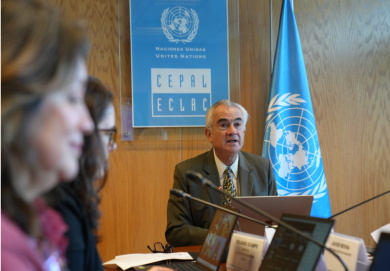
SANTIAGO, Chile, Apr 30, CMC – The 24th meeting of the Executive Committee of the Statistical Conference of the Americas of Economic Commission for Latin America and the Caribbean (ECLAC) is underway here with delegates discussing the progress made on the use of artificial intelligence in the official statistics.
The meeting has brought together representatives of national statistics offices from the region, regional and international organizations, and United Nations agencies, funds and programmes, among other stakeholders.
“Statistics are one of our best assets for navigating an extremely complex scenario. At the end of the day, we will not be able to achieve more productive, inclusive and sustainable development if we do not have data to know where we are, and how we can get to where we want to go,” said ECLAC’s Executive Secretary, José Manuel Salazar-Xirinachs.
He said that the region and the wider world are currently facing a critical situation that combines structural elements, summarized in the three development traps that ECLAC has been flagging: a trap of low capacity for growth; one of high inequality, low social mobility and weak social cohesion; and a third trap of low institutional capacities and weak governance.
He said these structural traps are compounded by emerging challenges, such as the climate crisis and the fast-paced digital revolution, as well as geopolitical elements that exacerbate the atmosphere of uncertainty and volatility in which the governments of our region must design and implement public policies.
“In this complex scenario, reliable evidence is indispensable. We need timely, comparable and transparent data produced with rigor and high ethical standards. That is the only way we can formulate effective policies that would truly transform the reality of our people.
“That is something ECLAC never forgets: at the center of our work, behind our models and projections, behind our studies and statistics, there are concrete people whose lives we are trying to improve,” Salazar-Xirinachs said.
The General Director of the National Office of Statistics of the Dominican Republic, Miosotis Rivas, who is also serving as Chair of the Executive Committee of SCA-ECLAC, said that official statistics not only measure change, they should lead it.
She added that today more than ever, the region’s countries have the opportunity to be the protagonists of transformation and to demonstrate that the future is not to be awaited, but rather built.
The Director of the United Nations Statistics Division, Stefan Schweinfest, spoke of the urgency of having a robust statistical and global information system, praising the work of the Statistical Conference of the Americas for its valuable contribution to the sustainable development of Latin American and Caribbean countries.
In the framework of the meeting, a special session was held on the use of artificial intelligence in official statistics, which sought to facilitate an active exchange between the participating countries regarding effective strategies and practical recommendations that can strengthen regional cooperation and maximize the benefits of the use of AI in national statistical systems.
During this session, the delegates highlighted practical experiences in implementing artificial intelligence in national statistics offices and other statistical entities in the countries of Latin America and the Caribbean.
Furthermore, they presented and discussed specific cases that illustrate successful use as well as the difficulties encountered in the practical adoption of advanced technologies such as automatic learning, natural language processing and predictive analytics in different statistical contexts.
The Statistical Conference of the Americas is a subsidiary body of ECLAC and is the main forum for discussing the development of statistics in the region.
Its main mandates include promoting the development and improvement of national statistics and their international comparability, along with international, regional and bilateral cooperation between national offices and international and regional agencies.
CMC/2025