
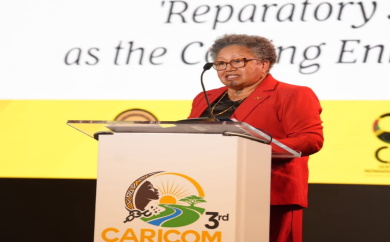
BRIDGETOWN, Barbados, Sept 18, CMC -Caribbean Community (CARICOM) Secretary General, Dr. Carla Barnett says the Caribbean has consistently asserted that reparations is fundamentally about justice.
“It is about recognition, accountability and transformation, and about building a just and equitable future for the descendants of those who, as the chattel of colonial owners, endured untold suffering, loss of life and freedom,” she told the Third Regional Conference on Reparations on Thursday night.
She said that the meeting was taking place at a critical moment in the region’s pursuit of reparatory justice for the crimes against humanity committed in Africa, the Caribbean and the wider African diaspora: genocide and the dispossession of indigenous peoples, trafficking in enslaved Africans and African chattel enslavement in the Caribbean and Americas.
“These are the crimes against humanity that we can never forget,” Barnett said, adding that the CARICOM Ten-Point Plan for Reparatory Justice: A Manifesto for the Coming Enlightenment provides a comprehensive framework for this agenda.
“It places at the centre of our efforts the needs of our people, including public health, education, psychological rehabilitation, cultural development, support for indigenous communities, gender justice, debt cancellation and monetary compensation. It reminds us that reparations must be meaningful and transformative, addressing both the historical wrongs and the resulting contemporary consequences.”
Barnett said that the expanded revised version of the Ten-Point Plan that was adopted by CCARICOM leaders in July this year, and which will be relaunched during the meeting here, brings new vision to the reparations agenda.
“It records the tremendous progress made in the past thirteen years by the global community and heralds an age of enlightenment, and a new global order based on equity.”
Barnett said regional leaders established the CARICOM Reparations Commission in 2013, with oversight by a Prime Ministerial Sub-Committee on Reparations, chaired by Barbados to signal the fundamental importance of this agenda to the dignity and development of the Caribbean Community.
On behalf of CARICOM, she expressed “deep appreciation” to the chairman of the Commission, Professor Sir Hilary Beckles, and his executive “for their tremendous and tireless advocacy, and intellectual leadership of the movement.
“We also recognise their courage in not backing down from difficult conversations and for leading this regional movement for reparatory justice to a new level of global consciousness. We appreciate the efforts and we congratulate and will continue to support.”
She said that since the establishment of the CRC in 2013, at least 12 member states have established national reparations commissions or committees, demonstrating the region’s collective commitment to advancing the cause of reparatory justice through coordinated national and regional action.
“Our progress reflects strong partnerships and expanding joint advocacy. Our advocacy has been significantly strengthened by the partnership between CARICOM and the African Union (AU),” she said, adding that the Second Africa – CARICOM summit held in Ethiopia in September 2025, adopted the “Addis Ababa Declaration on Transcontinental Partnership in Pursuit of Reparatory Justice for Africans and People of African Descent through Reparations”.
Barnett said this provides an important framework for the continued collaboration on the reparations agenda and also served to build momentum towards the adoption by the United Nations of the landmark resolution “The Declaration of the Trafficking of Enslaved Africans and Racialised Chattel Enslavement of Africans as the Gravest Crime Against Humanity” on 25 March this year.
“It embodied a good partnership among Africa, CARICOM and other supporting states, with all CARICOM Member States voting in favour of its adoption,” she adding that the region is “deeply appreciative of the collaboration and solidarity of the African Union”.
She said partnerships with the United Nations (UN) human rights organisations have also been vital to this process and “we continue to work closely with the Reparations Commission to advance reparations within the United Nations.
”We anticipate that our Heads of Government will make strong statements on reparatory justice at the upcoming 81st session of the UN General Assembly and will participate in the High-Level Meeting to Commemorate the Twenty-Fifth Anniversary of the Durban Declaration and Programme of Action, commencing next week in New York.”
She said CARICOM is also preparing to advance reparations on the agenda of the upcoming Commonwealth Heads of Government Meeting to be held in Antigua in November.
Furthermore, she said the CRC has developed strong partnerships with the National African American Reparations Commission adding that “the partnership with civil society is equally important because the reparations movement has never belonged solely to governments.
“It has been sustained by scholars, activists, community leaders, artists, faith-based organisations, youth and citizens who have kept the demand for justice alive across generations. Your knowledge, advocacy and lived experience are indispensable to the work before us.”
Barnett also welcomed the presence of representatives of the Indigenous Peoples – of the Garifuna, the Kalinago and the Maroons.
“As first peoples of this region, your history, rights and aspirations must be respected and supported. We look forward to hearing your voices within the deliberations and to your contribution to defining the next steps.”
Barnett said that the voices of the region’s youtmust remain central, adding “they will carry the torch and will inherit the opportunities created by our collective efforts. Their participation is essential if reparatory justice is to become a living instrument for transformation.”
Barnett said that the conference here provides an opportunity to reaffirm the region’s principles, renew its commitment to unity and, critically, to strengthen ts strategy.
“We must translate advocacy into sustained diplomatic engagement, research into evidence-based historical recognition to inform policy and programmes that improve the lives of our people.”
CMC/ag/ir/2026