
CARTAGENA DE INDIAS, Colombia, Jul 5, CMC – Three Caribbean Community (CARICOM) countries have been named as Vice-Chairs of the Presiding Officers of the Regional Conference on Population and Development that ended its fifth session here on Thursday.
Colombia has taken over as Chair with Antigua and Barbuda, Guyana and Suriname as Vice-Chairs.
The other Vice Chairs are Venezuela, the Dominican Republic, Honduras and Peru and a statement issued here said that the conference has reaffirmed the crucial importance of strengthening public policy management.
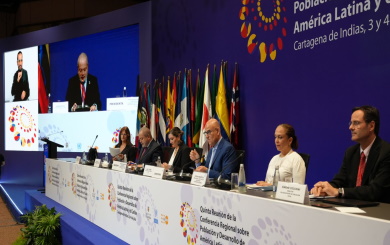 The delegates said that this is aimed at ensuring the full exercise of the rights and development of the autonomy and quality of life of persons with disabilities and stressed that these issues are an inherent part of the population and development agenda.
The conference, which was attended by more than 570 delegates noted that the full, effective, rapid and resourced implementation of the Montevideo Consensus will contribute significantly to the implementation of the Programme of Action of the International Conference on Population and Development beyond 2014 and the 2030 Agenda for Sustainable Development.
“After two days of intense debate held at the Convention Center in Cartagena de Indias, these representatives affirmed the crucial importance of strengthening public policy management aimed at ensuring the full exercise of the rights and development of the autonomy and quality of life of persons with disabilities and stressed that these issues are an inherent part of the population and development agenda,” according to the statement.
The Deputy Executive Secretary of the Commission for Latin America and the Caribbean (ECLAC), Javier Medina Vásquez, said that very valuable reflections were imparted in the course of the meeting, particularly in a global and regional scenario that is considerably more complex, uncertain and conflictual than it was three decades ago, marked as well by polarization and intolerance.
“In this context, the Montevideo Consensus is an instrument for developing a shared vision of the future, which reflects the comprehensiveness posed by the Cairo Programme of Action in 1994. It is also the most progressive document in the world,” Javier Medina said.
The Regional Director for Latin America and the Caribbean of the United Nations Population Fund (UNFPA), Susana Sottoli, indicated that “it is in the interest of all nations to pursue population-centered development, because it creates the conditions for healthy and empowered individuals and societies. Amid the recent complex crises and growing polarization, uniting the world in pursuit of this practice has never been a more urgent priority”.
Furthermore, she urged for continuing this dialogue to continue sustaining the progress made and to find solutions collectively and promote inclusive policies and practices that would allow for tackling inequalities, accelerating the actions needed to ensure that no one is left behind, and for living in a world where all people, women, girls, female adolescents can fully exercise all their rights.
In the resolution approved at the end of the meeting, the acceding countries resolved to establish the open-ended group of friends of the Chair on the rights of persons with disabilities and the population and development agenda in the framework of the Regional Conference on Population and Development in Latin America and the Caribbean, known as the Cartagena Group.
This Group aims to examine strategies to advance the inclusion of persons with disabilities in the framework of the Conference, thereby contributing to the promotion and protection of their human rights.
The resolution requests that countries, in their presentations on national progress on implementation of the Montevideo Consensus to be delivered at the Sixth Meeting of the Presiding Officers of the Regional Conference on Population and Development in Latin America and the Caribbean, which will be held in 2025, report on the progress made and public policy action implemented regarding the inclusion of persons with disabilities.
It also highlights the intergenerational and intercultural solidarity promoted in the Montevideo Consensus and looks forward with interest to the Pact for the Future and the annexes thereto and the Declaration on Future Generations to be adopted at the Summit of the Future, which will be held on September 22-23, 2024 in New York.
CMC/af/ir/2024