
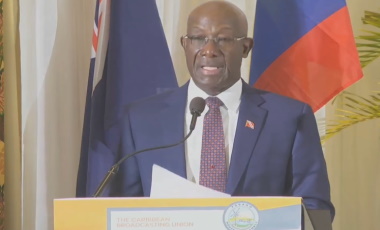
SCARBOROUGH, Tobago, Aug 16, CMC –Trinidad and Tobago Prime Minister Dr. Keith Rowley has called on journalists in the Caribbean to focus, investigate, interpret, educate and report on the development processes of their countries.
Delivering the feature address at the opening of the 53rd General assembly of the Barbados-based Caribbean Broadcasting Union (CBU) here on Monday night, Rowley, a geologist, who has spent 40 years in electoral politics, said he has been a close observer of the media as he sought to make himself clear on the thorny issue of development journalism.
“I believe that journalists, in what is loosely called the developing world, should see it, in their professional charge, to focus, investigate, interpret, educate and report on the development processes of their countries.
“They must take ownership and be guardians, and given the Caribbean’s history, they must be understanding and sympathetic to the realistic challenges of the fledgling development processes,” said Prime Minister Rowley, who earlier during his address had traced the history of the media dating back to 1622.
He told the media executives from the English, French, Spanish and Dutch-speaking Caribbean that most importantly, journalists must be able to carry out their function in the new environment “without any government guidance or intervention.
“As such they must cultivate, and view their world, with the so-called “Jeweller’s eye”, interpreting, educating and helping their fellow citizens to locate themselves and their interests in the wider world,” he said, lamenting however “I’m afraid that is not the journalism I see being widely practised
“It is the journalism of “publish and be damned”, “Gotcha!”, or simple, “He/She said that” — all largely without context or recorded history. A listener, reader or viewer is not helped or educated – in the democratic process, when a journalist has a story, then searches for a counterpoint. Full stop. That is, it!
“There must be a context, a wider, deeper background within, and to that story, which helps the receiver. Journalism today has to go beyond such limits of the current line of “attempts to reach Mr/Ms. So-and-So for comment, failed”. Again, that is, it!”
Rowley said he wanted to suggest that journalists in the Caribbean, must see “every story they write, as report within the history and uniqueness of the Caribbean condition.
“What is been argued as free and independent reporting, has to be seen wider than the metropolitan model, or context and carrying that flavour of our “West Indianness”.
“Also, journalists and journalism today must visit and keep re-visiting the volumes, written on the dangers of cultural imperialism, and what it has done, and continues to do to the minds of the West Indian people, and its youth.
“I do have much, much more to say, Chair, on this topic, example. such as radio stations, whose schedules are predominately American pop, or Gangsta, as opposed to meaningful, conscious West Indian music, art and drama. Worse, there are sections of the radio frequencies and significant column inches dedicated to the illiterate musings of the hired “hitman” spewing indignation and libel for a fee. “
Prime Minister Rowley said that it is in this context that he applauds both UNESCO and the CBU for promoting the discussion on its theme “Media and Information Literacy in Journalism”, as a relevant counter to the clear and present dangers of misinformation and disinformation.
Rowley said to him, the conference carries another significance, noting that the CBU handbook refers to highlights of the misinformation and disinformation, “from Cleopatra to Cambridge Analytica” which according to verifiable reports in the British Press the firm, CA originated some 10-15 years ago in Trinidad and Tobago before moving to larger playfield of American presidential politics.
“Interestingly, as I speak to you today, those wheels are still turning in Washington and in some quarters here in Trinidad and Tobago.
“As media people you must know that we dare not take incoming information at face value without the cautionary fact check. This is the era of the Big Lie or just the avalanche of common or garden lies since shame has been reduced in its societal tempering role. We are now required to spend so much of our time and our resources debunking lies and in search of the truth,” Rowley added.
He said while Trinidad and Tobago will be known for creating the steel pan, calypso, Soca music, “most regrettably,” it will also be remembered “for the modern-day popularisation of misinformation and disinformation.
“Which of us in media or who depend or interact with media and data can ever forget Christopher Wylie and his shock of pink hair, telling the British Parliament how when and where the era of misinformation was born?
“I believe that the era now demands that journalists re-frame their current model of reporting and delivering the news, within the framework of media information literacy, so that readers, viewers and listeners could trust that their product is one of quality, ethically-framed, worthy of attention and reflecting the Caribbean condition.
“As your Handbook says, news, using the Media Information Literacy framework that “builds trust in the media, through citizens, government and media partnerships, as well as stimulating civic engagement” is what we are after.” Rowley told the delegates to the three-day event.
The in-person CBU Congress is being held after two years of virtual-only gatherings due mainly to the coronavirus (COVID-19) pandemic that forced regional countries to shut down their borders and impose travel restrictions.,
The CBU event is being held in collaboration with Public Media Alliance and the Tobago House of Assembly (THA).
CMC/gf/ir/2022