
BRIDGETOWN, Barbados, Oct 18, CMC – A Needs Assessment of the Administration of Justice in nine Caribbean Countries (NAR), has found that efficient access to justice is undermined across the Caribbean region by delays within several key stages of the criminal justice process, resulting in major backlogs of cases.
“The identified backlogs are occasioned by pervasive human and technological resource and capacity constraints, which, in turn, contribute to massive bottlenecks in the work of the investigators, public prosecutors and courts,” said Juliet Solomon, the Regional Rule of Law, Security and Human Rights Specialist with the United nations Development Programme (UNDP).
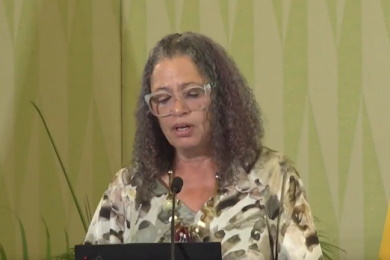
Addressing the seventh Biennial Law Conference of the Caribbean Court of Justice (CCJ) Academy for Law (CAL), Solomon said in 2012, the UNDP published the Caribbean Human Development Report entitled “Human Development and the Shift to Better Citizen Security”.
She said one of the key findings of the publication was the lack of data.
“It was clear that the judicial system and access to justice was a concern, but how to measure, assess and come up with solutions without data? “
She said in order to address this situation, in 2019-2020 UNDP undertook a NAR in nine Caribbean countries, which she did not named, but was a multi-country effort involving
consultations and detailed discussions with over 100 stakeholders to identify the issues causing backlogs in the criminal justice system and prioritise interventions.
Solomon said that a five-pronged approach guided the NAR that included a full analysis of country level documents, regional reports and academic research as well as broad consultations with judicial stakeholders in each jurisdiction.
She told the conference that the backlogs directly contribute to the “worryingly high levels of prisoners on remand for extended periods and serve to increase overall incarceration rates in the region, which are already among the highest globally”.
Solomon said that through the NAR, it was possible to identify the main challenges for a people centred approach to justice that leaves no one behind.
“The issue is not just access to justice (or) how easy is it to access justice services? How are justice services being delivered? How can that delivery be improved?) it is also the issue of the quality of justice being delivered. How easy is it to access justice services? How are justice services being delivered? How can that delivery be improved? “
She said that it is worth emphasizing that many of the issues around prolonged per-trial detention, for example, can represent infringement upon the human rights of citizens.
“The NAR represented a seminal document, containing both up-to-date data on the specifics of the administration of justice but also detailed recommendations from stakeholders across the judicial system from the judiciary, police, prisons, DPPs, forensic agencies and more.”
She said this allowed UNDP to work with the European Union to design a project which takes a “whole of system approach” to address the issues which, through the NAR, were identified as one of the most pressing: the reduction of backlogs and bottlenecks within the criminal justice system.
The project was launched on Tuesday and will cover 8 countries in the Eastern and Southern Caribbean. It has three anticipated outcomes, namely technology and infrastructure systems enhanced, empowered stakeholders and enhanced capacities and improved processes, procedures and coordination.
CMC/af/ir/2023