
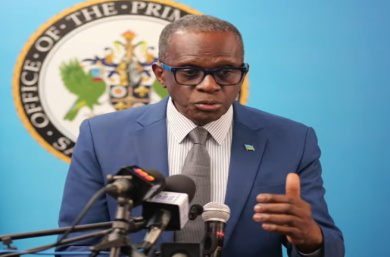
CASTRIES, St. Lucia, Sept 14, CMC – Prime Minister Phillip J Pierre Monday said Caribbean Community (CARICOM) countries will maintain its position regarding the 1.5 degree Celsius climate target to limit global average warming even as the developed countries continue to hedge on adopting measures linked to the Loss and Damage Fund.
The Fund for Responding to Loss and Damage (FRLD) is a global climate finance mechanism designed to help vulnerable developing countries pay for the economic and non-economic devastation caused by climate change.
It was agreed upon at 27th United Nations Climate Change Conference (COP27) in Egypt in 2022 and formally operationalised at COP28 in the United Arab Emirates in 2023-24.
While wealthy countries have promised between US$750 million and US$822 million to the UN-backed a major gap exists between what has been promised and what is actually available.
Pierre who has responsibility for Sustainable Development within the CARICOM Quasi Cabinet, whose portfolio includes, the environment, climate change, disaster management and water security, told a news conference here that the 15-member grouping has adopted a position that “we should stick to that the climate, the temperature should not go up by more than 1.5 degrees.
“That’s us. 1.5 to stay alive.To stay alive, that’s first position. Second position is our constant claim for loss and damage in that we are not the largest emitters but we pay the most. We don’t admit, but we pay the most for it.
“But again, and again, it’s a situation that’s a catch-22 situation,” said Pierre, the CARICOM chairman, adding “all the terms that we make to diversify our revenue sources are under pressure. “
Pierre said that diversification of the economy is necessary “so that we can stop having to always be begging”.
He said in the case of St. Lucia his administration has started a sovereign wealth fund, adding “we said to the world we are ready to save”.
He said Castries has also informed the global community of its Citizenship by Investment Programe (CBI) through which foreign investors are granted citizenship of the island in return for making a substantial investment in the country’s socio-economic development.
But he said Europe has asked “us to end the CBI programme in the next two years, even though we have set up a regulatory body where all the countries that have CBI programmes…got together and said what do you want from us?
“We are forming that body, but we’ve been told to close the programme in two years. Now, we’ve been asked for all levels of due diligence, which we continue to do step by step,” Pierre said, acknowledging that “some people may slip through the cracks.
“But all the due diligence will be asked for. We are doing it. But we are a country of laws. So we’re going to try our best to work with our European partners. We’re going to try our best to observe all the due diligence processes that they require to stay within the law.
“But all we are asking as a country is give us the scope to create our own sources of revenue so we don’t have to beg you for loss and damage, because when … there are weather events, all of us suffer, and these things do not reach the world news.”
Pierre said that St. Lucia is now experiencing a drought situation and “so what we ask in the world to do is as small states, give us the opportunity, not for us to beg you, but the opportunity with your help to create our own destiny for our people,” Pierre told reporters.
Last week, Dominica’s Prime Minister Roosevelt Skerrit said that the leaders of the Organisation of Eastern Caribbean States (OECS) whose countries operate a Citizenship by Investment (CBI) programme are hoping to mount a “high-level mission” to Brussels later this month.
The sub-regional leaders had in July announced plans for the mission after the European Union announced it would be moving towards ending the visa free programme for the regional countries.
In July, the leaders of Antigua and Barbuda, Dominica, Grenada, St. Lucia, St. Vincent and the Grenadines and St. Kitts and Nevis said they would undertake the mission “at the earliest appropriate opportunity” to engage directly with the President of the European Commission, the President of the European Council, the High Representative of the Union for Foreign Affairs and Security Policy.
“These engagements will seek to deepen mutual understanding of the unique vulnerabilities and development realities of small island developing states, to explore practical and mutually beneficial solutions to the issues identified by the European Union, and to strengthen the longstanding partnership between the European Union and the Eastern Caribbean.
“But the plan was to have a meeting towards the end of September and we are hoping that both sides can stick to keep looking at it, but we haven’t pinned down the date, precise date yet,” Skerrit told reporters.
CMC/a/k/ir/2026