
BRIDGETOWN, Barbados, Jun 9, CMC – The Belize-based Caribbean Community Climate Change Centre (CCCCC), says it is working with two CARICOM countries in implementing a Green Climate Fund project aimed at developing a climate resilient health system.
CCCCC executive director, Dr. Colin Young, participating in a Caribbean Development Bank (CDB) sponsored youth forum disclosed that the CCCCC is currently working on the project help improve adaptation to how the changing climate impacts health.
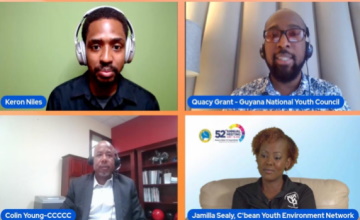 “The centre is currently working with The Bahamas and Trinidad and Tobago in implementing a Green Climate Fund project that is looking at how do we develop a climate resilient health system.
“In the Bahamas one of the deliverables … is going to be an electronic public health surveillance system that will improve the efficient monitoring and management of health issues amplified by climate change… [such as] the incidence of cholera, the incidence of dengue, of malaria that tend to accompany the floods that are increasing in both frequency and intensity,” he told the panel discussion.
The panel including youth leaders, climate experts and medical professionals, agreed that climate change is not and has never been simply an environmental issue amid concerns that the impact of climate change goes far beyond weather patterns and into personal lives, affecting physical and mental health.
Leader of the Caribbean Youth Environment Network (CYEN), Jamilla Sealy, participating in the Youth Forum on “Caribbean Youth for Innovation and Resilience (Youth FIRE), noted the reality for Caribbean youth in particular, in facing accelerated climate change and its attendant impacts on health.
“We need to know that climate change is a cross-cutting issue. It’s not just something that the environment world has to tackle. It affects every single person in many different ways,” Sealy told the panel that was moderated by Dr Keron Niles, lecturer in the Institute of International Relations at the University of the West Indies (UWI).
Echoing similar sentiments, Dr Quacy Grant, a medical practitioner and President of the Guyana National Youth Council, spoke of the health risks and impacts of recent flooding in his native Guyana.
“Currently in Guyana we are experiencing some flooding and with flooding we have risks for diseases such as leptospirosis, we have the vector borne diseases… That makes up the physical aspect that can make people ill.
“But we also have the mental health issues that the persons would go through. Because of the flooding they would have to think about displacement. If their homes are flooding, they would have to move out. They become… anxious and fearful, not certain of the future, not certain of tomorrow,” he said.
Grant said that for this reason “we have to remember … as we link health to climate change, we cannot take the person out of the environmental context in which that person lives.”
Sealy said that this was an issue not well enough appreciated and understood by the public, mentioning a recent survey conducted by the CYEN.
“In the last weekend, the CYEN in Barbados did a survey on climate justice and… from what I’ve seen, only 21.5 per cent of the 300 persons that were surveyed noted that they thought that health was an impact of climate change, so I believe maybe they’re not as aware of the impacts and might not include mental health as an issue. That is one thing we would all need to work on,” he added.
CMC/fd/ir/2022